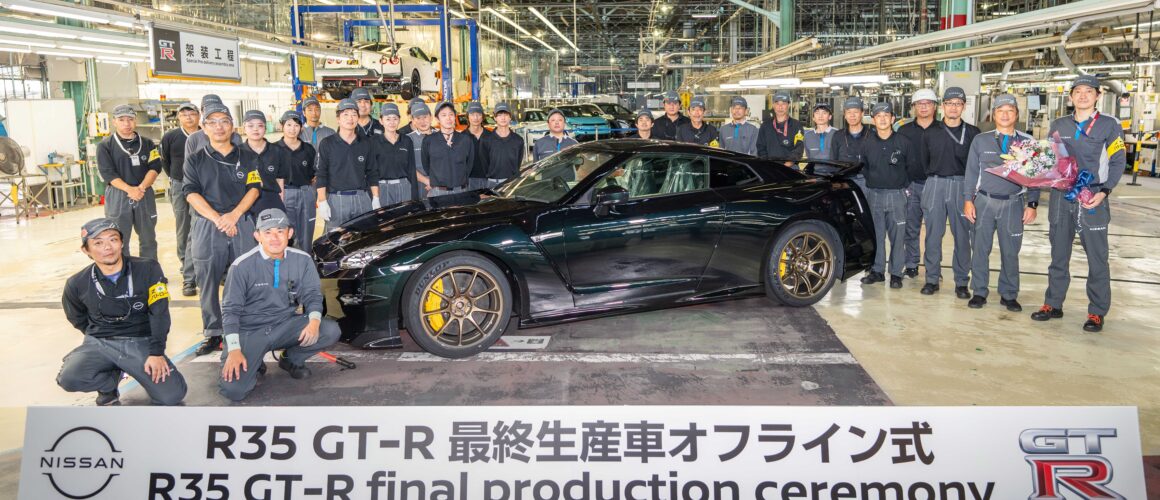
After nearly two decades in production, the final Nissan R35 GT-R has rolled off the line at the Tochigi plant in Japan, marking the end of an era for one of the most celebrated performance cars of the 21st century. The last car – a Premium edition T-Spec finished in Midnight Purple – will remain in Japan, closing an 18-year production run that saw around 48,000 examples built.
Launched in 2007, the R35 was a radical step in the GT-R lineage, no longer a derivative of the Skyline but a standalone flagship model. Powered by the hand-built VR38DETT 3.8-litre twin-turbo V6, each engine was assembled by one of just nine Takumi master craftsmen, their names engraved on a plaque fixed to the unit. Power rose steadily throughout its life, beginning at 480bhp and peaking at 600bhp in the NISMO models, which borrowed race-bred components from GT3 competition. Once tuning companies such as Litchfield got their hands on the GT-R however, modified cars were often known to produce upwards of 1000bhp comfortably.
The R35 also became a Nürburgring regular, setting a 7min 38sec lap on debut in 2007, and improving steadily to a best of 7min 08.679sec with the NISMO in 2013. Although not quite the motorsport legend as the R32, the GT-R claimed five GT500 and three GT300 titles in Japan’s Super GT series, victory at Bathurst in 2015, and further endurance racing successes in Blancpain and Super Taikyu competition.

First applied to the 1969 Skyline GT-R, a four-door saloon homologated for touring car racing, the GT-R badge became synonymous with motorsport dominance in Japan. The second-generation Skyline GT-R was short-lived, but the R32 Skyline GT-R of 1989 rewrote the rulebook. With its turbocharged RB26 straight-six and sophisticated ATTESA all-wheel drive, it won 29 consecutive races in Japan Touring Car Championship and earned the nickname ‘Godzilla’ from the Australian press due to the car’s dominance over the competition down under.
The R33 and R34 refined the formula, bringing the GT-R to wider global attention – with a younger audience becoming aware of the JDM legend through the cultural phenomenon that was Gran Turismo. The R35 modernised took advantage of that international reputation, as it was sold worldwide from launch. It became a cult car, revered for its ability to humble far more expensive machinery on both road and track.
Nissan says that the end of R35 production does not mean the end of the GT-R badge. Ivan Espinosa, Nissan’s President and CEO, confirmed: ‘This isn’t a goodbye to the GT-R forever. It’s our goal for the GT-R nameplate to one day make a return.’