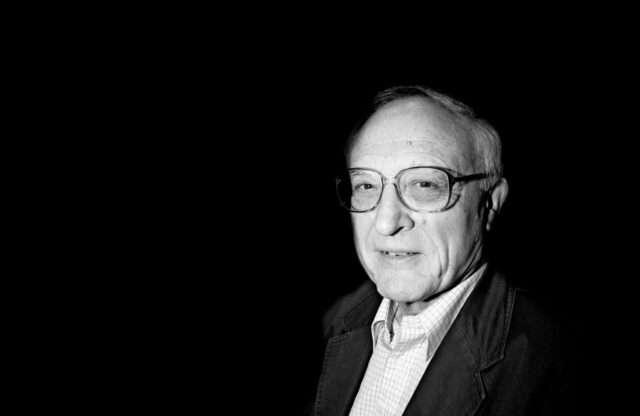
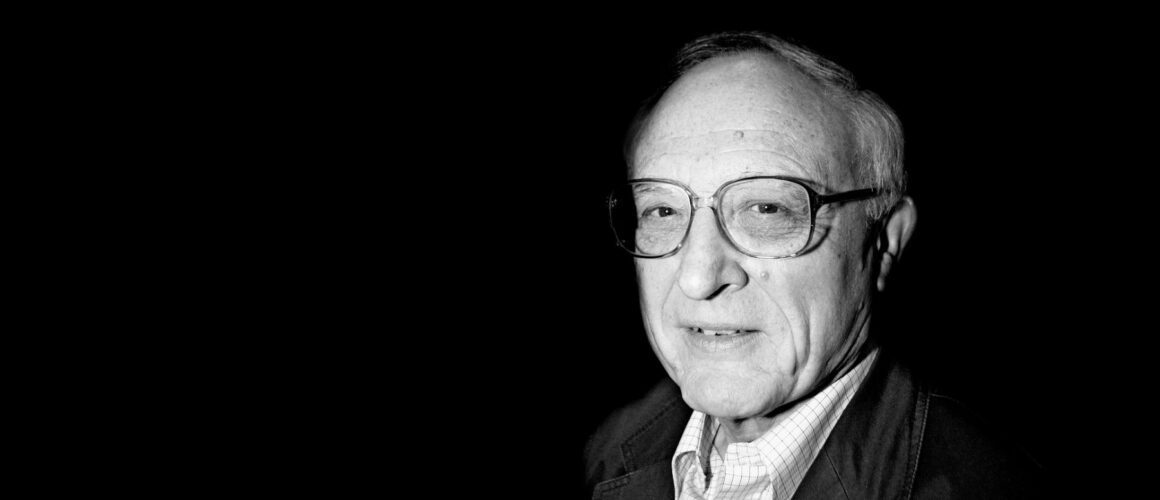
Stuart Turner, rally co-driver, journalist and the architect of BMC’s golden era, has died at the age of 92. He was the strategist behind the Mini Cooper S hat-trick on the Monte Carlo Rally.
Born on 14 January 1933, Turner’s passion was lit by a club rally ride-along; within a year he had started 60 events as a co-driver, partnering stars including Erik Carlsson and Pat Moss. He abandoned accountancy for the newsroom as Sports Editor of ‘Motoring News’, sharing a corridor with Bill Boddy and Denis Jenkinson, before succeeding Marcus Chambers as BMC Competitions Manager in 1961. With Paddy Hopkirk, Timo Mäkinen and Rauno Aaltonen, his meticulously prepared Minis became international folk heroes.
After BMC, Turner joined Castrol, then moved to Ford, steering victories on the Safari and London-to-Mexico while nurturing projects – including the stillborn RS1700T, C100 and GT70 – as well as navigating the premature end to the RS200’s career and the end of Group B rallying.
A tireless advocate for safety and grassroots motorsport, Turner wrote more than 20 books and also co-founded the Motor Sport Safety Fund.
A while back, Octane spoke to Turner with the goal of telling some of the great tales he had about the many great drivers he had worked with over the years. The full interview, conducted by Richard Heseltine, is reproduced below – and it helps to give a great flavour of his personality. You can also read more from Turner’s days as BMC Competitions Department manager here.
Stuart Turner: My 10 Favourite Drivers
Former team manager and all-round motor sport pro Stuart Turner has known all the greatest drivers. So Octane sent Richard Heseltine to ask him about his favourites
Two hours in, and it remains unclear who is the interviewee and who is the inquisitor. Former champion co-driver, team manager, author and all-round overachiever Stuart Turner asks as many questions as he answers, with humour never far away. He has potent opinions on all manner of topics, and rarely more so than the current state of his beloved rallying, but what is remarkable is that his 60 years in motor sport began more by happenstance than planning.
‘My father remarried when I was 18,’ he says. ‘I inherited four stepsisters, one of whom had a boyfriend who picked her up for lunch one Sunday and said they were going to do a rally – did I want to come along? Jean got lost so I picked up the maps and it’s been downhill ever since.’ Turner’s aptitude for navigation led to him winning the inaugural British Rally Championship in 1958, sitting alongside Ron Gouldbourn.
‘Rallying was still very much an amateur sport and the clubs back then were the backbone of the movement. I used to send our magazine to the motor sport weeklies and gradually started writing reports for them. I put in a footnote to one Motoring News story; something along the lines of could they give me a shout if ever a full-time job was going?’ A position became available in early 1960 and our hero left Staffordshire for London for life as a jobbing hack – the same year that he and Erik Carlsson claimed outright victory on the RAC Rally.
Not that a career in journalism could contain him, Turner departing to head the famed BMC Competitions Department shortly thereafter. ‘That came about because Marcus Chambers was leaving. John Thorley was then in overall control at Abingdon. I’m sure there were more experienced people than me around so, when I did replace Marcus, it was a gamble on John’s part. I inherited a wonderful team and stayed until 1967. I left to join Castrol before moving to Ford in 1970. That year’s World Cup Rally was one of my first major events.’
He would go on to run Ford’s Advanced Vehicle Operations department, before seeing out the decade as chief of public affairs. However, by the dawn of the ’80s, it was clear that the marque’s position in motor sport was on the wane. So much so that Turner was asked to prepare a paper on Ford’s future in motor sport.
‘The whole face of rallying was changing and it was clear that four-wheel drive was the future.’ His opinion was heeded and Turner was restored as competition chief. ‘I was incredibly lucky in working with people like Walter Hayes, in that I could fight to get things such as the RS200 into production.’
Given the countless stars who have driven for him, we thought it worth asking Turner to name his personal top ten; the best or – at the very least – most memorable. ‘Thinking of guys such as Carlos Sainz, Paddy Hopkirk, Rauno Aaltonen and Russell Brookes makes me wish I could do a top 20. I have been very lucky to work with so many great drivers.’
Indeed he has, but some of his choices may well surprise you…
Timo Mäkinen
‘I’m a bit reluctant to put drivers in any kind of order, but I will say that Timo is my personal number one. For me, his 1965 Monte Carlo win was one of the greatest drives in rallying history: Timo didn’t just win, he blew away the opposition. We first ran him on the Monte in ’63. He was in a Big Healey, and I cannot think of a more unsuitable car for driving on snow and ice. Timo and his exceptionally brave co-driver Christobel Carlisle won their class. I knew then that he was something special.
‘Timo was in a class of his own in ’65 in a Cooper S. The conditions were appalling, with all the snow and ice. Only 35 cars finished [from 237 crews]. Timo was fastest on virtually every stage and at one point he was eight minutes ahead of Eugen Böhringer, who finished second in a Porsche 904, although you also have to hand it to Timo’s co-driver Paul Easter for the vital role he played. We were immensely fortunate to have people like him and Henry Liddon in the works BMC team. Very talented and always well prepared.
‘Timo’s car control was incredible. He had been a very successful ice racer in his native Finland. He’d raced a Jaguar D-type so if he could handle something like that – on ice! – he was obviously very good. He won a hat-trick of RAC Rallies in 1973–75 as a works Ford man; in those days, a great many rallies were infested with Escorts and he had to beat some serious competition in virtually identical cars.
‘And it isn’t just me who rates him. Years ago, there was a Q&A session at some “do” where Paddy Hopkirk and Tony Fall were asked to name the best driver they ever competed against. Both named Timo without hesitation. Many mechanics from the time say much the same thing: he wasn’t necessarily a car-breaker, but they felt it was up to them to build a car that was tough enough to withstand anything Timo could throw at it. If the car held together, he would usually win.’
Erik Carlsson
‘Erik is a good friend and has to be here because, quite aside from his ability as a driver, he opened my eyes to just how good Scandinavian drivers were. If I hadn’t sat alongside him when we won the RAC Rally in 1960, I might not have felt the same way.
‘It seems funny now, but I remember having a meeting with Alec Issigonis and the chairman George Harriman and a key item on the agenda was whether or not BMC should employ foreign drivers. It was the British Motor Corporation, after all!
‘Anyway, Erik was as tough as they came, and his record speaks for itself: a hat-trick of RAC Rally wins [1960–62], victories on the Monte Carlo Rally [1962–63] and more besides. He was also a brilliant ambassador for Saab. You know, he almost signed for Ford, and had a contract in front of him and a pen in his hand. He was ready to commit, but felt honour-bound to call Sweden and tell Saab. The guy on the other end of the phone burst into tears, so he stayed…
‘When I was running the BMC Competitions Department, I naturally wanted Erik to drive for us. That would have been 1962. He was down to do the Circuit of Ireland in a Mini but, for reasons I cannot recall, that never happened. As you can probably tell, I’m a great admirer of Erik, and of Pat Moss who became his wife, and one day I will ask him which of them was the fastest!’
Hannu Mikkola
‘Hannu has to be here because, thanks to him winning the 1970 London to Mexico World Cup Rally, I got to keep my job! I’d burst my budget by a factor of three and remember telling my wife Margaret that I had a meeting with our accountant and might not have a job by the time I returned home. But Hannu’s success with the Escort was brilliant for us, and we weighed the press clippings. And then he went and won the ’72 East African Safari Rally for us in an RS1600…’
The Morley Twins
‘These days, the word “amateur” sometimes has negative connotations, but in the 1950s rally drivers had day jobs. That soon changed as competition became fiercer and you needed drivers who could go and do a test somewhere at the drop of a hat.
‘For me, Don and Erle Morley were among the best there was, and an event such as the Liège-Rome-Liège was made for them. Unfortunately for me, they were farmers and wouldn’t do it as it coincided with the harvest. Don was a superb driver and Erle a meticulous navigator. Of course, they had great success in Healeys, winning the Alpine, Tulip and other rallies, but I am sure they could have won a lot more. I was their team manager on a few events, though, and they won their class on the 1964 Monte Carlo Rally in a works MGB despite not liking the event very much. I would put them up there with the very best.’
Colin McRae
‘I’ve included him here because of what he achieved, even if I was partially responsible for not fighting to keep Colin as a Ford driver early in his career. He became a rallying icon, and was one of those characters who transcended their sport. However, he never learned to moderate his speed: he either won or he crashed. Of course, that’s why the fans loved him – he was spectacular to watch – but he should have won a lot more than he did.’
Jackie Stewart
‘I have to be careful what I say here because we have spent quite a lot of time being rude about each other in after-dinner speeches! Long after he retired from F1, Jackie was very helpful while we were developing the RS200 Group B car but, most of all, I want to include him here because of what he did for driver safety. He caught a lot of flak at the time; from track operators, from one or two journalists who should have known better, and even from some drivers. Without him, though, a great many more lives would have been lost. I’m still involved with the Motorsport Safety Fund, so it’s a topic that is dear to my heart. Quite aside from his considerable success in F1 and elsewhere, Jackie deserves praise for taking criticism on the chin and sticking to his guns.’
Pat Moss
‘As a card-carrying member of the Moss Family Appreciation Society, and seeing as I was Pat’s biographer, she was always going to be here. I sat alongside Pat on quite a few rallies, and I know she put in a good word for me when they were looking for someone to replace Marcus Chambers managing the BMC team, so I always had a lot of time for her. When I was navigating for Pat, and later as her team manager, a great way to motivate her was to say that I thought no driver would be able to complete the following section on time – whoosh, off we’d go and she would be one of the fastest. And her win on the 1960 Liège-Rome-Liège in the works Healey should be considered every bit as significant as Stirling’s 1955 Mille Miglia victory. She and “Wiz” [Ann Wisdom] drove for 96 hours over four days – with just one hour’s break – unbelievable when you consider today’s sprint format for rallies.’
Stirling Moss
‘Strictly speaking, I was his team manager for just one event – the 1962 Sebring 3 Hours, where he drove an Austin-Healey. We had four Sprites, and Stirling, Pedro Rodríguez, Innes Ireland and some actor called Steve McQueen… Of course, Stirling ran away at the start, and was leading the class until he had to make a late pit stop which put him down to third.
‘But more than that, I admired him on many levels. I was fortunate enough to see him lead home Juan Manuel Fangio to win the 1955 British Grand Prix at Aintree, which was the first GP I ever attended. I remember doing my first-ever overseas event as a co-driver – the 1959 Sestrière Rally – and getting a lift home with Pat Moss. We were driving down the Mall in London when she began flashing her lights at another car. Then one S Moss pulled over. We had a chat and I went back to the Midlands telling everyone that I had just met Stirling Moss. I don’t think I mentioned the rally at all! He was instrumental in moving motor racing from the sports pages to the front pages, so I have to include him here. That’s my excuse, and I’m sticking to it!’
Gerry Birrell
‘Gerry was a super guy, and he’s here because of his ability as a test driver. I mean, he was a very good racing driver and, if it hadn’t have been for his fatal accident in an F2 car at Rouen in 1973, I have no doubt he would have excelled in Formula 1. But more than that, he was one of those guys who could take a total dog of a car and transform it. I got to know him well when he moved to Boreham, and he did a lot of development work on the original Ford Escort RS2000 for us. He had an intuitive feel for developing cars, and was one of the nicest people I’ve ever encountered in motor sport. A lovely man, and one who deserves to be remembered.’
Roger Clark
‘What can I say about Roger? I admired him for his sheer style. He embodied the spirit of rallying; at least he did if you were British. You know, I got a lot of stick for hiring Scandinavians over British drivers, but the truth of the matter was there were few Brits who could consistently match the likes of Timo Mäkinen, Ari Vatanen or whomever. Roger on his day was very – very – good, but you had to gee him up to get the best out of him. I maintain that I inadvertently spurred him on into winning the RAC Rally in ’76.
‘The year before, I’d made some idiotic off-the-cuff remark during a TV interview with Judith Jackson; something about there being no decent British drivers. I’m not sure why I said that, probably something to do with Timo taking his hat-trick, but I was rather dismissive of the locals’ efforts, if not necessarily of Roger’s. Anyway, I jokingly take credit for motivating Roger and he did deserve to win in ’76, having previously won the rally in ’72.
‘In many ways, Roger was bigger than rallying. What I mean by that is that he had the looks and the personality that were very promotable: he was sponsored by Cossack, the hairspray people, for heaven’s sake! For many fans of a certain age, Roger Clark sideways in an Escort was rallying. And prior to Colin McRae’s success, he was the last British driver to win a round of the World Rally Championship.’