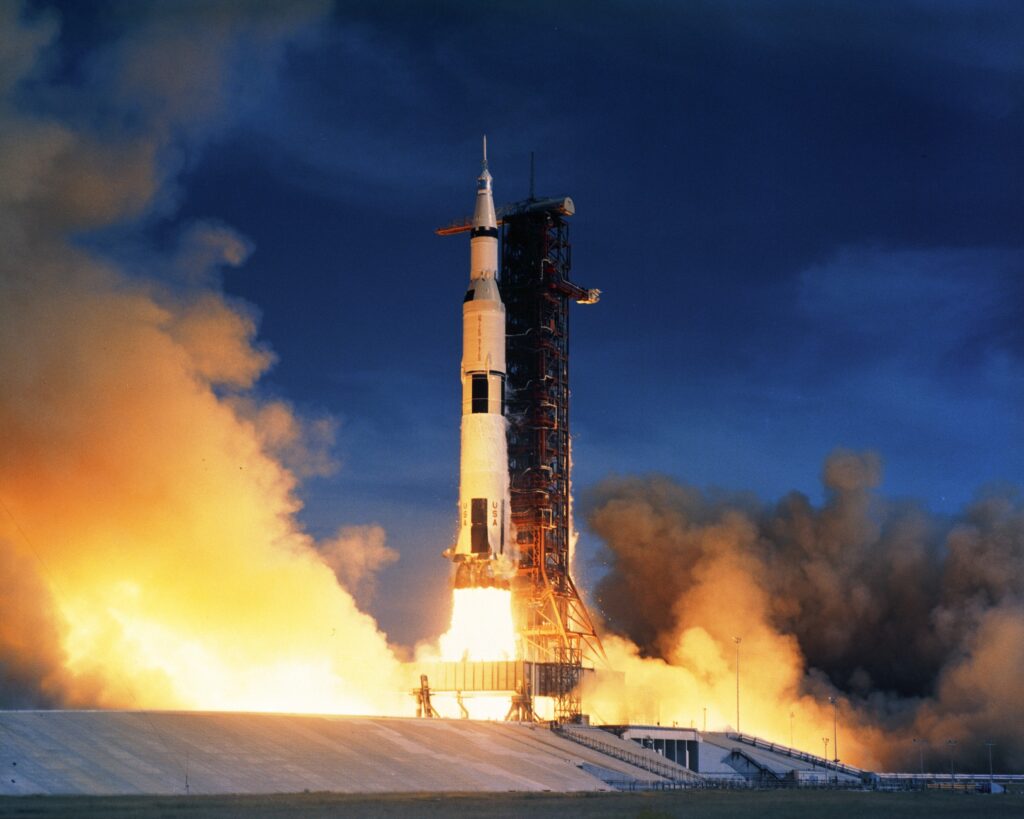
Astronauts Dave Scott and James B Irwin were packed like sardines inside the cramped confines of the Apollo 15 Lunar Module, Falcon. In July 1971, they crossed the lethal 250,000-mile void of space to inscribe near-eternal footprints on another world. Not only footprints but tyre-tracks, too.
As with all previous Apollo missions, every inch of the Lunar Module was crammed with tools, equipment and supplies essential for scientific discovery – and survival. Velcroed checklists, stashed food packets and myriad life-support systems competed for space within the cabin. But Falcon also carried something unprecedented: the Lunar Roving Vehicle 1 (LRV-1), folded beneath it like intricate origami, ready to transform forever the scope of human exploration.
As Falcon began its descent toward the Moon’s mountainous Hadley-Apennine region, Scott and Irwin peered through triangular windows at the crater-scarred surface below. Their perilous lunar landing was a masterclass in precision, requiring staccato bursts of thrust to control their descent safely to the surface. When the module’s landing struts pressed into the fine regolith, Scott’s voice crackled through the radio: ‘Houston, the Falcon is on the plain at Hadley.’
After hours of checks and preparation, they turned their attention to the rover, a machine as vital to this mission’s success as the module itself. Packed into a narrow triangular recess in the descent stage, the LRV was a triumph of engineering, ingeniously designed to unfold like a life-sized puzzle. On the lunar surface, Scott and Irwin released latches and pins, carefully deploying the skeletal aluminium-framed vehicle.
‘It’s beautiful,’ Scott murmured, as the final components unfolded and then snapped into place. Once he’d been ratcheted into the driver’s seat, he palmed the simple T-shaped tiller and inched the rover forward. Crisp tyre- tracks appeared in the virgin regolith, destined to endure for epochs. And all this in fewer than 100 years since the first commercially available motor car – the Benz Patent- Motorwagen – had made its first tentative tyre-tracks back on Earth.
Scott and Irwin’s extraterrestrial automobile was the first of three to be driven on the Moon’s surface. While some might dismiss it as a bold propaganda tool – or evidence of America’s unrestrained love affair with the motor car – the reality is far more profound. Not only were these rovers essential to some of Apollo’s most significant scientific breakthroughs, they also laid the groundwork for the future of extraplanetary exploration.

‘The Lunar Rover completely transformed everything about the Apollo programme,’ asserts Earl Swift, who chronicles the lunar vehicle story in his meticulously researched 2021 book Across the Airless Wilds. ‘Especially when you consider that on Apollo 11, Neil Armstrong and Buzz Aldrin ventured no more than 65 yards from the lunar module. Their entire exploration could fit within a football field – with plenty of yardage to spare.’ The introduction of the rover vastly expanded the range of lunar exploration, enabling the Apollo astronauts to cover nearly 60 miles over three missions.
The LRV’s impact on the scope of the Apollo programme was profound and the story behind its creation is fascinating. ‘Its origins go back to the 1950s, both conceptually and in early prototypes,’ says Swift. ‘The idea emerged from the fascination of two General Motors employees: [Mieczysław Gregory] “Greg” Bekker, a Polish-born engineer, and his Hungarian protégé, Ferenc Pavlics. They became fascinated with the prospect of extraterrestrial mobility after Sputnik I, and immediately began working on it. They saw it as an interesting, abstract problem because no one knew what the lunar surface was like at the time.’
The uncertainty surrounding the lunar surface inspired a range of truly innovative – and sometimes bizarre – vehicle concepts. Austrian-born British astrophysicist Thomas Gold, for example, hypothesised that the Moon’s surface was covered in seas of fine, loose dust, accumulated over millions of years from relentless asteroid bombardment. Gold’s prediction led some to speculate that any spacecraft landing on this lunar ‘sea’ might simply sink into the dust.

To test these theories, GM’s engineering team in Santa Barbara, California, built a large soil bin – 5ft wide, 3ft deep, 50ft long – and filled it with baking flour to simulate the lunar surface. They used the bin to experiment with various extraterrestrial vehicle designs, including a novel Archimedes screw that would drill its way across the surface. Ultimately, however, it was the third and most conventional four-wheeled design that gained the most traction (pun intended).
‘Eventually, and after a lot of experimentation, GM concluded that, when factoring in weight and complexity, the wheel made the most sense. Wheels handle dry surfaces pretty easily, and since the Moon’s surface was waterless, they made the most sense,’ Swift explains.
‘So then it became a question of what arrangement and type of wheels would do best in an airless, waterless environment with extreme temperatures. This led them to come up with wheels that incorporated 800 strands of stainless-steel piano wire coated in zinc and wound into a fine, tight mesh.
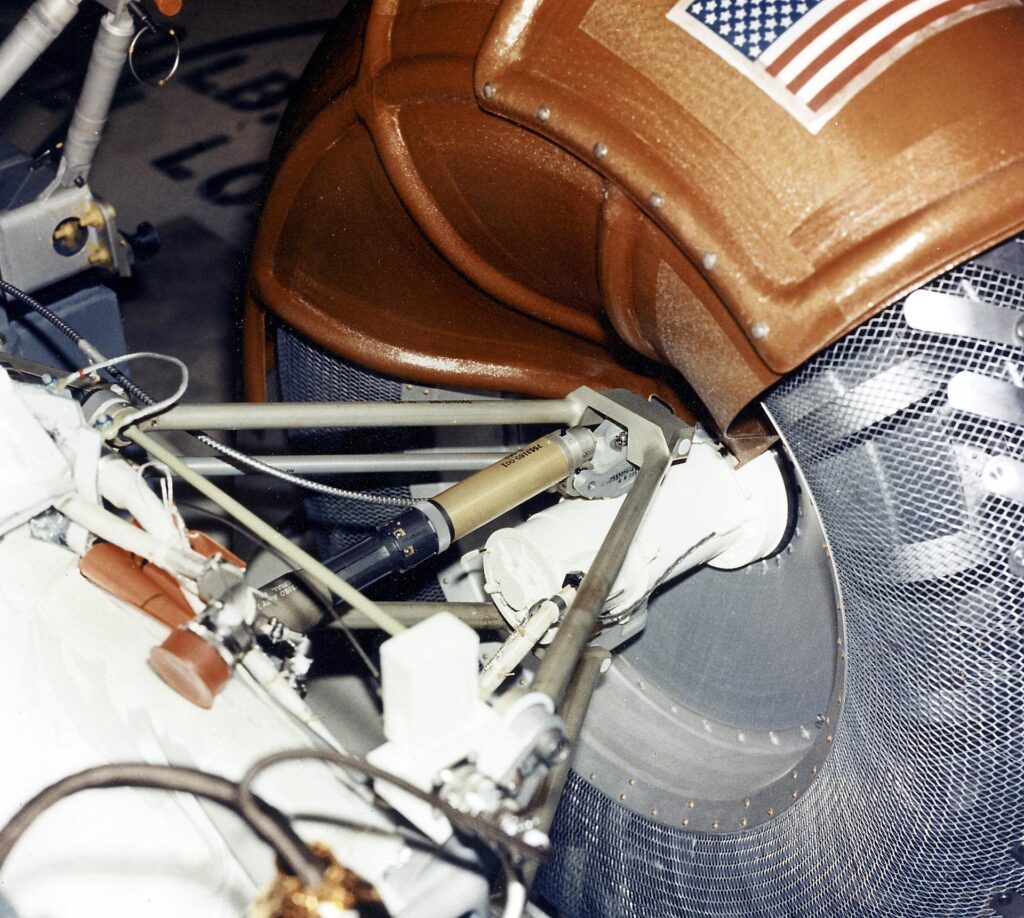
These wheels were very stiff and about the same size as automotive tyres of the day, but they weighed only 12 pounds [5.4kg], including their spun aluminium hubs.’ These wheels had a unique advantage: ‘They were stiff yet provided a good contact patch. They deformed just enough to absorb impacts when encountering an obstacle.’ Perfect for a different world.
Titanium chevron tread was then added for traction, but the challenges didn’t stop with the wheels. Engineers also had to account for the Moon’s extreme temperature fluctuations, which ranged between a blistering 121°C during the day and a frigid -173°C at night. As if that wasn’t enough, the lack of atmosphere made combustion engines useless and also prevented air-cooling for the rover’s vital components. The lunar dust, while fine and dry, was also remarkably abrasive and could damage the vehicle’s moving parts.
With all of this taken into consideration, the design team, which was led by US aerospace company Boeing, turned to electric propulsion, incorporating a small quarter-horsepower motor into each wheel that delivered its drive via a harmonic reduction gear – similar to what’s used to turn heavy machinery. Both axles were steered, and the aluminium chassis was hinged so that it could fit within the lunar module.
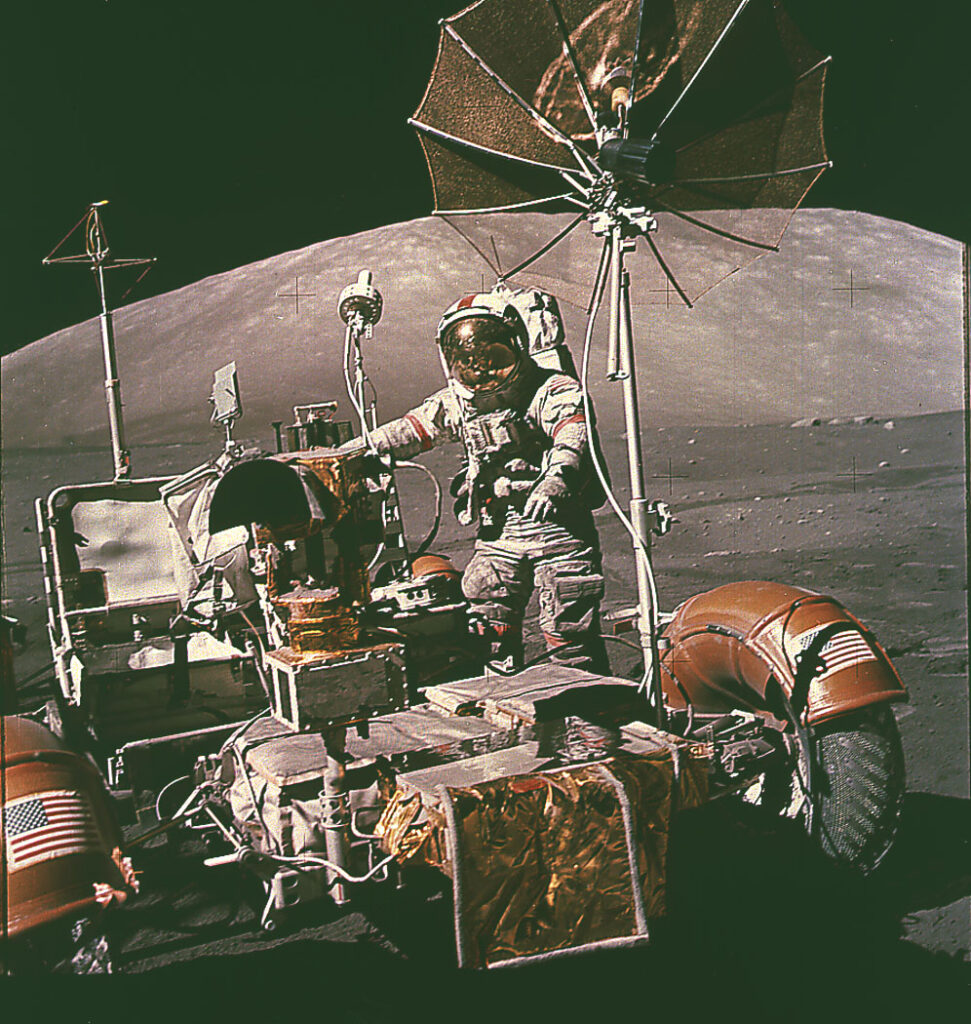
While a mere 1bhp total might not sound like much, the rover’s remarkably lightweight design made it highly efficient. Weighing just 210kg on Earth, the LRV tipped the scales at only 34kg under the Moon’s reduced gravity – just 16% of Earth’s. Despite its minimal weight, it boasted an impressive payload capacity of 490kg, essential for transporting astronauts, cameras, scientific instruments and geological samples.
Predictably, the controls were entirely different from those of a typical vehicle. Acceleration, braking and steering were all managed using a simple T-shaped tiller, positioned in the middle of the cockpit for ease of access. This design was chosen so that the LRV could be controlled by both passengers and because gripping a joystick while wearing a pressurised space suit required an enormous amount of physical effort.
‘When we watch footage of astronauts bunny-hopping around on the lunar surface, it looks like they were having a ball, but it was hard work,’ Swift explains. ‘Imagine wearing a space suit that’s 18 to 21 layers thick. The best way to picture it is like putting on 18 raincoats, one after the other, sealing the cuffs, and then inflating them until they’re as stiff as an all-season radial tyre. Now, try bending your arm. You’ll quickly see how much effort it takes.’
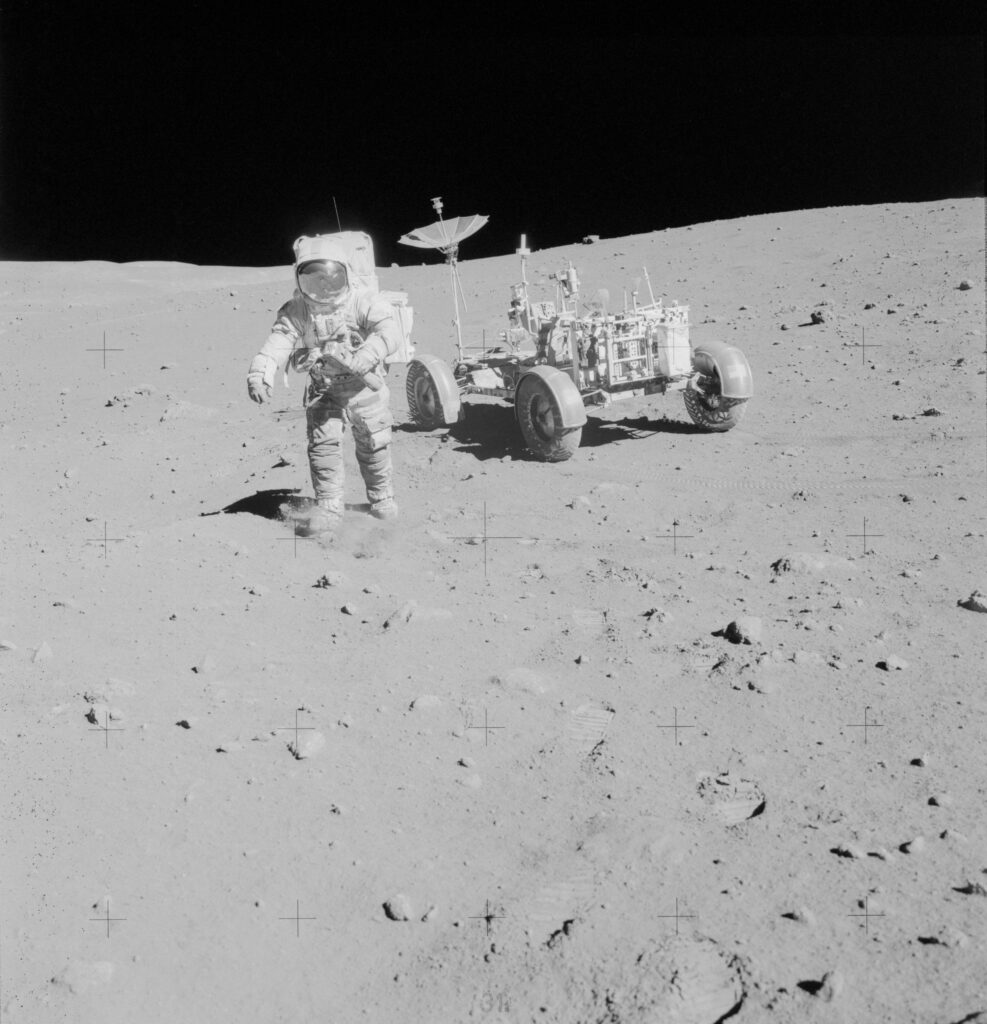
Despite its unconventional design, the LRV had an undeniable charm. The only feature it shared with a regular car was, perhaps, the lawn-furniture-style seats – which, humorously, resembled those of an early Citroën 2CV. Yet these lightweight, utilitarian perches – much like the rest of the design – were perfectly suited to the lunar environment.
While both Boeing and GM collaborated on the project, the involvement of Pavlics and Bekker was crucial, with Pavlics, in particular, playing an important role in bringing the intrepid vehicle to life. The team’s work came to a head when, in a moment of mischief, Pavlics allegedly drove a scale model of the LRV into the office of Wernher von Braun, the former Nazi rocket scientist who pioneered the design of Apollo’s Saturn V rocket. His response? ‘We must do this!’
And so, by March 1971 – and after just 17 months – the first of the three LRVs was successfully loaded into Apollo 15’s Falcon module and deployed and driven by Irwin and Scott on the Moon. Despite the short build time, the project was beset with difficulties and ran well over budget from $19m to $38m – or $300m in today’s money.
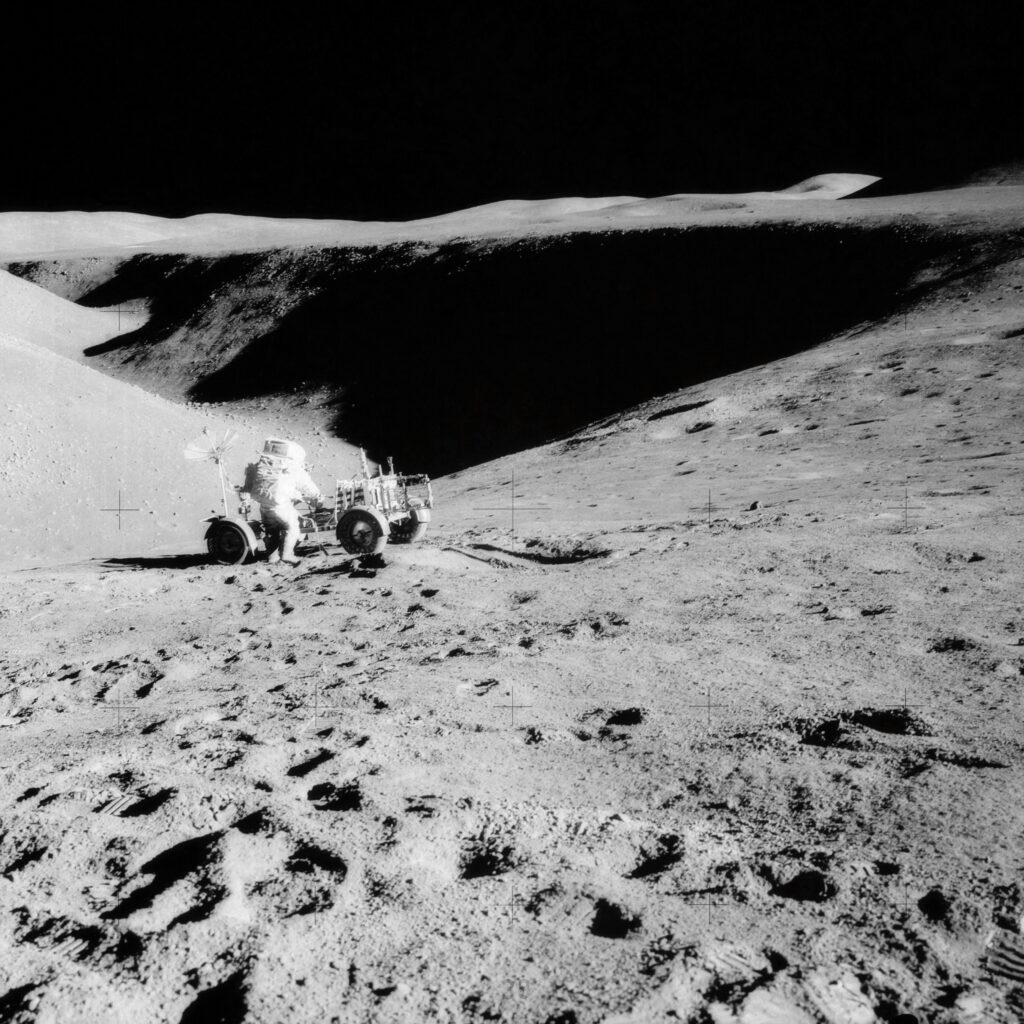
However, putting the steep engineering challenges and the US Government’s vast financial commitment to one side, what makes the LRV and Apollo so evocative is the historic bravery of the men who piloted them, as Earl poignantly points out: ‘It takes a rare kind of courage to journey a quarter of a million miles to the Moon, step out of your one-way ride home, climb into a 1969 General Motors creation, and drive it far beyond the reach of your only way back. It’s mind-blowing – a level of courage that’s almost unimaginable.’
It seems apt, therefore, that all three of the Lunar Roving Vehicles are destined to remain as monuments in the heavens to mankind’s greatest achievement. Regardless of what the future holds for humanity – whether it ends through our own stupidity, pestilence, or some unforeseen cataclysm – a sliver of solace can be found in the knowledge that these automotive creations will endure in the bleak eeriness of the Moon’s landscape for millennia.