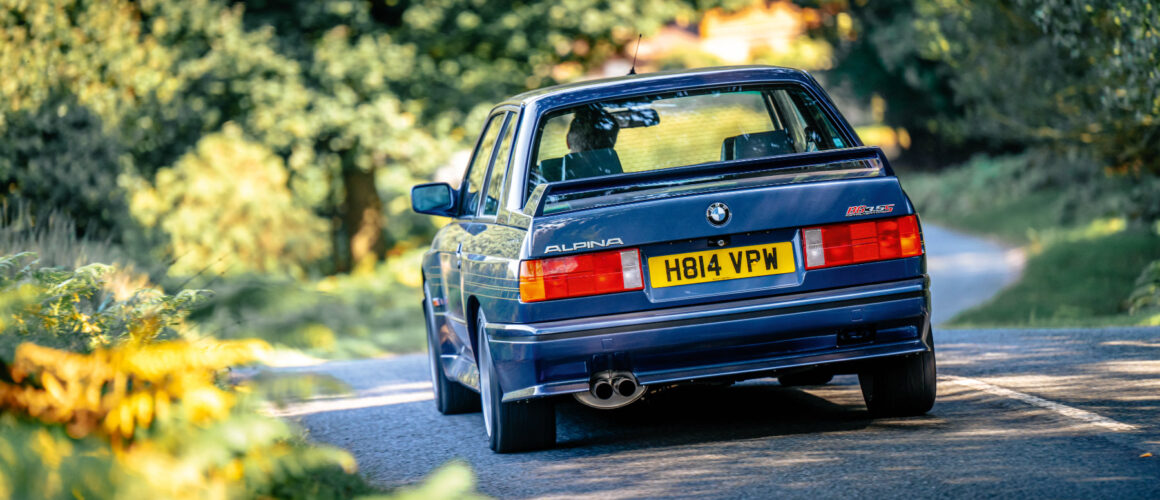
In Chinese philosophy, Yin and Yang is an interconnected, self-perpetuating cycle – complementary yet opposing forces that form a dynamic system in which the whole is greater than the parts. You can apply the same philosophy to the E30 3-Series. Those who praise the M3 mention its poise and screaming S14 four-cylinder engine; detractors point out that, unless you’re giving it the full Steve Soper everywhere, it can be a little underwhelming. Conversely, there are those who view the creamy M20 straight-six from the 325i as an engaging, torque-glorious unit that better fits the template of what we define as small sporting BMW saloons to this day. On the other hand, its antiquated rear suspension and slow steering led to many being worn by trees like Christmas decorations.
What if you could combine the best of both worlds? Enter Alpina, with the B6 3.5 S.
It’s easy, of course, to see why the E30 M3 is so lionised, standing as it does as testament to perhaps the true glory years of international motorsport. Many eulogise the 1960s, though the racing was often anything but close. Come the 1980s, with budgets seemingly infinite, manufacturers would spend millions chasing the finest margins. While Group B is seen as the ultimate expression of this, perhaps Group A demanded more of its competitors. Group B required only 200 roadgoing cars to be built – for Group A, you needed to sell 5000.
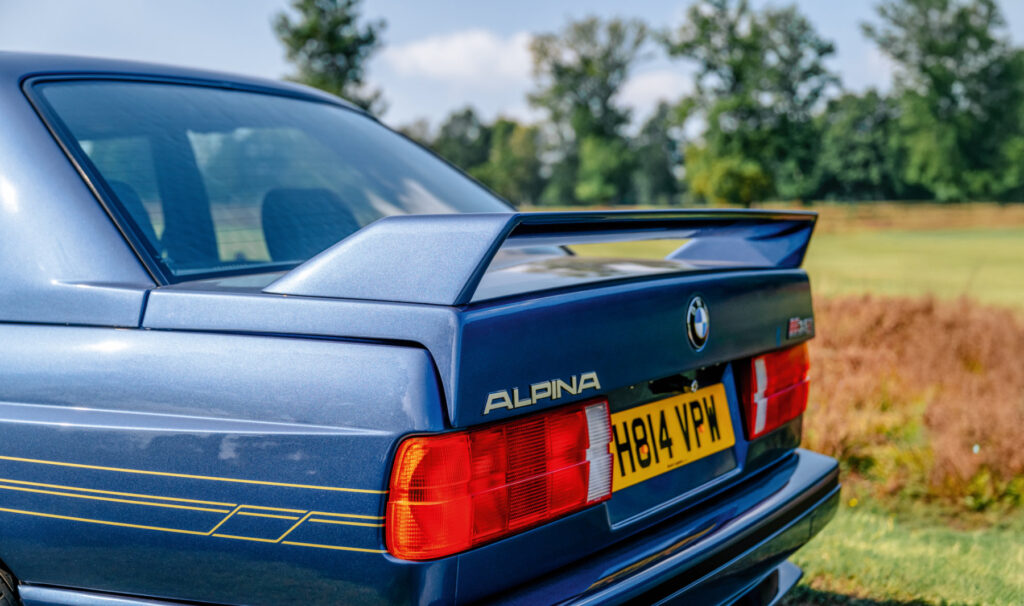
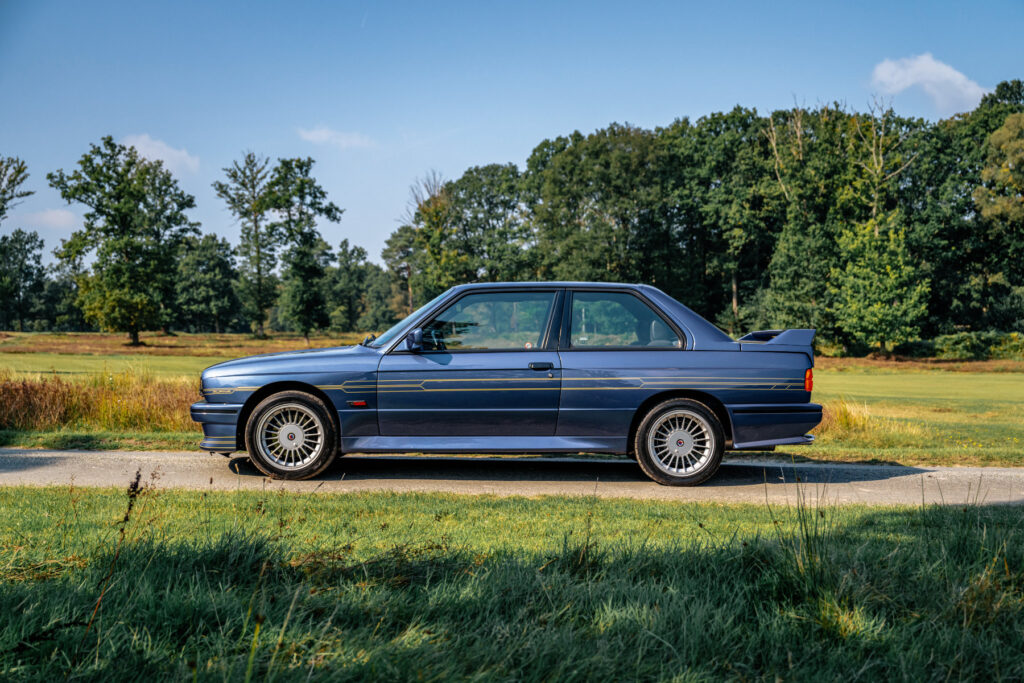
Looking at the lengths BMW went to with the first M3, it seems such an enormously tall order. Just look at it: the wide arches, front splitter and rear wing are the most obvious concessions, but examine closely the rear three-quarter where the C-pillar and screen were given a whole new rake angle and the bootlid was raised by 40mm, all specially made from glassfibre in the name of better airflow. Even the windscreen was glued in, rather than framed with rubber piping.
The M3 shares front MacPherson struts and rear semi-trailing arms with other E30s, but its super-quick and bespoke 19:1 steering rack introduces a level of connectedness a 325i driver could only dream of. M Division increased front wheel caster by three times, the semi-trailing arms were set at 15 degrees and the anti-roll bars rearranged. Springs and dampers were stiffened, the ride height dropped, and twin-tube hydraulic dampers employed at the front.
The result was a racing car that delivered championship after championship – however, the S14 four-cylinder engine was some 100bhp down on the racers in road trim. Drive one today and, as with other Group A homologation specials, you might come away disappointed – not much happens south of 5000rpm. For all the hype, the M3 is a car that comes alive only when you thrash it – and if you don’t, it’s a very expensive and noisy four-cylinder BMW.
There was another methodology, however, 70km to the west down the A96 in the small town of Buchloe, where the B6 was created by BMW tuning firm Alpina.
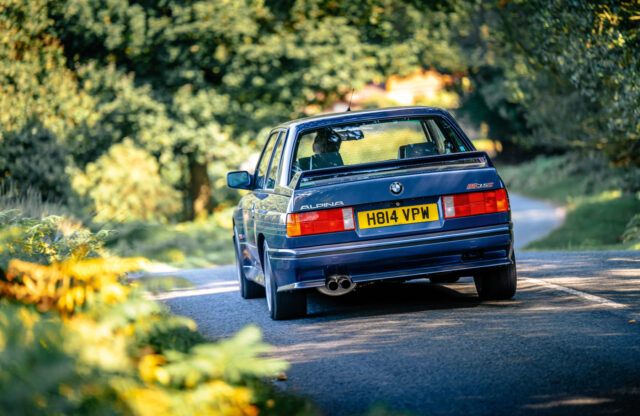
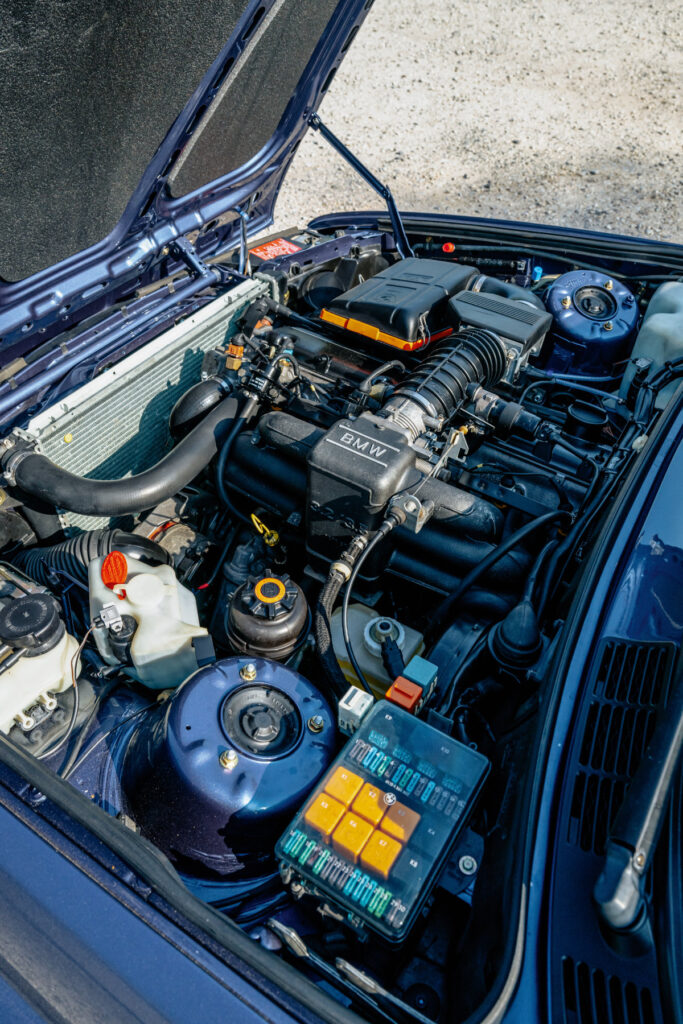
Two years before the M3’s 1986 launch, Alpina had taken the 3.5-litre M30B34 straight-six used in the 635 CSi, 535i and 735i of the time and treated it to a full handbuilt revision: an Alpina-designed camshaft, upgraded valves, modified cylinder head porting, shorter Mahle pistons with longer connecting rods, and a reprogrammed Bosch Motronic ECU. The compression ratio grew to 10:1, and power and torque swelled to 261bhp and 237lb ft. Even though the addition of a catalytic converter took the B6 3.5 S down to 254bhp, that’s quite a leap over the M3’s 200bhp, not to mention the 325i’s 170bhp.
Looking back at the car raises a chuckle from Andreas Bovensiepen, who today heads up Alpina alongside his brother Florian. At the time he was fresh to the firm from his studies, and was competing in the DTM championships in a luminous-green Michelin-sponsored M3. ‘A lot of customers were talking to us about the M3 – it was a great car, the best-handling BMW ever,’ he says. ‘The chassis was great, but it wasn’t being exploited by the engine’s power.’
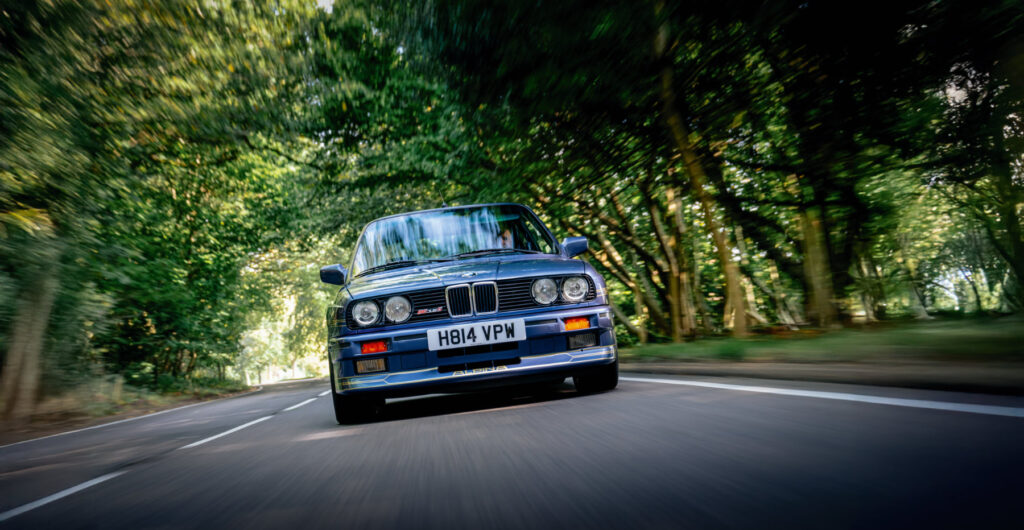
Combining the M3 chassis with the B6 drivetrain would form the B6 3.5 S, which was first revealed to journalists in 1988 ahead of a full launch a year later.
The concept of Alpina getting to grips with an M Division car would be unthinkable now – in just a year’s time the brand will be fully absorbed into the BMW mothership as the Bovensiepen family regroups around Alpina Classic. ‘At the time, BMW Motorsport was really focused on racing, and while it was important to sell road cars, motorsport success was at the forefront,’ Andreas says. BMW simply had to sell 5000 M3s to homologate the racers, which was a tall order given that four-cylinder BMWs were largely the preserve of the lower-management classes. M Division was happy to sell whatever it could to whoever it could, so Alpina simply bought M3s off the line and shipped them back to its Buchloe HQ for a full conversion by hand.
Once there, Alpina fitted the stiffer front springs from an air-conditioning spec M3 and switched the rear axle ratio to 2.79:1 from 3.25:1 and… well, that’s it, other than the engine and some minor aesthetic changes. While the E30 M3 is lauded as a paragon of dynamic virtue, adding two cylinders and 40kg into the snout could change things – couldn’t it?
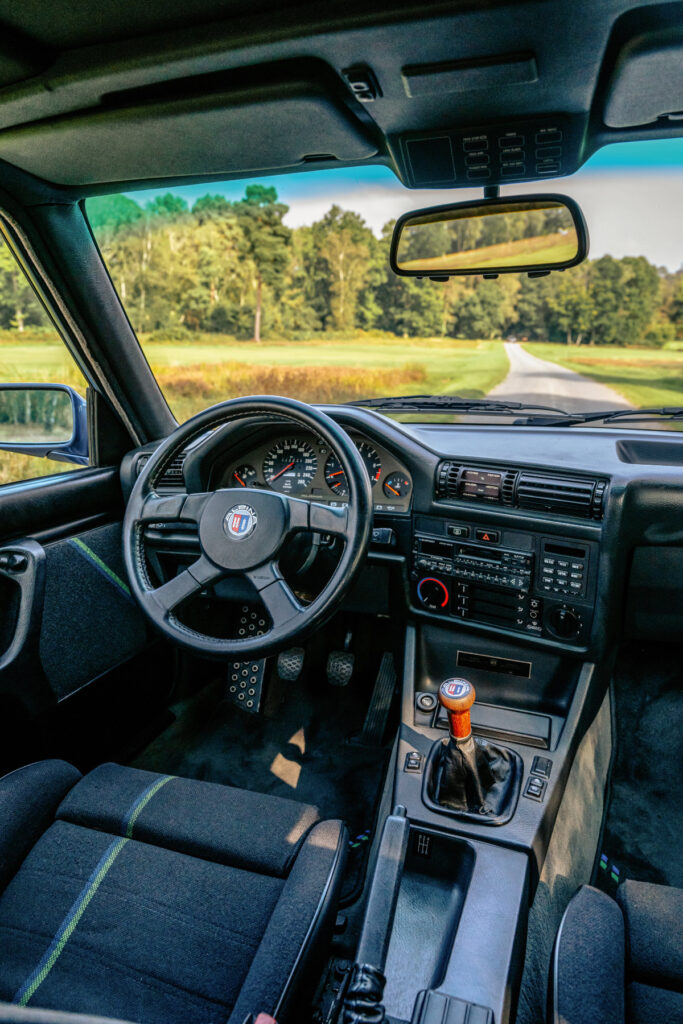
That plays on my mind as I nose this one out onto the East Sussex roads surrounding its restorer, Munich Legends.
I needn’t have worried – it’s all very civilised. True, the M3-derived, Getrag-built five-speed dogleg gearbox is decidedly notchy and requires slow, deliberate shifts, but the big six’s broader spread of torque makes the B6 S a much more amenable place to be. There’s enough grunt to pull away in the higher gears.
I’m not here for that, however, and it soon becomes impossible to resist the engine’s familiar delights: instant throttle response, linear power delivery and a shimmering, heart-stirring whine as the rev needle sprints to the 6750rpm peak. But it’s not the peak power, all 254bhp of it, that really defines this car. No, it’s the torque. And that’s something the M3 lacked.
M Division’s E30 doled out its comparatively meagre 173lb ft at 4750rpm, whereas the B6 S thumps out 236lb ft at 4000rpm; on paper that may not sound huge but the effects are seismic. In-gear acceleration is chunky – 60–80mph in fourth occupies just 5.7sec, as does 70–90 – and the sprint from rest to 60mph takes just 6.6sec; some magazine road-testers even managed six seconds dead, the same as a Ferrari Testarossa. All out, you’ll be doing 156mph.
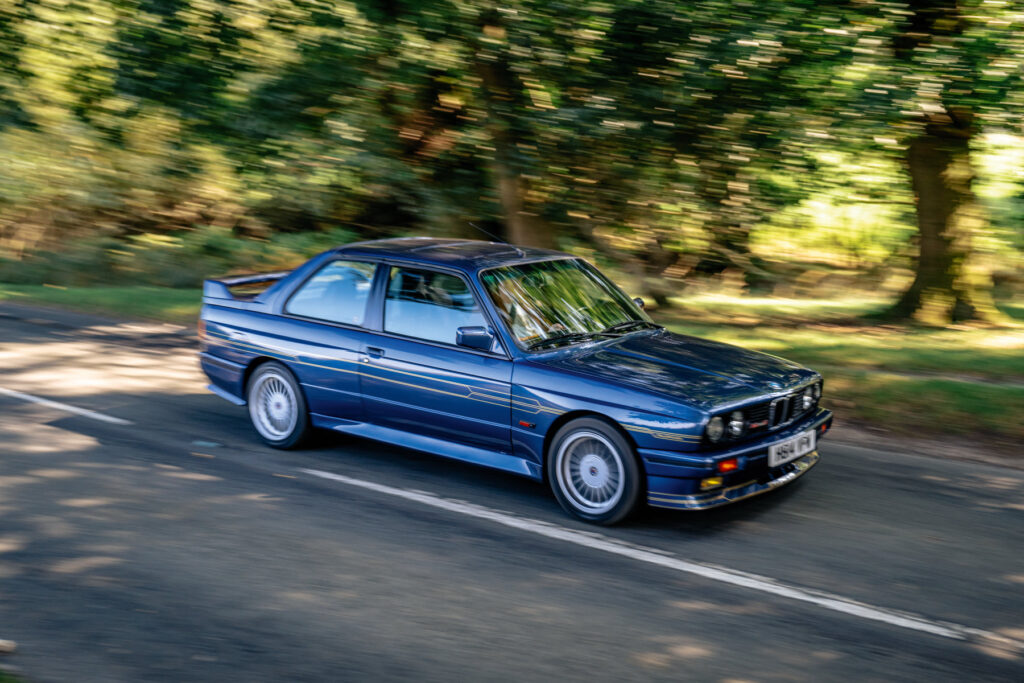
So far, so Alpina – the brand is built on autobahn annihilation, so torquey straightline oomph shouldn’t come as a surprise. What sends my eyebrow into orbit is that, if anything, the B6 S handles better than a standard E30 M3.
A big part of this is down to the 225/45 tyres, wider and lower-profile than the 205/55s of the standard M3 and shared with the M3 Sport Evolution. Turn-in is sharper and, though there’s a whiff of understeer, there’s enough torque to wake up the rear axle, tucking the nose into the corner via the 25% limited-slip differential. Push it further and there’s the potential for the mid-corner exuberance you’d associate with more modern M-cars.
The confidence to do all this comes from the sublime steering and the feedback through the wheel. While it may not telegraph the realities of life at treadblock level to Lotus standards, it goes far beyond customary Alpina and even M degrees of feel. This all means there’s the mental space to fully liberate that fabulous straight-six whenever and wherever possible. The gearing is valley-wide – you can clobber 70mph in second, 93mph in third – which allows you to focus on steering inputs. In a standard M3, I’d be grappling with the same awkward Getrag just to keep the S14 on the boil.
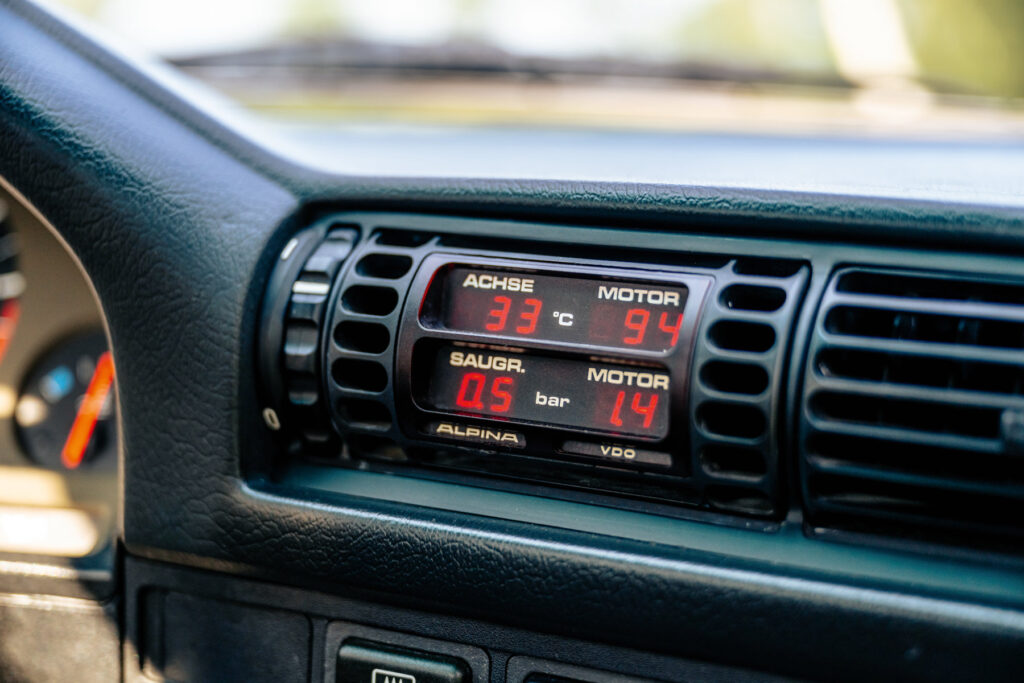
Speaking to Andreas later, it all chimes with the aims of the project. ‘Unlike other fast cars at the time, you could drive it quickly and not get out with sweating hands – it wasn’t demanding,’ he muses. ‘We looked to have a smooth transition for when the rear axle starts to travel and goes into oversteer. Being smooth is better than being 2km faster, and then losing the rear abruptly. The ideal would be to be able to go from Hamburg to Munich at 6am at 250km/h or more and get out after five hours fully relaxed. You could leave the B6 S in fifth at 150km/h and you didn’t need to shift down – the engine was so torquey in something weighing 1280kg, you could just accelerate.’
Despite the pumped-up bodywork and Alpina warpaint, the B6 S would have surprised much more extreme machinery at the time. After all, 911s and Ferraris were still somewhat hairy in extremis; the B6 S not only matches them on pace but feels like it could outdo them on poise, too.
Andreas vividly remembers one such autobahn experience in a B6 S. ‘I spotted this 911 coming up behind me, just as I was slowing down behind someone moving out of the way. He put his indicator on, and I thought “Come on guy”,’ Andreas chuckles. ‘We came to some fast corners and I pulled away, because he was having to work harder at the steering wheel than I was. He didn’t expect a car like this to have a top speed of more than 250km/h. It was a real underdog – it might have had a sporty exterior, but nobody saw it on the autobahn, and it was easier to go faster because of the longer wheelbase and suspension layout.’
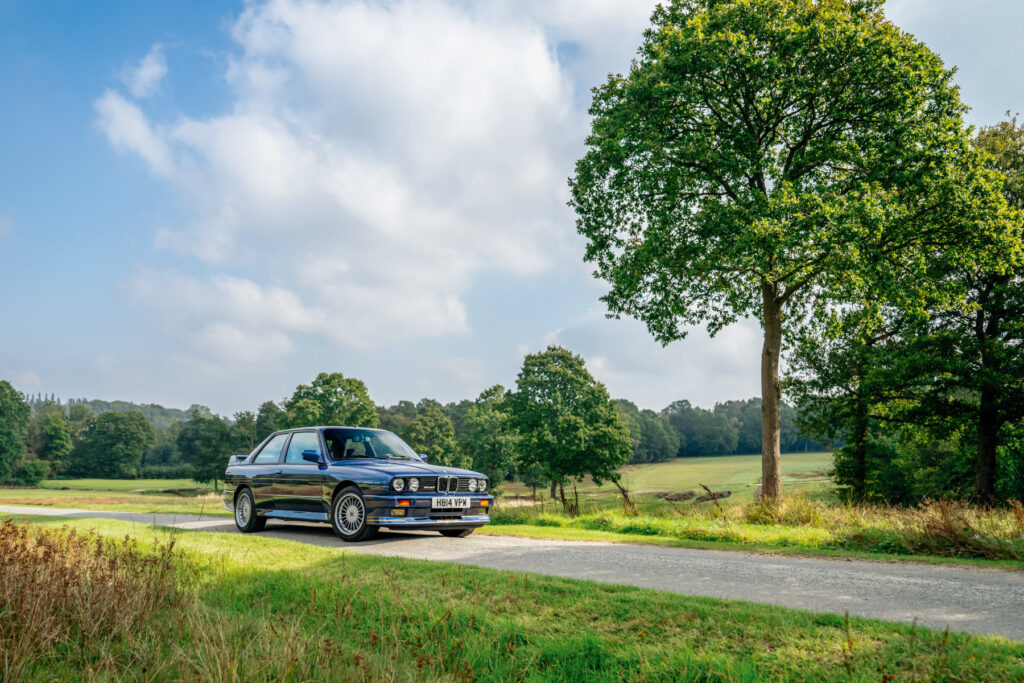
As I head back towards Munich Legends, with the six-cylinder fizz rippling through the chassis and yours truly, the feelings are bittersweet. It’s easily the best E30 I’ve driven, and up there with the E28 M5 as the most engaging pre-Millennium BMW. It delivers where the M3 falls flat, yet handles with a sharpness even M-cars into the early 2000s would struggle to get close to. Only the CS and CSL-spec E46 M3, and perhaps the Z4M, with their famed ‘purple tag’ steering racks, offer such a satisfying mix of six-cylinder surge and fingertip-fizzing feedback. It’s that good.
The sad bit is that only 62 were built, and the cost of entry is getting close to a quarter of a million pounds. It’s also the last of a certain type of Alpina – after the Z1-based RLE and the E34 B10 Biturbo, the firm embraced its luxury niche more fully from the 1990s onwards.
Though it started by offering performance tuning parts in the 1960s and 1970s, and delivered BMW’s first Touring Car success before M Division even existed, it had little choice as BMW Motorsport’s marketing potential grew. ‘Besides the E30, it was never the intention to make a better M3 or M5 – it was always to be the most luxurious BMW,’ Andreas says. ‘That was our niche.’
Perfectly understandable, of course, yet I can’t help but wish for one last moment of madness before Alpina is absorbed into the Munich mothership: an outrageous modern B6 3.5 S on an M2 base is a mouthwatering if unfeasible idea.
Instead, we can only judge the B6 3.5 S by its legacy – introducing a full-fat straight-six to an E30 M3 chassis, and proving the concept. At the time, BMW kept a close eye on the project, and had even dabbled with a similar idea itself.
Just a few years later, BMW M released the E36 M3, the first six-cylinder M3, a set-up that, except for the V8-powered E90 generation, BMW has stuck with, although turbos followed.
What was that about Yin and Yang working together for greater harmony? Just look to Alpina and BMW M – and the B6 3.5 S.
Thanks to Munich Legends.
1989 Alpina B6 S specifications
Engine 3430cc OHC straight-six, Bosch Motronic II fuel injection Power 254bhp @ 5900rpm Torque 237lb ft @ 4000rpm Transmission Five-speed manual, rear-wheel drive Steering Power-assisted rack-and-pinion Suspension Front: MacPherson struts, progressive-rate coil springs, Bilstein gas dampers, anti-roll bar. Rear: semi-trailing arms, progressive minibloc springs, Bilstein gas dampers Brakes Discs, vented at front Weight 1320kg Top speed 156mph 0-60mph 6.6sec