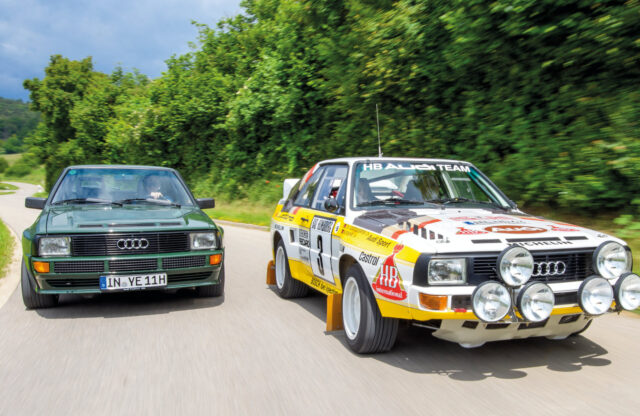
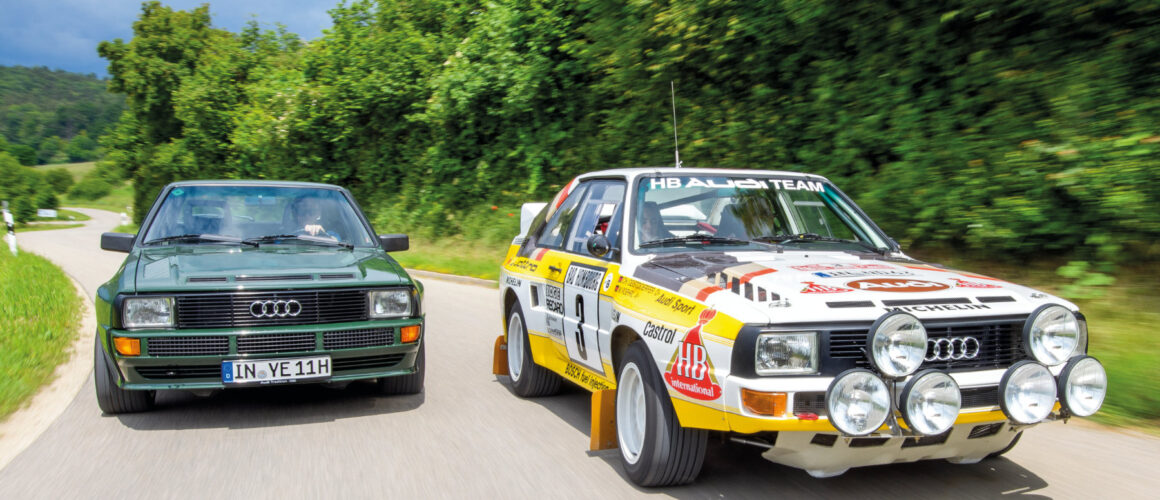
Of course, we Octane types love to drive. But sometimes the passenger seat is a very privileged spot indeed. And here I am in an Audi Sport Quattro, sitting next to Stig Blomqvist, 1984 World Rally Champion and runner-up in 1985.
Both of those notable championships were with Audi Sport. And the 1984 season was the one in which the Ingolstadt company turned up the wick, building this shorter, more powerful Group B weapon to keep it at the top of the table, Technik having done its Vorsprung to perfection. 40 years on, man and machine are in harmony once more, though perhaps with a less experienced co-driver this time.
This is not the first occasion on which I’ve shared the cockpit with the veteran Swedish rally driver, nor my first time in this car. Back in 2021 we were in San Romolo, scene of a closed-road mountain stage in the Rallye Sanremo 40 years earlier, when Michèle Mouton had taken her maiden Group B win, and Audi its second Group B victory (and third podium finish). It’s also the scene of the Sport quattro’s final victory, in 1985.
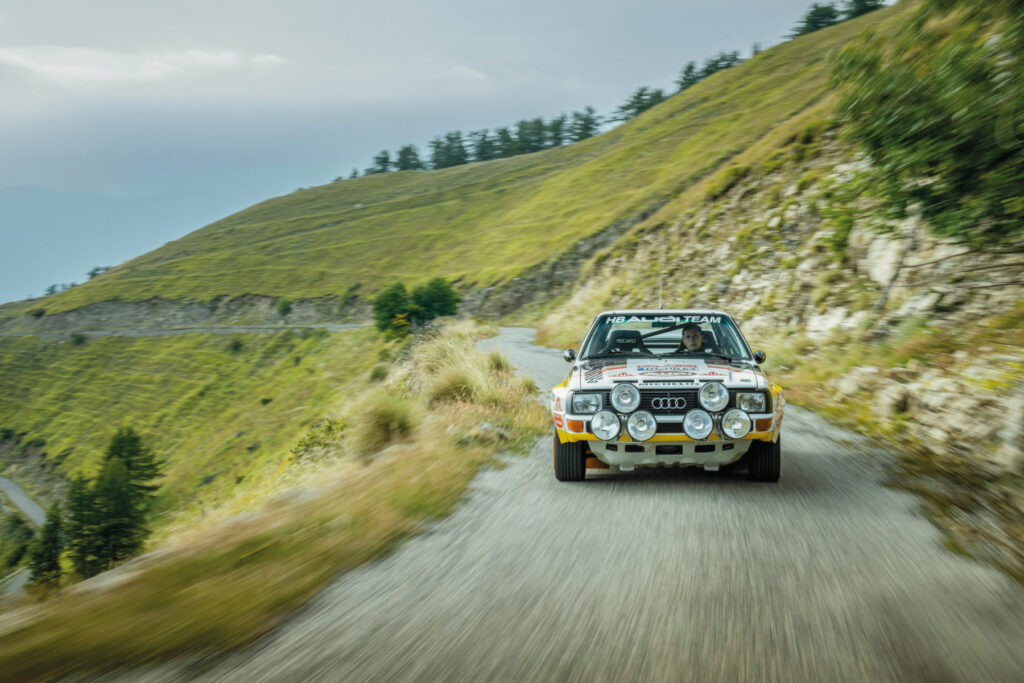
This particular Sport quattro was built in 1984, of course, and finished in second place on the Rallye Monte-Carlo in January 1985, piloted by Audi Sport works driver Walter Röhrl with Christian Geistdörfer, before it became a testing and experimental vehicle – hence its remarkable state of preservation.
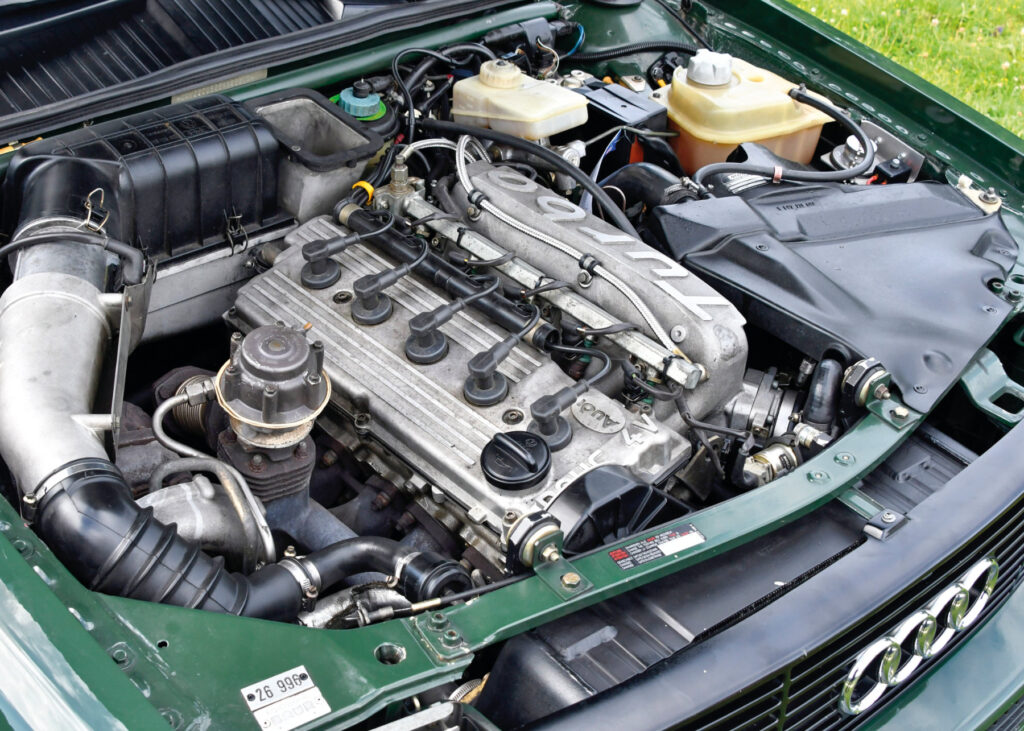
Part of the Audi Tradition collection, it still features its original turbocharged five-cylinder engine, although the museum’s own engineer granted that the boost has been reduced just a little in the name of conservation, so maybe the output is down slightly on its former 414bhp at 7500rpm. But you wouldn’t know that, not given the pace with which Stig blasted it away from the Ristorante Dall’Ava and around the winding single-tracks of the Cinque Valli, high above the elegant Mediterranean resort of Sanremo.
As that familiar off-beat baritone blare thundered around and reverberated off the rockfaces, with rictus grin, spellbound and suffering slightly with the petrol fumes, I tried hard to concentrate on what made Stig, Stig. He’s not so tall, maybe a few inches below 6ft, but sitting a long way back in the car, he was smooth, relaxed, committed, inch-perfect.
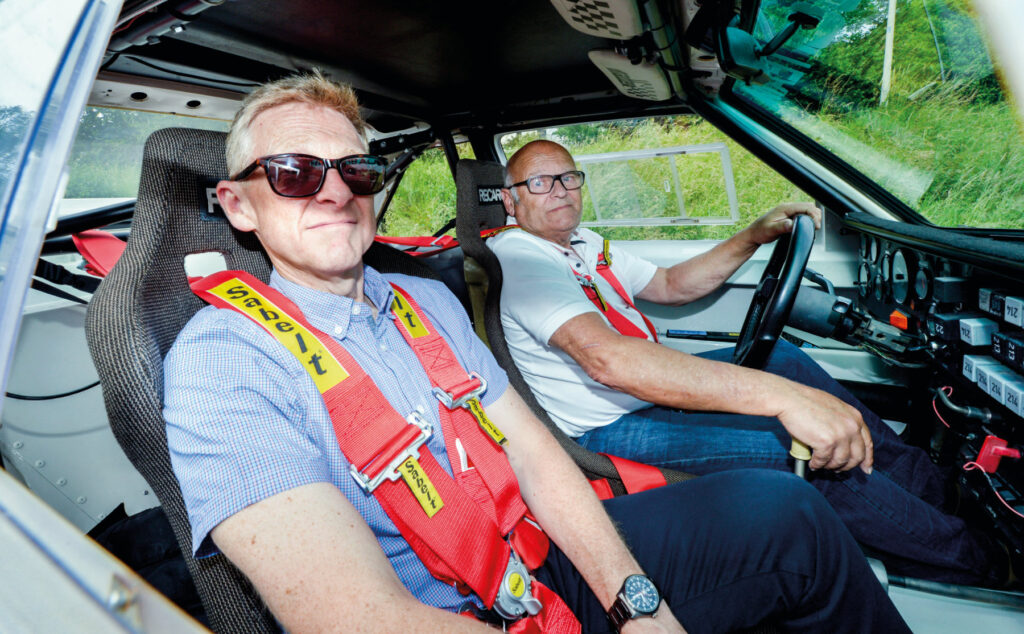
Fast? Naturally, perhaps even supernaturally, to the degree that when I wrested my eyes away from his flying hands and dancing feet to try to focus on the view through the front screen, I could scarcely believe the pace with which the epic scenery was scrolling by. And he was driving at ‘maybe 70% or so’. Yup, he still had it, even as a 74-year-old.
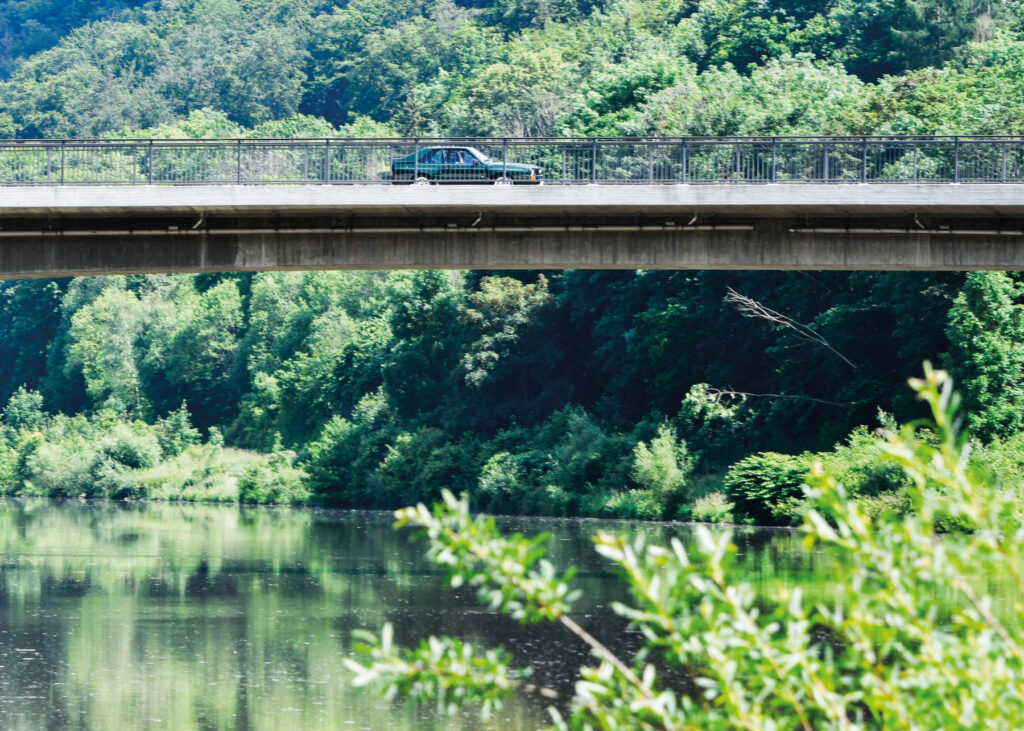
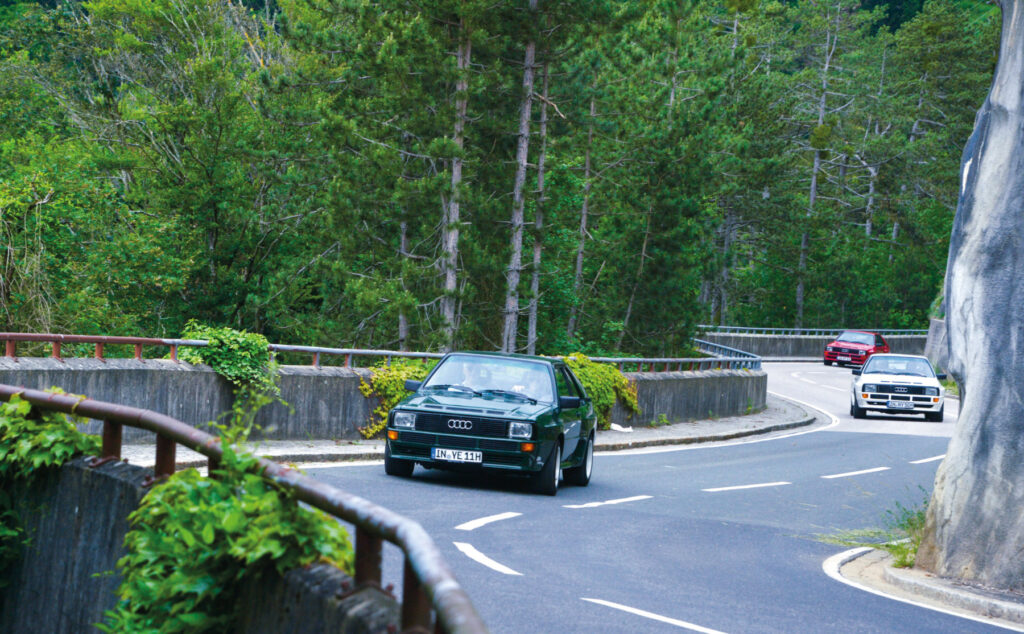
This time it’s different. We’re on the road, in Bavaria, gorgeous weather, rock-strewn countryside and quaint villages scattered an hour or so from Audi’s Ingolstadt hometown. This time I get to work out how he drives, still noting the commitment, the smoothness, alert yet relaxed, his total one-ness with the car.
‘It’s like being reunited with an old friend,’ he smiles, in that quiet, modest way. Like his fellow Scandinavian rally hero and Audi Sport driver, the late Hannu Mikkola, he is strikingly free of ego, somewhat reserved until he relaxes in your company.
This car’s gulping great turbo saw it to 60mph in 4.8sec, putting it in the company of Porsche’s 911 Turbo.
Pulling away from rest, he corrals the lumpy, grumpy pulses of the high-idling five into a seamless herd, matched exactly to the point at which the clutch bites, and thereafter there is no feathering. Likewise his progression up and down the gears, each shift achieved briskly yet without any drivetrain snatch nor any hunting of revs as engine and propshaft speeds seek common ground: it’s there, a perfect match, straight away.
We’re somewhat short of that 70% for most of the time; the liveried works car turns enough heads without going full-shout, but when there’s a straight stretch ahead, and no other traffic around, the glint in his eyes gets a little steelier, the slightest crinkle around his jaw signals a smile and the hammer goes down.
Those horses get let loose for just a few seconds of glorious, life-affirming Group B WRC-style acceleration, and Stig is Stig all over again. Every piece of the car seems to come alive, your hearing is overwhelmed by the engine’s snarl, and the road surface is telegraphed in microscopic detail through your seat; yet it’s all communication, not punishment. The structure feels animated in a way that brings to mind only one other car of my acquaintance – and that’s a Ferrari 250 GTO.
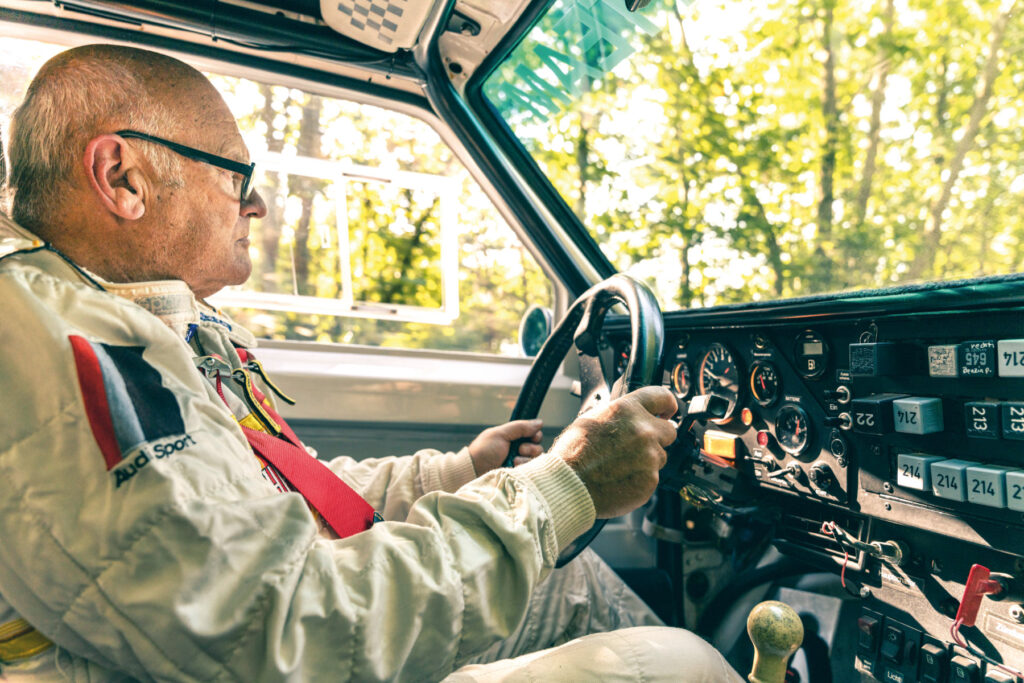
Power is nothing without control, of course, but it’s the way in which that control is meted out that’s so impressive. You expect a Group B car to have strong brakes and, sure enough, hauling us down from a high-speed run sees me forced tight against the five-point harness. But what’s noticeable is how Stig brakes for the absolute minimum, to shed only the necessary speed in the shortest distance. If there’s a downshift to match, it’s heel-and-toe perfection. And obviously there is never a hint of confidence-dabbing before a corner. Precision rules. Right every time. That’s how champions drive.
We pause at the charming Bräustüberl Biergarten Hotel Schattenhofer in Beilngries, a chance to find out more about the man and his extraordinary experiences with Audi Sport. He admits that his past rally career with Saab gave him an advantage when he joined the team in 1982.
‘Four-wheel drive is very different from rear-wheel drive,’ he smiles. ‘You can’t do it on the throttle, so like a Saab really, using the same technique, left-foot braking to set the car up into turns. With the ur-quattro, traction was incredible, but acceleration was the big difference with those early turbocharged cars.’
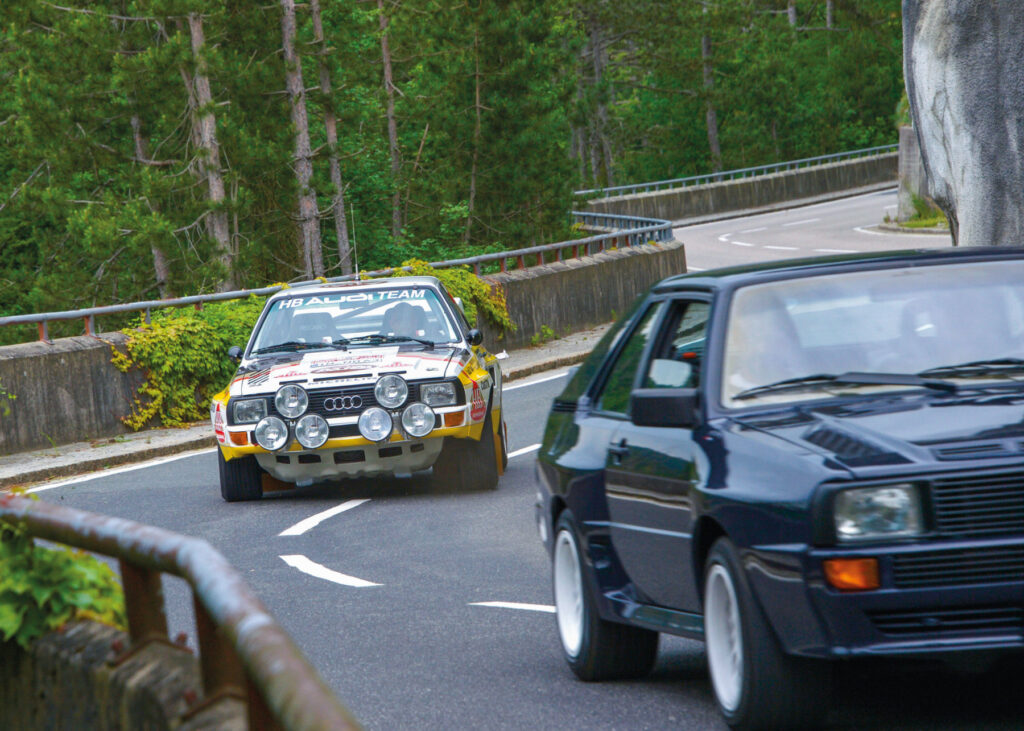
The next step-change came during the 1984 season, and the introduction of the short-wheelbase Sport quattro, which brought an extra 112bhp over the long-wheelbase cars, thanks to 20-valve cylinder heads and a bigger turbo.
Stig laughs: ‘I played things safe to start with and carried on using the old car! You have to change your style a bit, it was a bit tricky in corners, you have to do more, use the traction for accelerating and braking rather than cornering. The biggest problem at first was pitching, much more pronounced with the short wheelbase. We ran much stiffer suspension on tarmac, much softer for gravel. I’d always preferred the long-wheelbase car, but the Sport quattro had a better engine to compensate for the handling, so it was a big improvement overall.’
Obviously, evolution was baked into the programme, too. ‘We started with a 50:50 torque split, then came a centre diff, better for turning but the reaction was a little too slow in those days. I wanted to run a limited-slip in front, Mikkola preferred to go without. I was more in tune as I’d been used to similar steering with Saab, only more physical – there was no power-assistance on the Saab!’
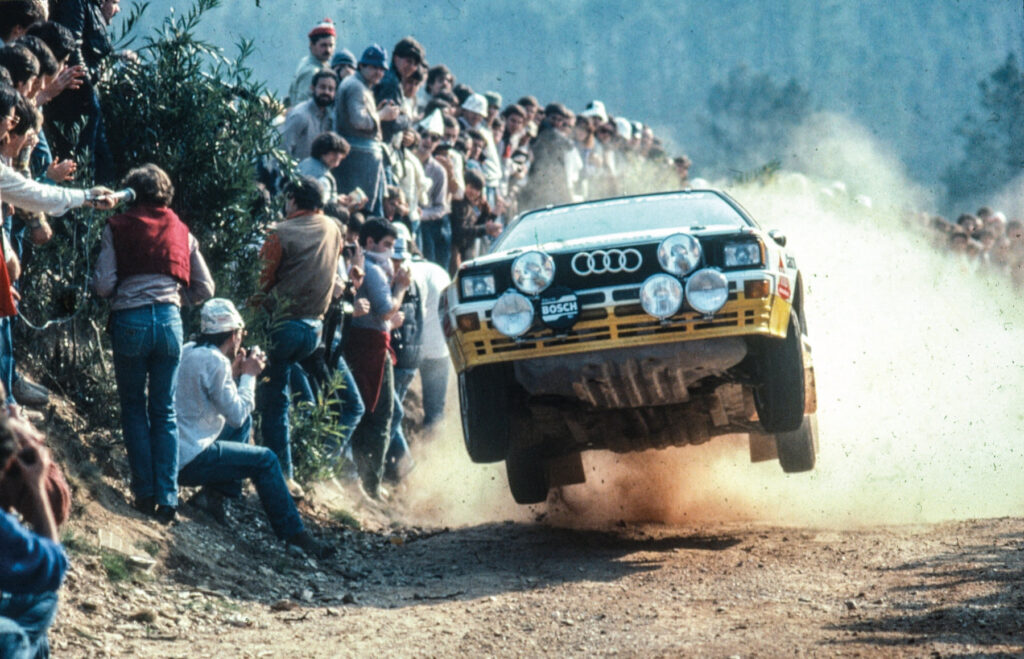
Then came the E2 version with its aero package and a further boost to 473bhp, still from the same 2143cc five-cylinder. ‘It did a hell of a lot for the car, stability and cornering speed, so much more of both. And the pitching problem was going away, too. Gravel suited it best, the car was outstanding. So much more power, we just had to get used to it.’
That latter sentiment is a recurring theme. ‘With the quattro, it had taken a while to learn how to win. We had the hardware and it’s not just the driver but the whole operation. We came up slowly; Michèle came so close in 1982 when Audi won the Manufacturers’ title; then Hannu won in ’83, me in ’84. We just had to get it together. Audi had a big budget, it was suddenly in the game and had to push.’
In a team with more than one star driver, there was rivalry, too. ‘Everybody knows what to do and how to do it,’ says Stig, with a serious expression. ‘We all had the same chance to win – only Audi had that problem! And Walter [Röhrl] didn’t do all the rallies, just his favourites.’
Group B came to an end in 1986, something Stig believes was unnecessary. ‘It was easy for some drivers with little experience to get hold of the cars, so there was a wrong decision somewhere. But within a year the Group A cars were even quicker anyway! In that final season I drove the Ford RS200 and the Peugeot 205 T16. I guess that means I’ve driven more Group B cars than most, but the long-wheelbase Audi is my favourite of all the cars I’ve driven.’
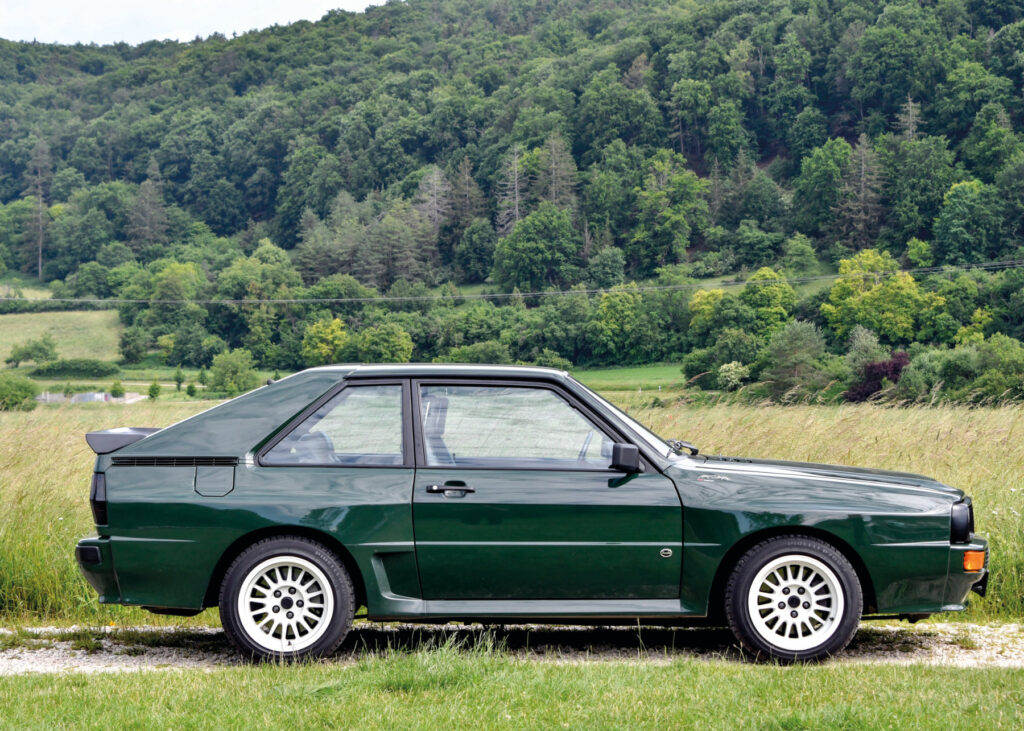
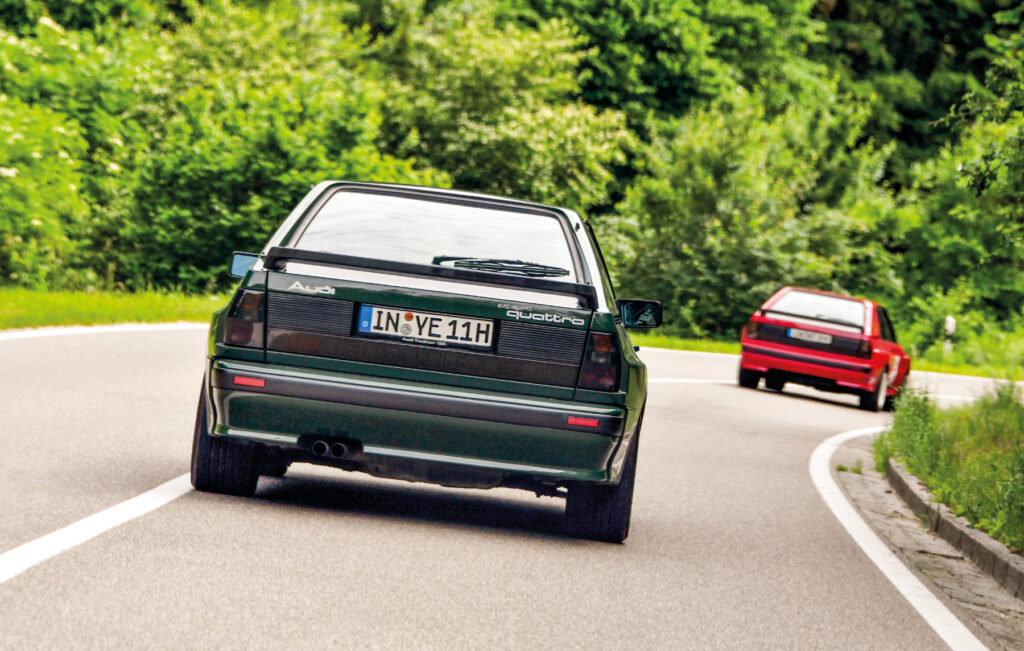
Now it’s my turn behind the wheel – not in the works car, but one of the 164 Sport quattro road cars, from a total production run of 224. With 320mm taken out of the wheelbase, the ‘shorty’ has obviously different proportions from the ur-quattro that sired it, though the nose is longer – ironically – extended to house a bigger intercooler. The windscreen is much closer to vertical than the earlier car’s, borrowed from the Audi 80 saloon in an effort to reduce glare and reflection – an issue drivers had reported in the E1 and E2 competition cars.
The road car features an all-alloy version of the twin-cam, 20-valve five-cylinder engine, rated at 306bhp. It features thin steel cylinder liners which are known to be rather less robust than the standard block – many cars were later retro-fitted with steel liners. It’s just one of the complexities of owning an exotic homologation special. All 224 cars were built in left-hand drive and officially available in the UK only as personal imports. It’s thought that just six came here in period. Value today? You’ll need around half a million pounds – and a storied works car could fetch three or four times that.
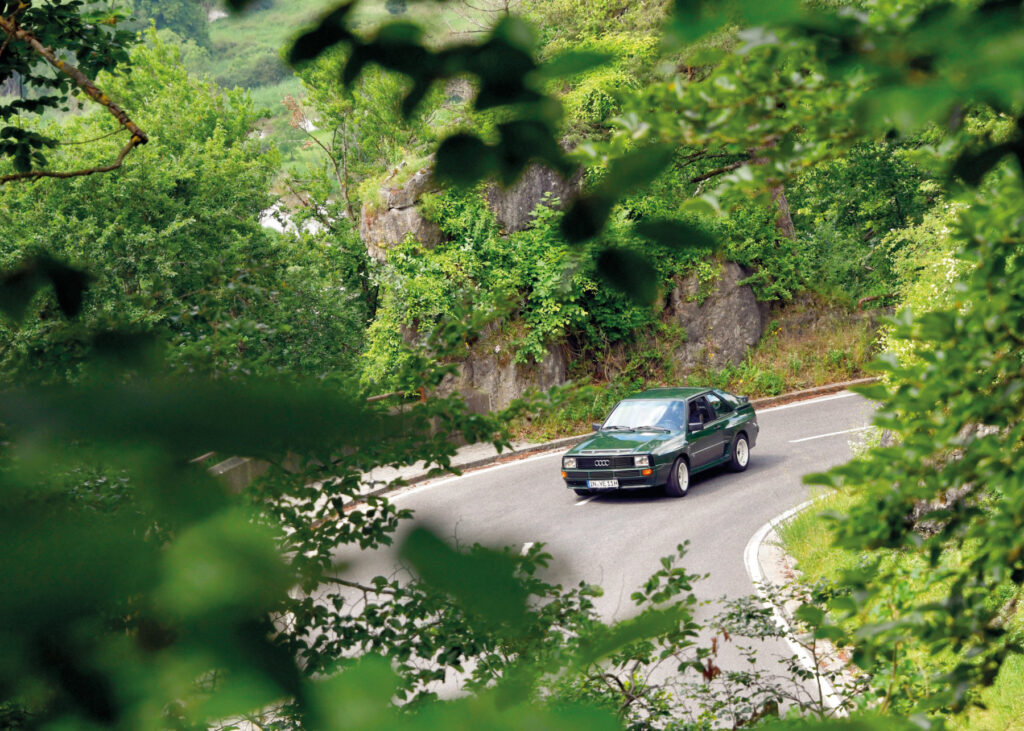
Road cars that could crack 60mph in less than five seconds were few and far between in 1984. This car’s massive Kühnle, Kopp & Kausch turbocharger hurled it to 60mph in 4.8sec, putting it in the rarefied company of Porsche’s 911 Turbo – and frankly little else.
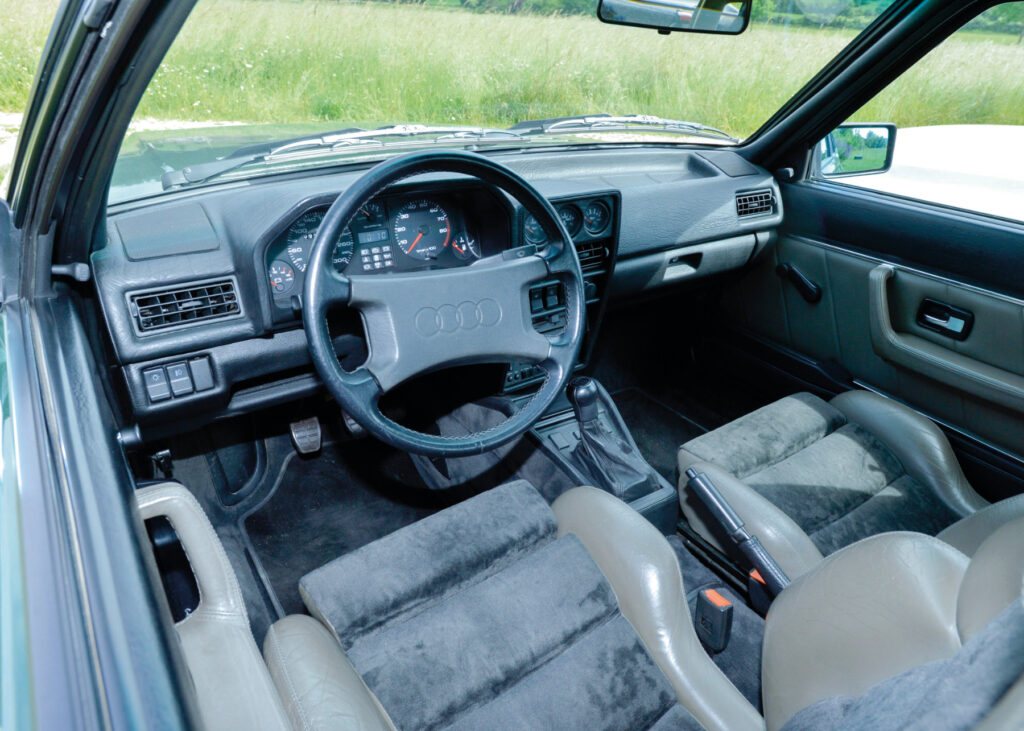
Yet it all feels remarkably civilised. The seats are comfortable, stylishly trimmed buckets. Leather swathes the doorpulls and bins. The doors shut with that dense, reassuring thunk unique to 1980s German engineering. The bespoke dashboard, reminiscent of the Audi 100 saloon, is a world apart from the ur-quattro’s blocky layout. You wonder why Audi didn’t standardise this fascia across the Coupé range.
Perhaps silenced to a degree by the forced induction, the five-cylinder engine raises its voice only enough to deliver a low-rev growl and a high-rev warble. The five-speed manual gearbox has Audi’s familiar wooden action from the period, but it shifts cleanly. The ride is firm but composed, feeling well-damped rather than harsh, keeping body movement taut while rarely jarring.
The steering feels quicker, and the shortened wheelbase delivers a noticeably more immediate turn-in. It doesn’t feel nervous, just agile – engaging yet mature, friendly even. Some have reported that it can be twitchy on the limit, but the experience here is one of confidence and composure.
That it’s four-wheel drive is rarely noticeable in normal driving. There’s no heavy understeer, no wayward tail – just a strong sense of balance and neutrality. It’s less overtly dramatic than a 911 Turbo, but more focused, more concentrated in character than the ur-quattro. The Sport quattro isn’t just a homologation special – it’s the distilled essence of Audi’s most transformative era.
Regular readers might recall Harald Demuth from Octane 157 – the man who famously drove an Audi 100 quattro up a ski jump for a television commercial. He’s also a highly successful rally driver, and was central to the development of the Audi quattro programme.
‘It was 1978. Reinhard Rode had moved from Opel to Audi. He was a close friend and there were rumours of turbos, four-wheel drive… I was with VW, but I’m a Bavarian and Ingolstadt was much closer to home,’ says Harald. He’s still lean and spry in his seventies, twinkle-eyed behind frameless glasses, joining this video call before heading off on a cycling holiday in the Alps.
‘My contract began on 1 January 1979, actually with the press department – Audi Sport hadn’t even been invented yet. They were building a car in the cellar with four mechanics. I was taken on with Freddy Kottulinsky, who won the 1980 Paris-Dakar Rally with Gerd Löffelmann.’ That was in a VW Iltis prepared by Audi – an important part of the quattro story, as detailed in Octane 202.
The first true quattro, by any other name, was a heavily modified Audi 80 with a turbocharged five-cylinder, a reversed rear axle at the back, and a centre differential.
‘We tested it in Algeria. I was driving and it caught fire – the whole car was burned out. The next day, Ferdinand Piëch arrived and demanded to know why he couldn’t test it. “Why did you not stop the fire?” he asked. “I’m just happy to be alive!” I told him. From then on, every car had to have a fire extinguisher!’
Even in the earliest tests, it was clear that the quattro concept would be transformative. ‘It wasn’t just the four-wheel drive. The power was something else – completely new. We did so much endurance testing, long runs on the autobahn at night. “Please come back with 1000km,” Piëch would say.’
Ferdinand Piëch, famously Ferdinand Porsche’s grandson, had joined Audi in 1972 after time at both Porsche and Mercedes. By 1975, he was on the board, driving Audi’s push to rival BMW and Mercedes-Benz through advanced engineering. The five-cylinder engine came first, followed by improved aerodynamics (notably the Audi 100 C3), and then quattro.
It was Audi engineer Jörg Bensinger who proposed applying the Iltis’s four-wheel-drive system to a production car. Walter Treser, Piëch’s direct report, championed it for competition.
‘The problem was, we couldn’t ask anyone for advice,’ says Harald. ‘We had to invent it all. Nothing else had a turbo and four-wheel drive. We had problems with the brakes and suspension. With a centre diff, you got the same rear braking whether or not you needed it. A lot of testing was about solving that.’
‘We needed drivers who were fast and consistent. I worked with Jürgen Stockmar – he later became Audi Sport’s chief engineer. I’d give him lots of feedback, but he’d always ask: “Are you faster or slower?” That was it. Every time. And eight out of ten times, if I said “faster”, I was. “You’re a great test driver,” he told me.’
When the Sport quattro was in development, Audi tested three different wheelbases. ‘We went with the middle one. It was the better car, easier to handle,’ Harald recalls. ‘The aero on the E2 was a big step, and the more powerful engine was fantastic. You could see out of those cars much better too.’
It’s only fitting that the last word on the Sport quattro should come from the man who drove it in Group B’s final WRC outing – the 1986 RAC Rally, for David Sutton.
‘I wasn’t a big fan of how it looked back in 1984. I thought the ur-quattro looked better. But this car was designed to perform – not to win prizes at Pebble Beach.’
Got it in one.