Audi’s Quattro rightly takes the credit for a lot of things. It transformed rallying while also laying the foundations for four-wheel-drive performance cars. Far less celebrated is that it killed Mercedes-Benz’s plans for an assault on the World Rally Championship with its upcoming 190E, though that ultimately led the company down a different racing route. The eventual result was this bonkers-looking Evolution II model, which pushed the Group A category to its limits by 1992.
Development of the Group A homologation 190E 2.3-16, along with its Cosworth-developed M102 16-valve engine, was far enough along for Mercedes to put the road car into production despite abandoning its rallying programme. It subsequently built the minimum 5000 road cars required for homologation in the hopes that a few privateer teams would take it racing.
It was the perfect motorsport candidate: advanced five-link rear suspension (with self-levelling), plus the tough and tunable Cosworth engine, and it was inherently well-balanced: privateers didn’t take long to prove the concept. Even without factory support, the 190E was a serious contender in the 1986 DTM Championship, and by 1987 it was the car to beat. Of course, then BMW’s E30 M3 came along, and that was all the provocation Mercedes needed. It offered factory support to many of the teams, and pulled in AMG as an official partner too. With Ford and Opel joining the fray, things started to get a lot more exciting and Mercedes had to make significant changes to stay competitive…
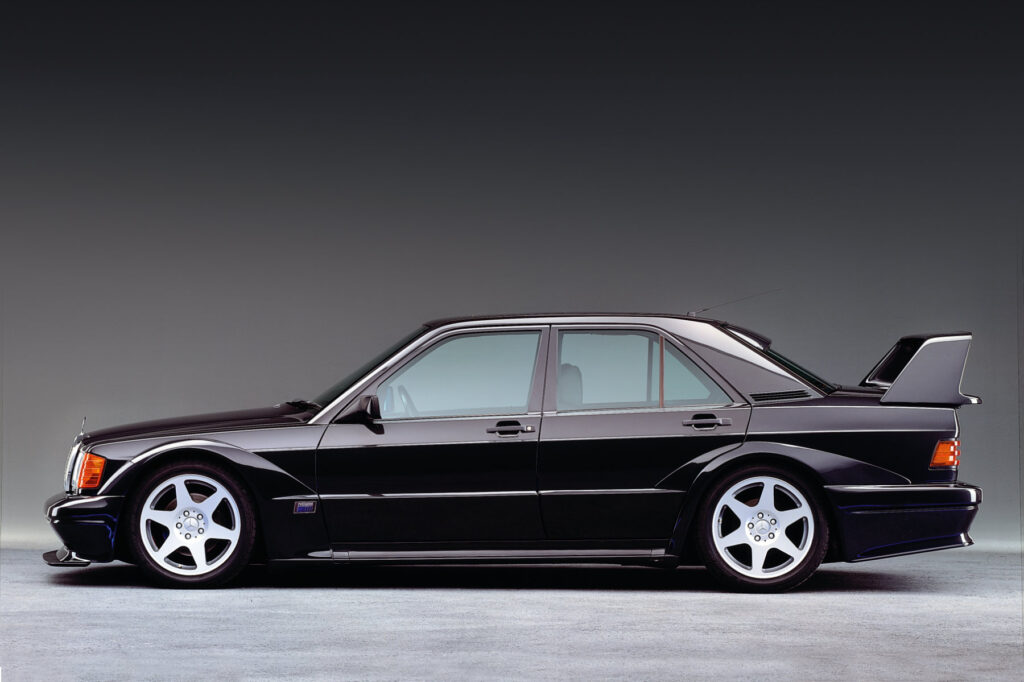
We’re at Immendingen, just outside Stuttgart, one of Mercedes’ biggest and most modern testing facilities, to get acquainted with the final and most extreme result of those changes. You’re looking at the 190E 2.5-16 Evolution II from Mercedes-Benz Classic’s collection. It’s one of only 502, and there’s no mistaking what it was built for: winning races.
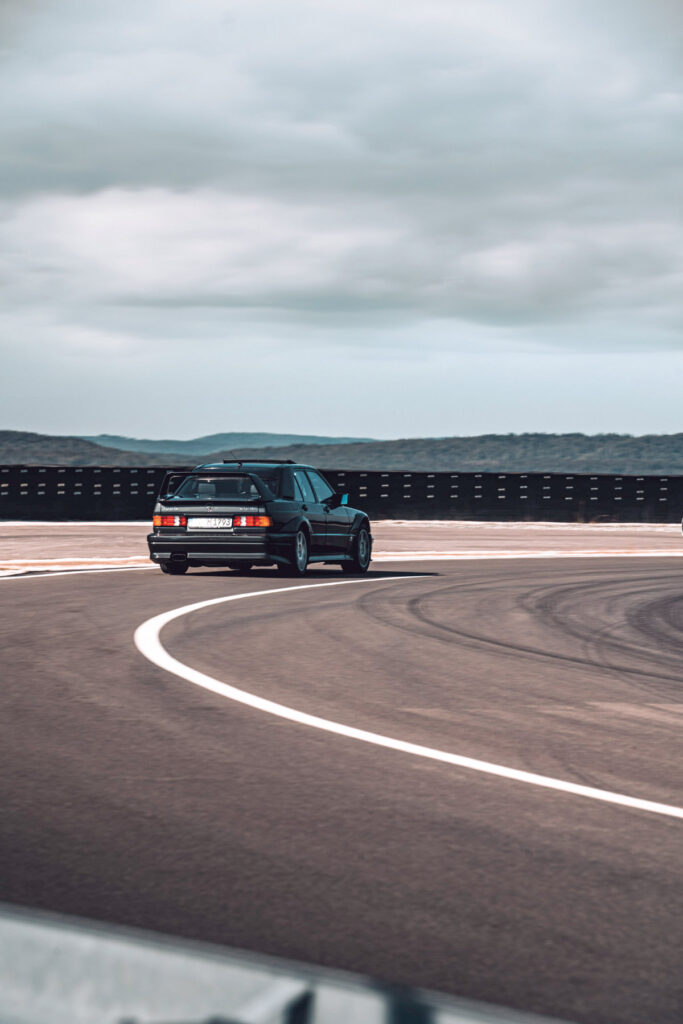
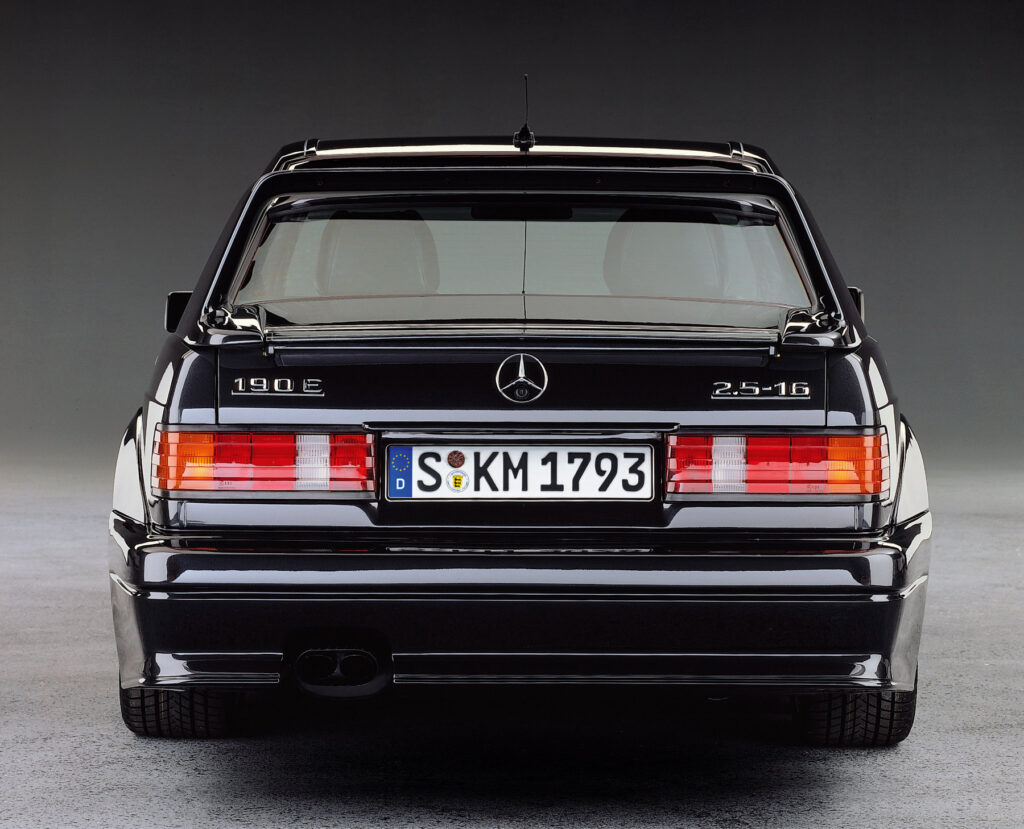
Its extreme bodykit looks at home in the pitlane of this technical circuit, but the absurdity of its styling soon sinks in. In the context of conservatively styled German saloon cars of the early 1990s – especially those from Mercedes – it would have looked utterly outlandish on the autobahn. Even compared with today’s more lairy road cars, this 190E is at the crazy end of the scale.
How did Mercedes get to this point? Surprisingly, the roadgoing 2.3-16 was a sales success following its launch in 1984, with just shy of 20,000 produced before the updated 2.5-16 was unveiled in 1988. Although it coincided with the DTM announcement, the introduction of the 2.5 had nothing to do with homologation and more with improving the 190E’s refinement, torque and performance in light of the E30 M3. To fight for the DTM Championship, Mercedes-Benz came up with a package of racing modifications, which required a further run of 500 ‘Evolution’ road cars. This first Evo model surfaced at the Geneva motor show in 1989 and, visually at least, stayed close to the standard road car.
At first glance, the uninitiated would scarcely notice the subtle wheelarch extensions or deeper front and taller rear spoilers. Slightly larger yet low-key 8x16in alloy wheels allowed larger brakes – and, more importantly, opened up the race teams’ choices, as they could only run wheels up to two inches larger than the standard road car’s. More meaningful changes happened beneath the surface.
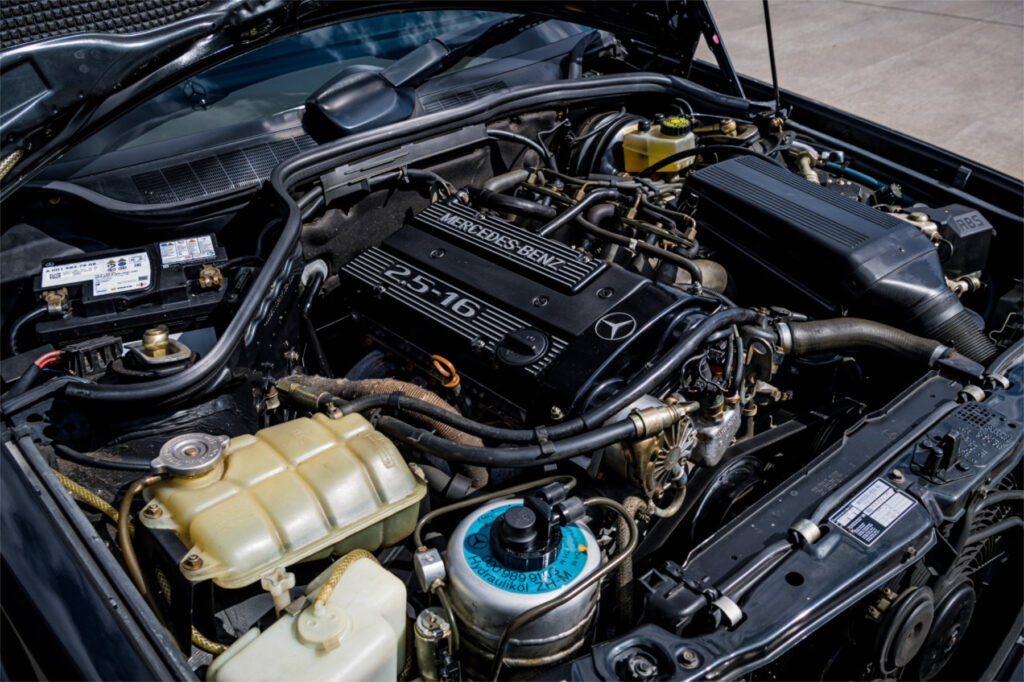
Cosworth was brought back to further develop the engine and, as the brief had changed from rallying to circuit racing, it was re-engineered with a larger bore and shorter stroke. Lightweight pistons and an uprated oil system were specified, which resulted in a slightly smaller 2463cc engine capacity, down from the standard car’s 2498cc. In road form, power and torque figures were hardly different, at 204bhp and 177lb ft, but the engine could rev much more freely, with greater top-end potential. An AMG-developed ‘Power Pack’ was optional, too, liberating 231bhp via uprated camshafts, plus a larger throttle body, inlet manifold and exhaust manifold: the race teams managed to push it beyond 300bhp.
The five-speed ‘dogleg’ Getrag gearbox was unchanged although, as with the standard 2.5-16, its ratios were taller to improve top speed. New three-way height-adjustable suspension sat it lower to the ground, and a quicker steering rack made it more nimble.
Offered only in left-hand drive and a single shade of blue-black, a total of 502 were built – and sold out almost instantly. The changes helped to get the 190E back on the pace in the 1988 DTM series, though BMW still took the title. Clearly, yet more work was needed…
And so the second Evolution model was underway towards the end of 1989. The engine was fundamentally unchanged, although the AMG power pack became standard and, to give the racers yet more wheel and brake options, the wheel size was increased to 17 inches. But if Mercedes wanted to win, the 190E would require some radical aerodynamic work, which is where the University of Stuttgart’s aerodynamics expert, Professor Richard Eppler, came in. And, unlike with the Evo I, it doesn’t take an expert to spot the changes!
Up front there’s a smoother bumper, with a much lower, adjustable splitter. This feeds into more sculpted wheelarch extensions and side-skirts, plus a matching rear bumper. Its party piece is the huge rear wing, though a cheeky piece of trim had to be added to the top of the rear window, to reduce its size slightly and so get around a rule that the wing shouldn’t obscure the driver’s view.
All Mercedes had to do was homologate it with a further 500 roadgoing versions – and all sold immediately on its launch at Geneva in 1990 – despite costing 50% more than a standard 2.5! All 500 were painted in the same shade of Blauschwarz as the Evo I. Two further cars were built in Astral Silver, one given to AMG and the other kept by Mercedes-Benz.
The aerodynamics dramatically increased the amount of downforce generated at racing speeds, while at the same time reducing the drag coefficient to 0.29Cd from the standard car’s 0.33Cd figure – but was it enough for Mercedes to win the DTM series?
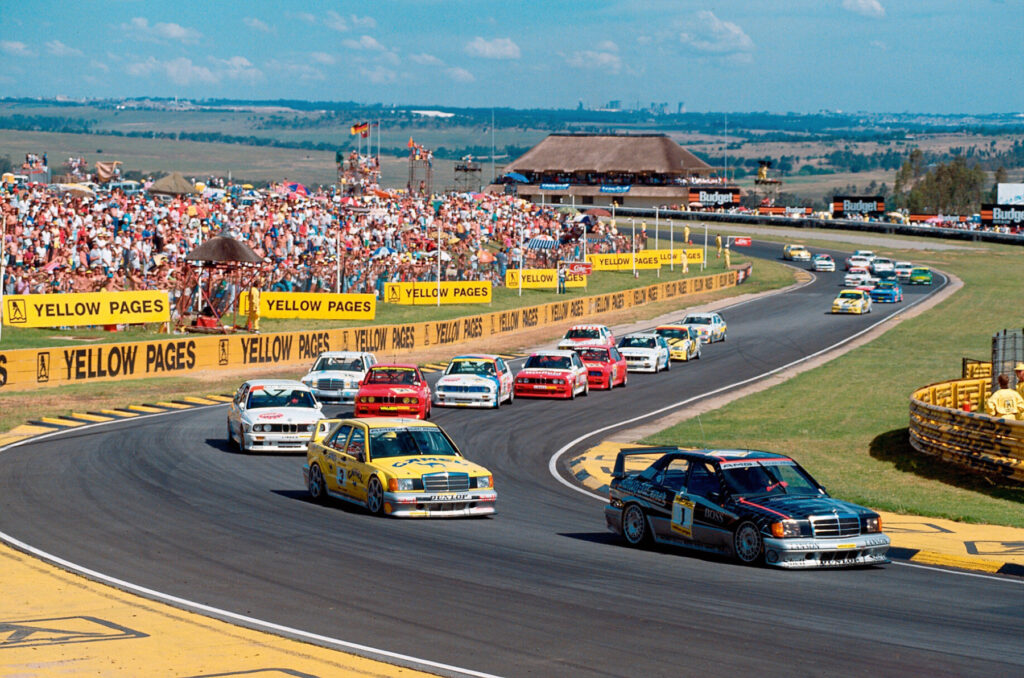
The first Evo IIs hit the circuit in 1990, and competition was fierce. BMW’s E30 was still the hottest contender, as Ford’s Sierra RS500 had found itself outlawed, though Audi was suddenly in the picture with a Group A version of its four-wheel-drive V8 saloon. The Evo II got off to a poor start, though it showed great potential. The 1991 season was extremely closely fought, yet BMW still managed to steal the Championship in the final round.
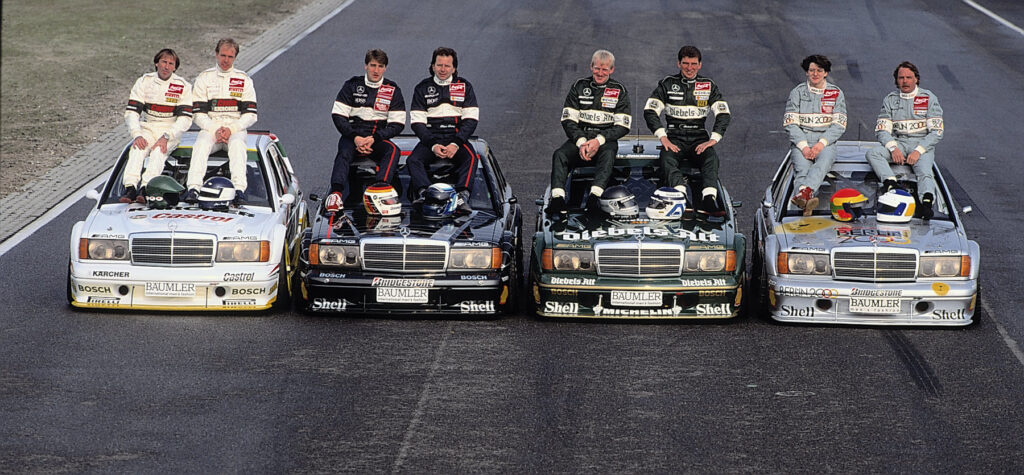
A final chance came in 1992, which signalled the end of Group A regulations in DTM. By then the Evo II was producing up to 360bhp thanks to better race fuel, and Mercedes’ works-supported teams were full of top-tier racers such as Jacques Laffite, Bernd Schneider, Klaus Ludwig and Keke Rosberg. Mercedes took 16 of 24 possible victories, with Ludwig’s AMG-team Evo II taking five of those – and the Championship. Mercedes had won at last!
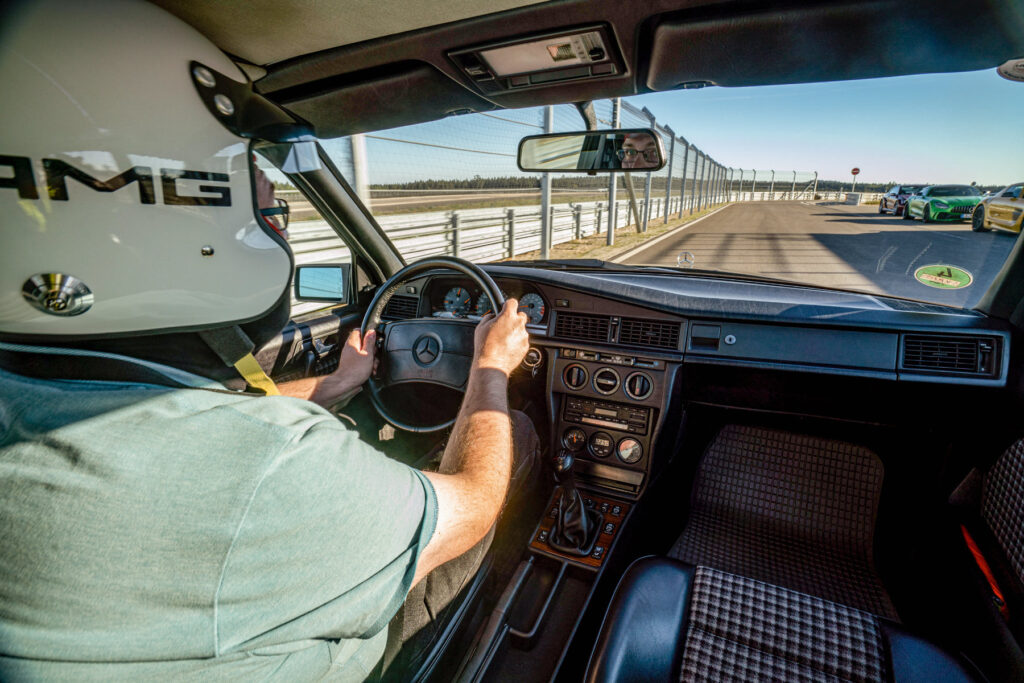
So the 190E had proven itself, and all of Mercedes’ efforts were finally rewarded. Now here I am, nearly three decades later, to experience it for myself. This beautiful example is straight out of Mercedes-Benz Classic’s immense collection and, like many of these highly collectable cars, it has led a sheltered life: box-fresh with its original road-spec cloth and vinyl interior, and little to distinguish the dashboard from an ordinary 2.5-16’s, or even a standard taxi-spec 190D’s. A small figure on the gearknob signifies the build number, and that’s about it. In a way, it’s the normality within that makes the Evo II even more absurd than its ridiculous rear spoiler would suggest. It’s a car of multi-faceted character, which is echoed by the driving experience.
I fire up the engine and there are no theatrics; it ticks over with the decorum you’d expect of any older Mercedes. It’s quiet, too, with a deep yet civilised burble from the exhaust. The delightfully crisp throttle suggests things are a little different from a standard 190, though the recalcitrant dogleg gearbox and obstructed rear view are equal indicators.
As you set off, the chassis feels softer than the extreme looks suggest it should be. Even at low speeds roll is quite noticeable, although far from excessive, and the amount of body movement over bumps comes as a bit of a surprise. The steering is light and there’s just enough immediacy to make the car feel responsive. It feels well-planted and composed on the higher-speed corners, and its inherent balance is astonishing.
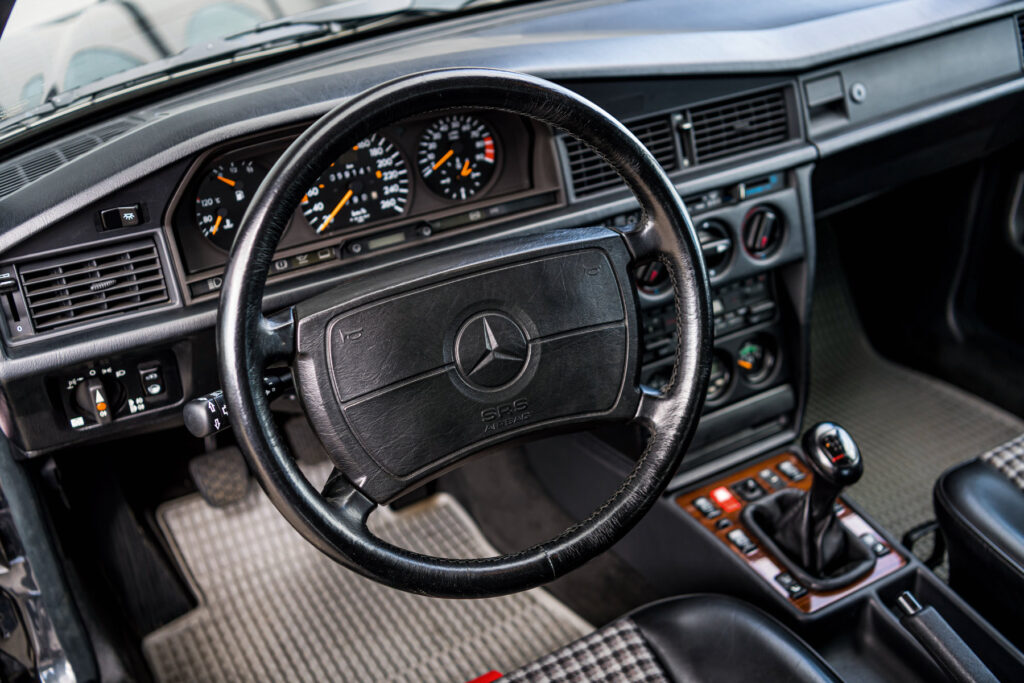
That Getrag ’box isn’t a particular joy to use, but this was a criticism of the 190E Cosworth generally when it was new. Some are reportedly better than others, and this lightly used example would probably feel slicker with a few more miles on it.
Get some revs on that 2.5-litre engine and it really comes alive. From about 3500rpm the induction roar is glorious, and it pulls strongly to well beyond 7000rpm. As is often the case with revvy four-pots, it takes a bit of effort to wake the car up, but, when it gets going, the steering, suspension and even the gearbox start to come together. The compliance in the chassis is matched with exceptional poise, which begs you to push harder and faster. The engine is so willing to rush to the redline that it’s easy to see why it made the perfect starting point for a 10,000rpm race-spec screamer.
In typical Mercedes style, there’s little in the way of drama yet there’s no denying the Evo II’s pedigree. There are many great Group A homologation specials out there, and this is surely one of the most exceptional. Just looking at that rear wing, and those arches, it’s easy to see why these cars have become such a firm favourite with collectors. Don’t let the spoilers and bodykit deceive you, though; this car is every bit as gentlemanly to drive as any Mercedes-Benz should be, which makes it all the more peculiar. This is a DTM racer in which you really could take the family shopping.
1990 Mercedes-Benz 190E Evo II specifications
Engine 2463cc DOHC four-cylinder, 16-valve, Bosch electro-mechanical fuel injection Power 232bhp @ 7200rpm Torque 173lb ft @ 5000-6000rpm Transmission Five-speed manual, rear-wheel drive Steering Recirculating ball, power-assisted Suspension Front: double wishbones, coil springs, telescopic dampers, anti-roll bar. Rear: multi-link, coil springs, telescopic dampers, anti-roll bar, hydropneumatic self-levelling Brakes Discs, ABS Weight 1320kg Top speed 155mph (electronically limited) 0-60mph 7.1sec