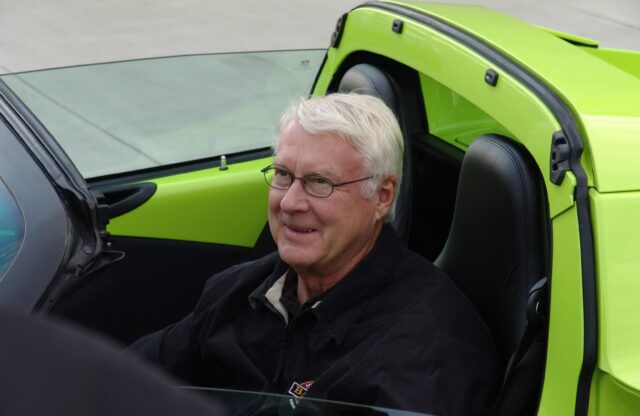
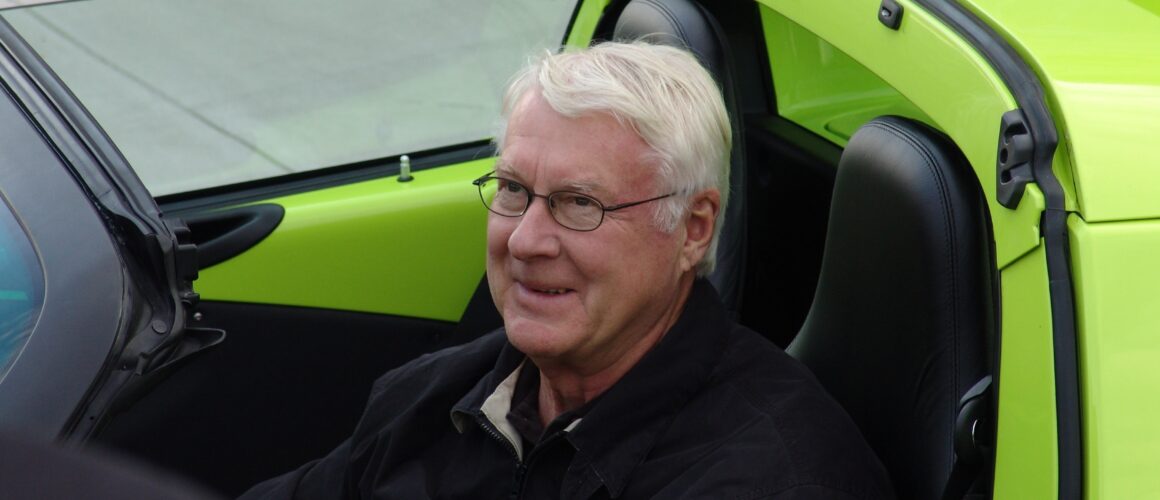
George W. Barber Jr., founder of the Barber Vintage Motorsports Museum and creator of Barber Motorsports Park in Birmingham, Alabama, has died aged 85.
Born in 1940, Barber built his early career in business, expanding the family dairy company into a major regional enterprise before selling Barber Dairies in 1998. Yet it is in the world of motorsport that his name will resonate most strongly. Over several decades he channelled his resources, competitive instinct and eye for detail into creating one of the most remarkable privately funded racing and museum complexes anywhere in the world.
Barber’s own competition career began in the 1960s. Racing across the American South, he amassed 63 victories and competed against established names such as Dan Gurney and Peter Gregg. Following the death of his father in 1970, he stepped back from driving to focus on the family business, but his enthusiasm for motorsport never waned.
In the late 1980s he turned his attention to collecting, and what began as the restoration of a handful of motorcycles soon developed into a full time endeavour – to assemble the finest motorcycle collection in the world. The Barber Vintage Motorsports Museum opened in 1995 and has since grown into a 230,000-square-foot architectural landmark, housing more than 1600 motorcycles alongside a significant collection of Lotus racing cars.
Adjacent to the museum lies Barber Motorsports Park, a 2.38-mile circuit sculpted from Alabama terrain. Designed by Alan Wilson, with input from John Surtees and Carroll Shelby, the track quickly earned a reputation for its flowing layout and immaculate presentation. Barber once described his ambition as creating ‘a botanical garden with a race track in it’, a phrase that neatly encapsulates the balance between aesthetics and competition that defines the venue.
Today the park hosts major international events including IndyCar, while the museum operates as a non-profit educational institution, preserving and restoring historic machinery and inspiring thousands of students each year. In recognition of his contribution, Barber was inducted into the American Motorcycle Association Hall of Fame in 2014.
Though he never married, Barber was widely regarded as a generous employer and benefactor, supporting dozens of organisations across Alabama. For enthusiasts worldwide, however, his lasting legacy is the extraordinary campus he created – a place where engineering history is not only displayed but maintained in running order, ensuring that future generations can experience the sights and sounds of racing’s past.
Barber’s Shop
In 2016, Octane met the man behind the Barber Museum, home to the world’s largest Lotus collection and more than 1400 motorcycles. Here it is in full…
Words Rachael Clegg
Photography Erick Runyon
You could say that, when George Barber decided to start a motorcycle collection, he got a bit carried away. The dairy processing tycoon – based in Birmingham, Alabama – started collecting bikes in 1989 and has since established one of the world’s largest motorcycle collections.
To house his armoury of exotic machines, Barber built a state-of-the-art museum so awe-inspiring it could give the Guggenheim a run for its money. It’s nestled within 740 acres of beautifully landscaped parkland, which cuddles Barber’s specially designed race circuit. The track is used by Porsche and Mercedes-Benz for testing, as well as for the Indy Grand Prix, but on days when it’s free, around noon, the museum takes one of its machines out for a blast.
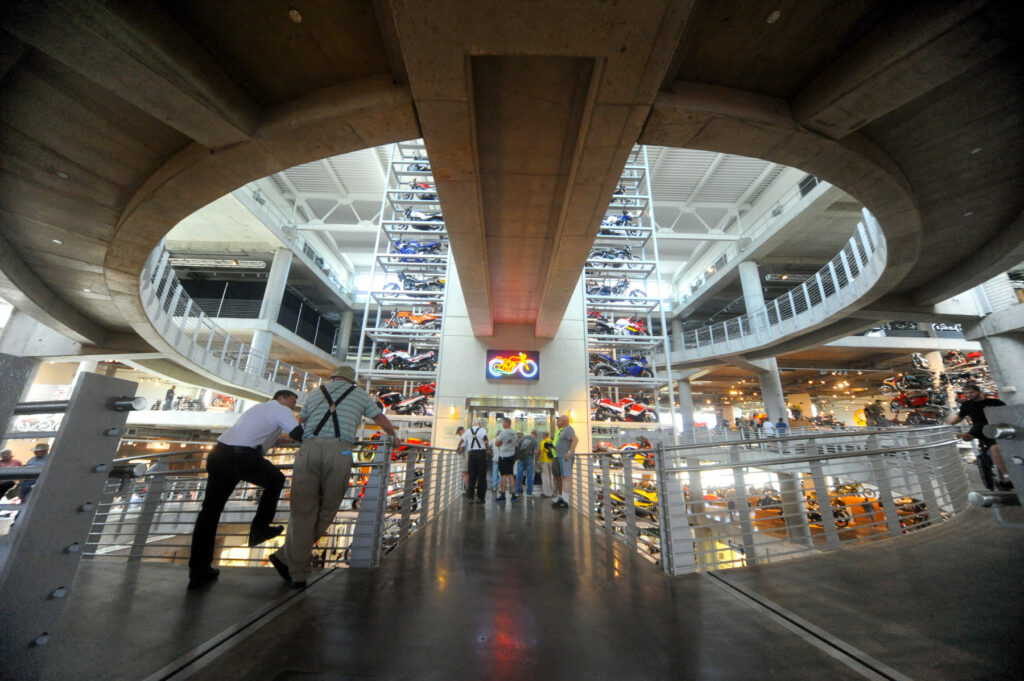
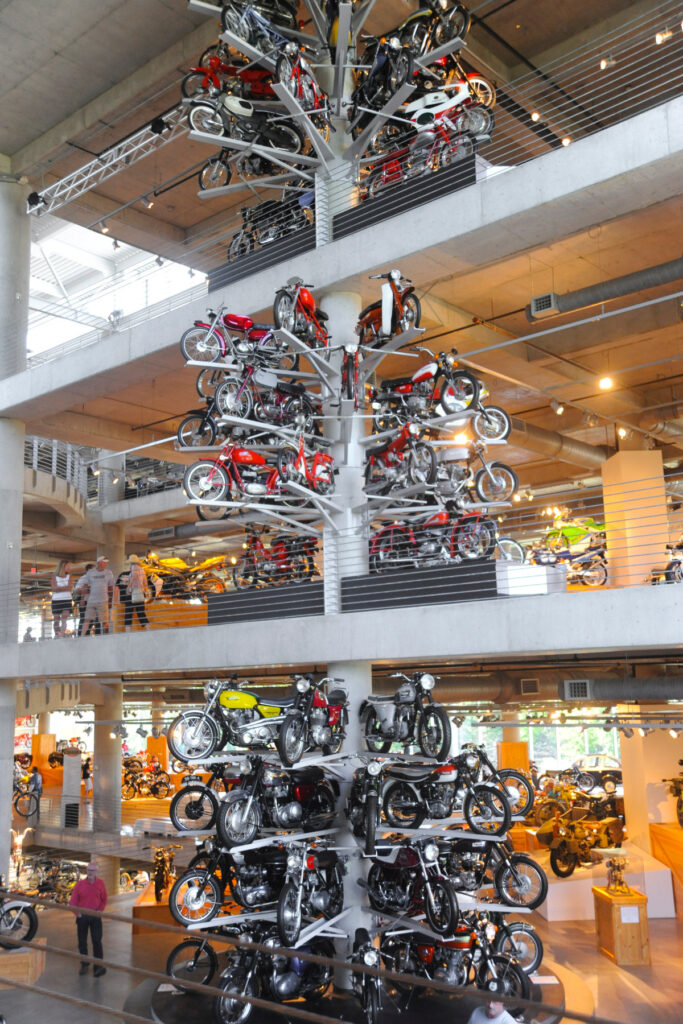
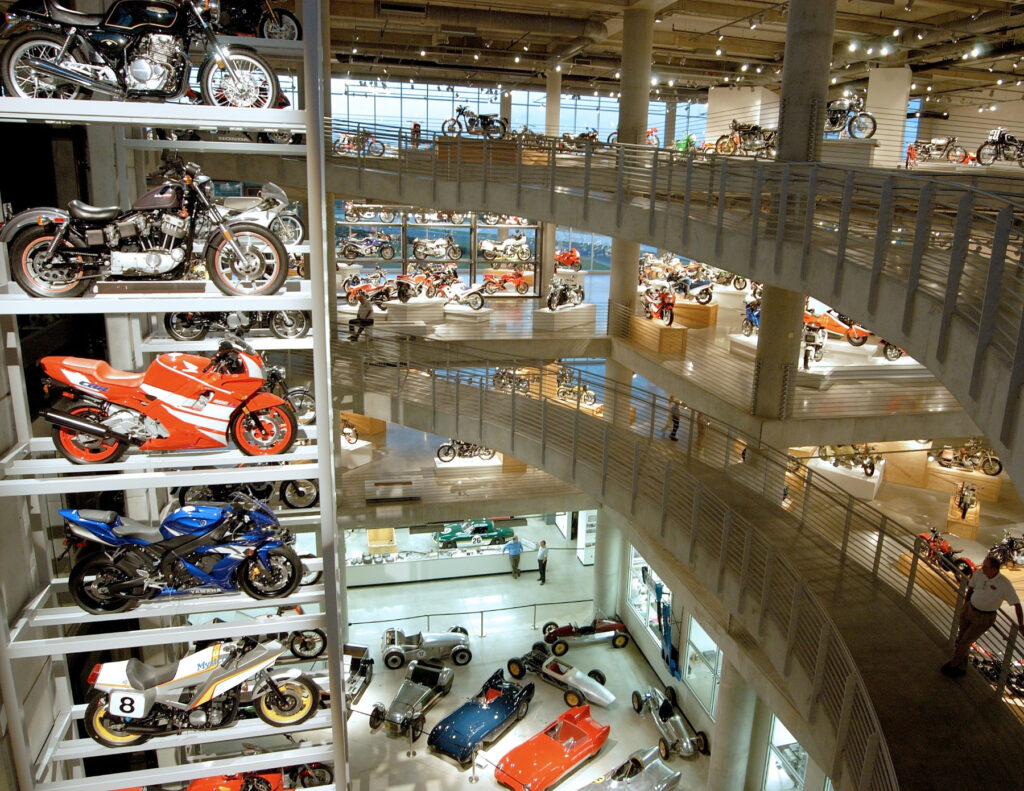
The lobby of the Barber Vintage Motorsports Museum is a sight to behold: an enormous tower of motorcycles dominates, clutching either side of the elevator shaft – which is big enough to accommodate a Formula 1 racing car – while other machines hang on mobiles, rotate on huge discs or stand like statues on massive plinths. If the Barber Motorsports complex is the collector’s Acropolis, then this is its Parthenon.
Everything in the museum – so it claims – can ‘run within the hour’, thanks to a 20-strong staff, many of whom are restorers and mechanics. This team works from a basement complex of glass-fronted workshops. Mouldings for racing bikes hang from the wall like hams in a Spanish bar, while elaborate machining powers away, returning classic bikes to their former glory. Here, Barber claims, staff can ‘certainly build a bike from scratch’.
And then there’s the circuit, designed by Alan Wilson in consultation with the late Carroll Shelby and John Surtees, a close friend of Barber.
‘While we were designing this track I would send a particular corner to Carroll Shelby or to John and they would say either “Open the kerb up a little bit” or “Give it a little bit of camber there”,’ Barber says.
This proved an interesting insight for Barber. ‘For me it was fascinating for John to look at a corner and be able to understand how a car was going to behave either by changing the camber or opening up or tightening it up a little bit. He was very helpful.’
The fact that Surtees was a champion on both two wheels and four was also a benefit. ‘He looked at it from the perspectives of a four-wheel guy and a two-wheel guy and that was very good.’
The track was formed from rough Alabama terrain and took around two years to complete. ‘We moved about two-and-a-half million cubic yards of dirt to make the track and put it in another place,’ says Barber. Those cubic yards now form the soft, undulating hills that have given it its nickname: ‘the Agusta of race circuits’.
But there’s also a whiff of the surreal to this 2.8-mile circuit. Huge replica spiders and ants lurk around corners, one of which clutches a motorcycle racer.
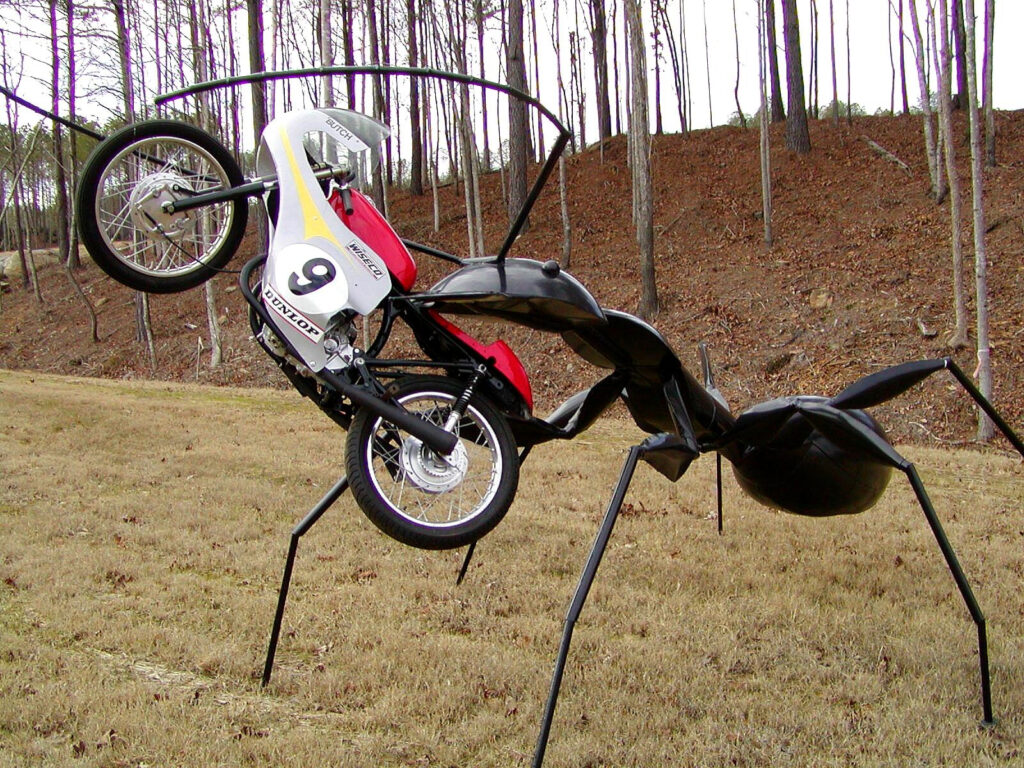
‘When we first started building this racetrack the so-called environmentalists – they really weren’t environmentalists at all – started to attack us. They were people who wanted to stop growth of any kind and they were quite vicious in their attacks, both personal and corporate. Everybody here got kind of depressed and I thought “We’ve got to do something to get people interested in finishing this job”, so I built the spiders, the giant ants and the dragonflies and I put them around the track.’
The grand finale for the environmentalists was much more public. ‘I called the press and I said “Gosh, look at this – the environmentalists were right: these critters came out here and drank this water and look at what happened to them!”’ The press had a good laugh and realised how ludicrous the attacks were, and the opposition eventually backed off.
Barber still delights in his super-sized creatures. In his polite southern drawl, he says: ‘We love to tell people about our serious insect problem; we ride along and I’ll say “Oh my gosh, look over there – the ants have got another motorcycle rider!”’
All this – the giant ants, the Surtees-consulted circuit and the 144,000 cubic-foot museum – came about thanks to a fortune gained from dairy products and the rather whimsical suggestion of a Barber employee.
Barber’s business, Barber Dairies, was established in the 1930s by his grandfather, also named George Barber. The company housed its own ice plant, generating enough ice to keep milk, buttermilk and cheese cold in its delivery trucks at a time when only an eighth of white-collar homes owned a refrigerator. With this edge, Barber Dairies quickly became the state’s dairy leader and soon started delivering to Florida, Mississippi and Georgia.
By the late 1940s and 1950s, the current George Barber was delivering milk every day after school and during the holidays.
‘It was tough, hoppin’ those trucks and delivering milk. We’d see up to 200 customers a day. I was just a helper but to a kid a couple of those half-gallon jugs of milk were pretty damn heavy.’
While his friends were playing, Barber was working. ‘My family sure got their money’s worth out of me, I guarantee you that.’
Grandfather Barber wasn’t only a shrewd businessman; he also helped establish the US Public Health Service Grade A Pasteurized Milk Ordinance and introduced the wax-coated carton. The business kept growing, eventually even operating its own truck rebuilding facility. And it was here that the seeds of the Barber Vintage Motorsports Museum were sown.
‘We had our rebuild facility and, as I was beginning to wind that down, the man who was working there said “Let’s do a bike or two.” The bikes worked out so I bought a couple more and we restored them as well. What fascinated me about bikes compared with cars was the fact you could see the engineering; you could see, for example, how one man did cylinder heads compared with another man on the next bike.
‘Then I realised I could probably put together the best motorcycle collection in the world and have a hell of a lot of fun doing it.’
A true Alabamian, Barber wanted to keep the museum in Birmingham. ‘I love my city. In Alabama we have a larger potential for inland waterways than any other state in the Union, we also have miles of frontage on the Gulf of Mexico and mountains to the west. It’s a beautiful state.’
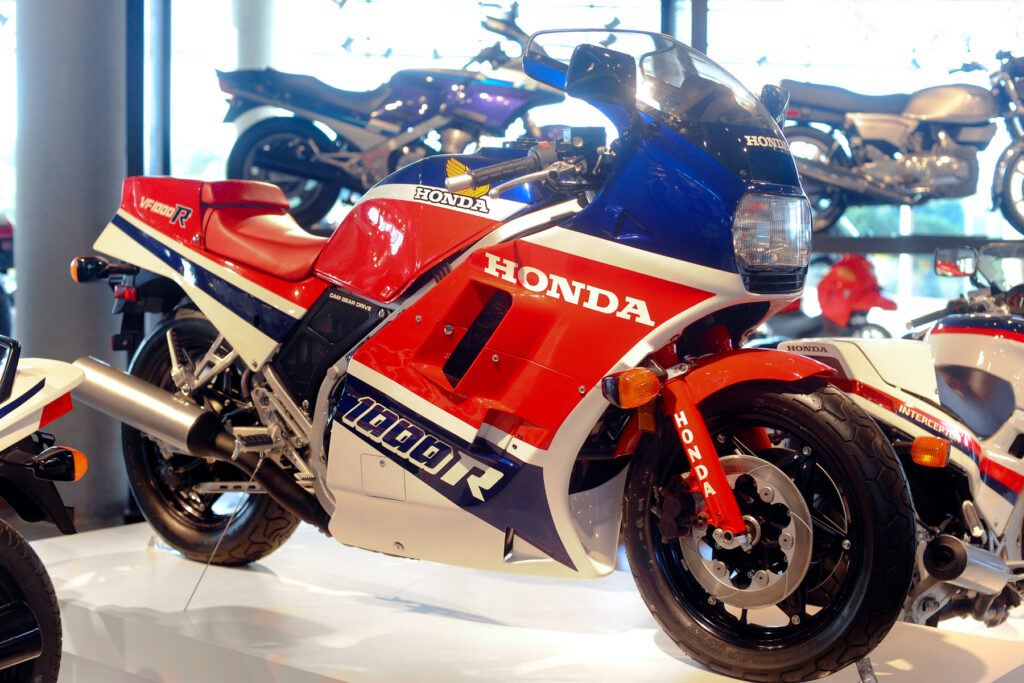
His first acquisitions – a 1986 Honda VF1000, a 1986 Honda VFR750 and a 1986 Honda VF500 Interceptor – were bought in 1989.
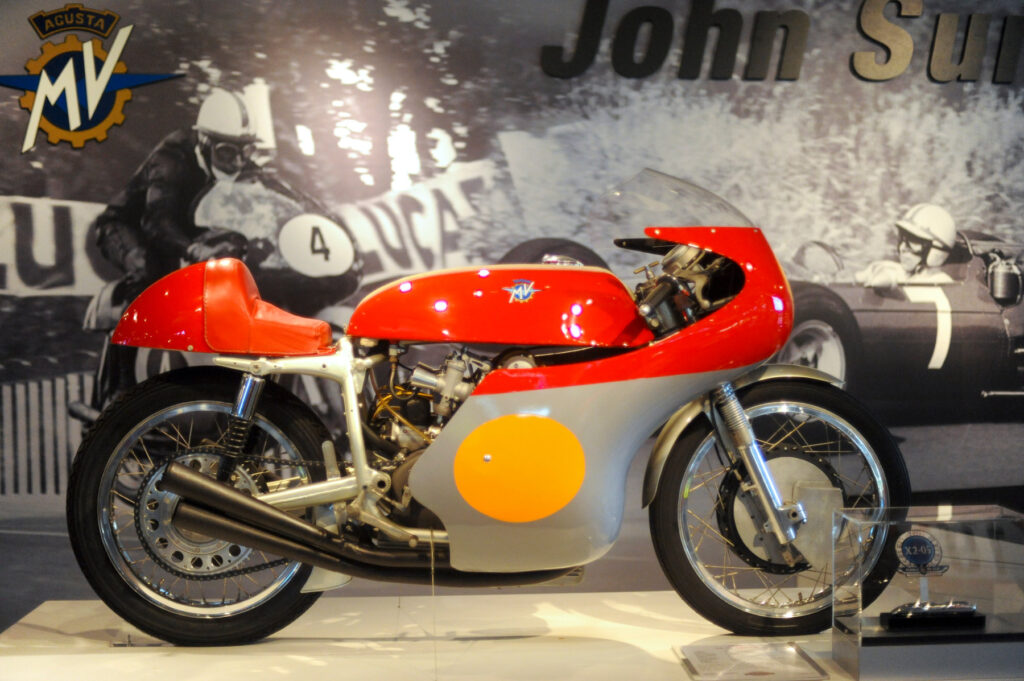
The motorcycle collection now spans more than 200 manufacturers from as many as 20 countries. Among the historically significant machines are the MV Agusta ridden by Surtees in 1956 and the Britten built by ‘underdog’ engineer John Britten in 1991.
‘The Britten is a fantastically beautiful machine and we are sad that John has gone. His bike is in the museum and people take great delight in seeing it. Visitors often study it closely and shake their head in awe.’
Barber sees all his machines as ‘children’ and insists he doesn’t have a favourite. But he does light up when talking about his 51-strong Lotus collection.
He was himself a racer in the 1960s but gave up competition to take over the family business after his father passed away. It was while trying to buy one of his former race cars that Barber began collecting Lotuses.
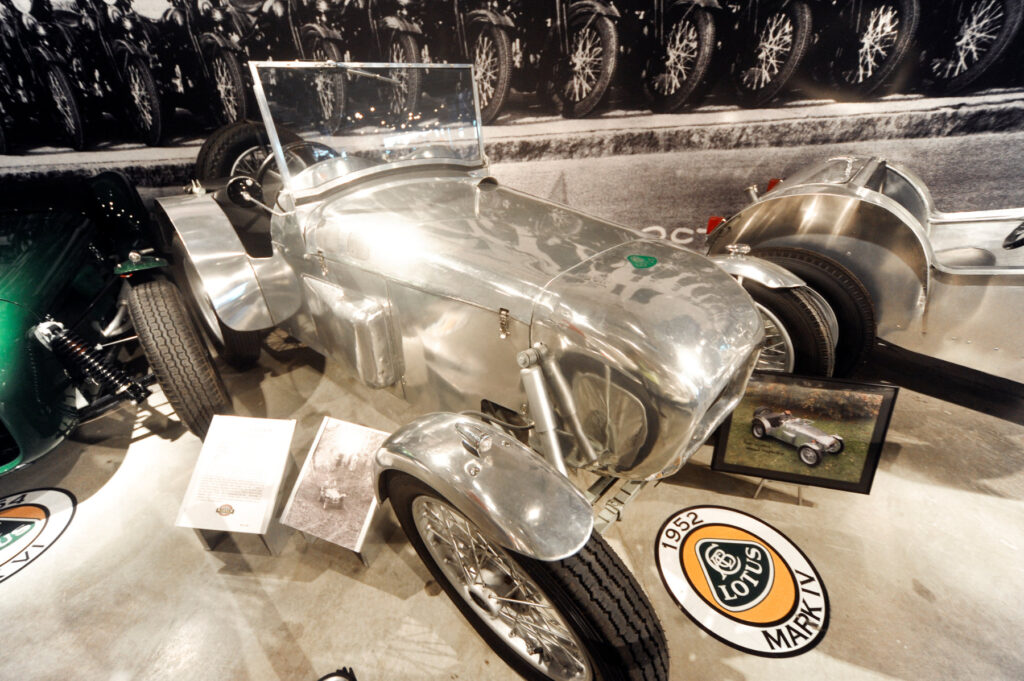
‘I think my first Lotus was a 21 with a Climax engine in it. That was back in ’61. I started looking for a few of my favourite Porsches that I raced. One was a 904 and one was an RSK, and I looked and I looked but, when I finally found them, the 904 was over a million dollars and an RSK was over a million dollars too. I sold my RSK back in the day for $4000 or something like that. It was almost $3,000,000 for two little silver cars.
‘So I thought, for that kind of money, I could put together the best Lotus race collection in the world, and I have. It’s more exciting to have a collection like that than two silver cars.’
The collection doesn’t stop at 51. ‘We’ve just bought three of the “soap box” downhill racers that were used at Goodwood. They are exquisite little cars designed by Lotus and we bought all three of them.’
Among Barber’s favourites is another Surtees machine: the 1964 World Championship-winning Ferrari 158. Surtees and Barber first met in the late 1950s, on what turned out to be one of the luckiest days of Barber’s life.
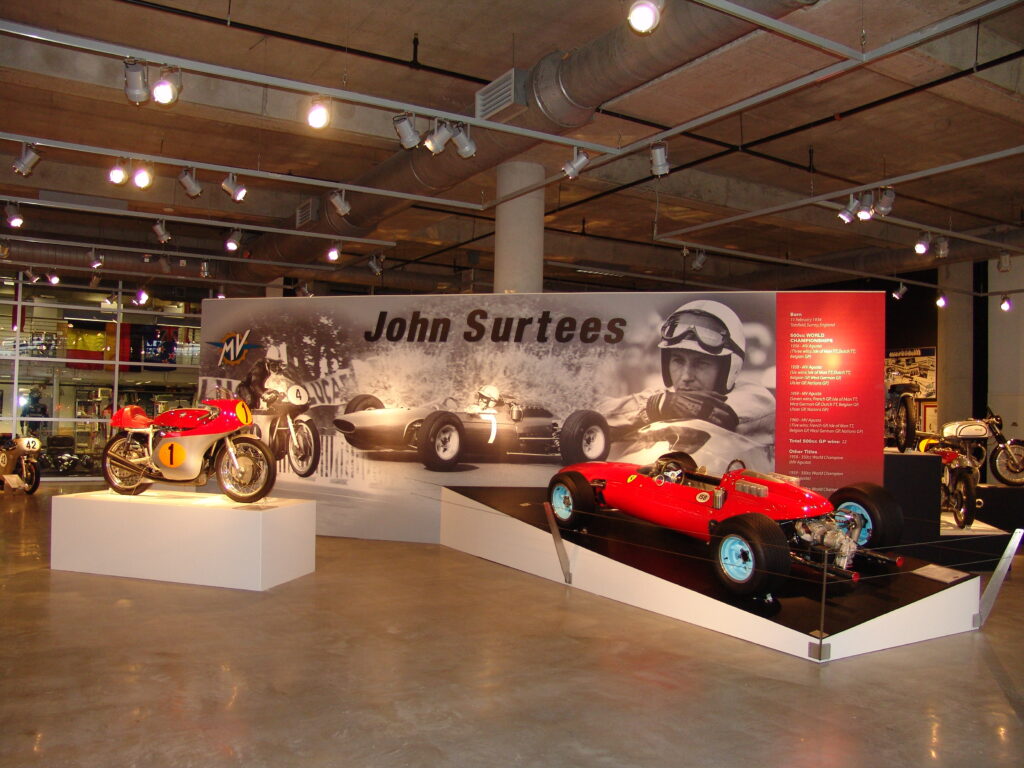
Barber had flown to the UK to watch the British Grand Prix.
‘I was on an airplane flying to England, and I was determined to go to Silverstone. I was sitting next to a very stately woman and she asked me where I was going. I said “I’m going to Silverstone” and she asked how I was getting there and I said “Well, I don’t know, but if I have to hitch-hike or crawl, I will.” She said, “Well, I’m going as well and if you would like to have a ride I would love to have you come along.”’
The next day, the lady collected Barber from his hotel. It turned out she was the wife of Peter Berthon, co-founder of BRM.
‘She put one of the mechanics’ tags on me and said “You can go anywhere you want and I will introduce you to as many drivers as I can.” I was 18 or 19 and I was about to faint.’
It was there that Barber first met Surtees.
‘I ran into John Surtees and said hello; I think he was driving a Lotus 18 at the time. Looking back now, it’s funny to think I now own the Ferrari he used to win the World Championship, but at that time I would have never imagined that.’
Today that very car sits in Barber’s own Parthenon in Birmingham, Alabama.