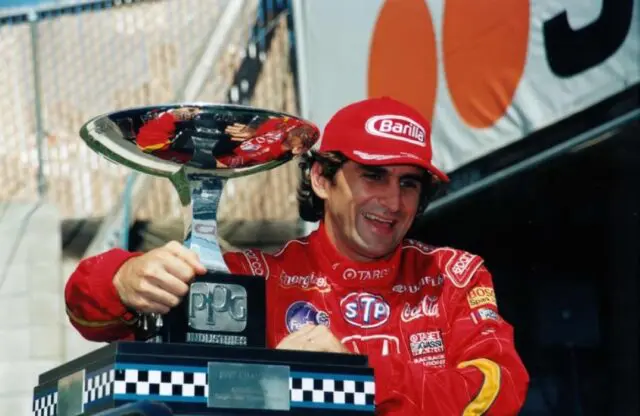
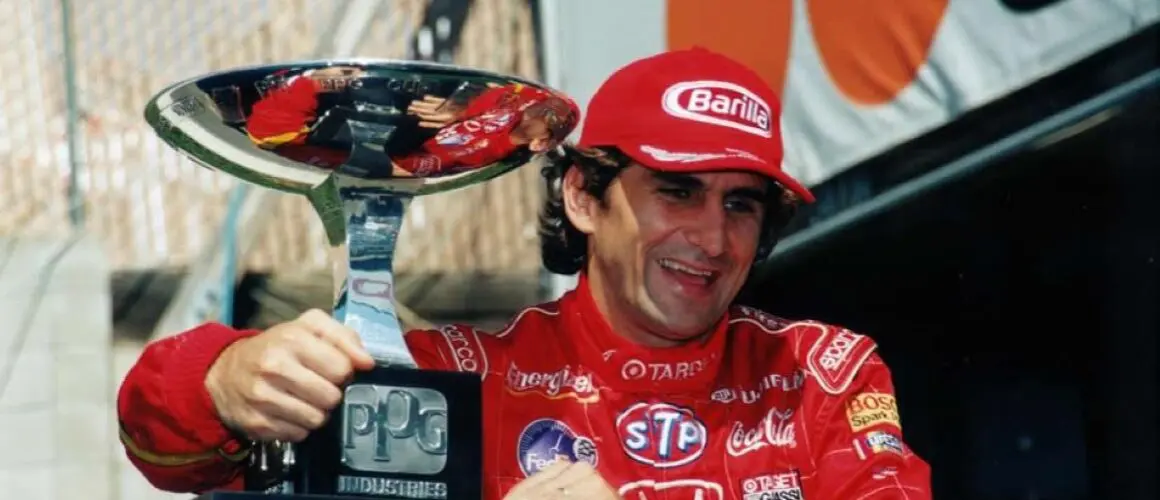
Sad news broke over the weekend, following confirmation that former Formula 1 driver and Paralympic gold medalist Alex Zanardi had died on 1 May, 2026, aged 59. He passed away peacefully at home, surrounded by his family.
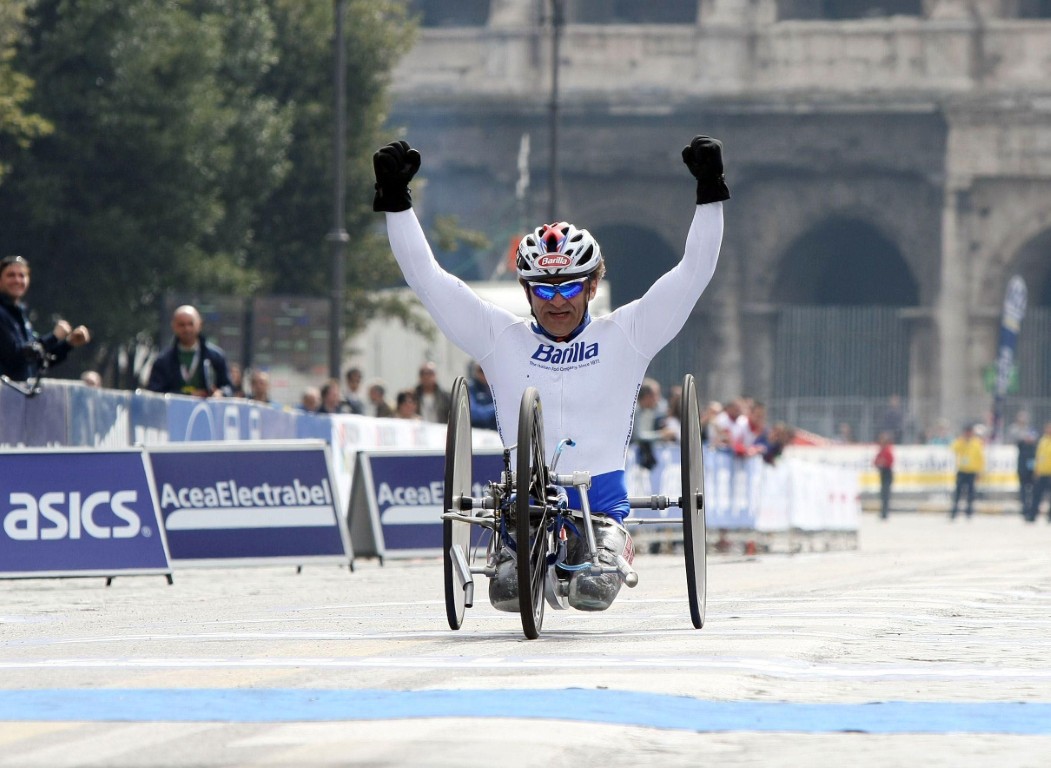
Few sporting lives have encompassed such extremes of triumph and adversity. After winning back-to-back CART titles in 1997 and 1998, Zanardi suffered a catastrophic accident at the Lausitzring in 2001 that resulted in the amputation of both legs. What followed was extraordinary – a return to motorsport that saw him win the 2005 Italian Touring Car Championship using hand controls, and a new career as a Paralympic handcyclist that brought gold medals at both the London 2012 and Rio 2016 Games.
Tragically, he was involved in a further major accident in 2020, losing control of his handbike and colliding with an oncoming truck in Tuscany. The injuries he sustained were severe, and it is widely understood that his death is a consequence of that crash.
Octane interviewed Zanardi in issue 115, shortly after his triumph at the London Paralympics, when the world was still marvelling at what he had achieved and how. We republish it here, unedited, as a tribute.
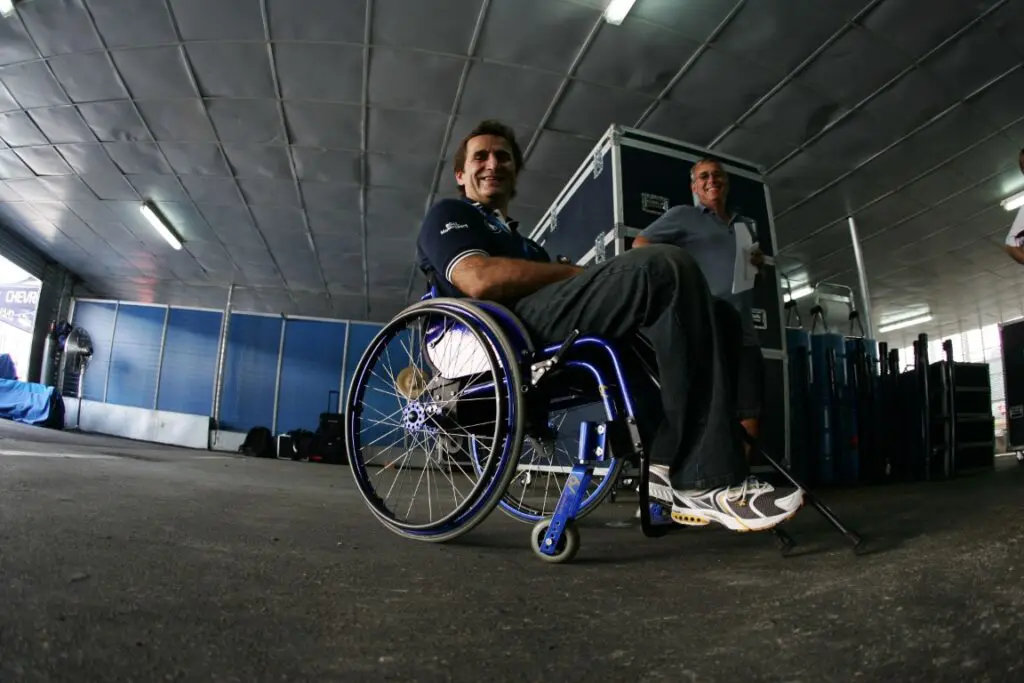
As soon as people hear you’re meeting Alessandro Zanardi, they want to let you know that they think he’s an amazing inspiration. So I’m wondering how to find out what everybody wants to know: how do you spring back from one of the most horrific crashes ever witnessed in motor racing, to then carry on racing and even compete – and win gold! – in the 2012 London Paralympics?
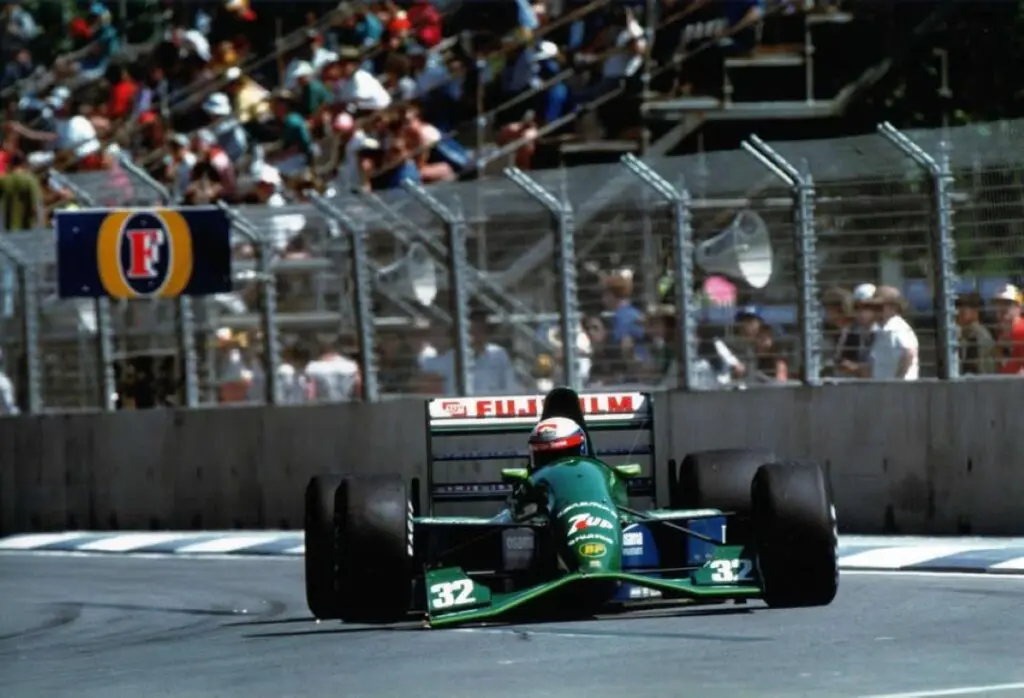
Like so many racing drivers, Zanardi’s career began in karting, in 1980 when he was 13 years old and with his father as mechanic. His talent was obvious and he graduated to Formula 3 aged 21. Success followed in Formula 3000 and in 1991 he made his Formula 1 debut, with three starts for the Jordan team. Guest drives for Minardi came in ’92, after which he tested for Benetton; in 1993 he joined Johnny Herbert at Lotus, scoring his first Formula 1 point in the Brazilian Grand Prix, but a crash in practice for the Belgian Grand Prix ended his season prematurely. Zanardi replaced the injured Pedro Lamy from the Spanish Grand Prix onwards the following season, but he failed to score any points.
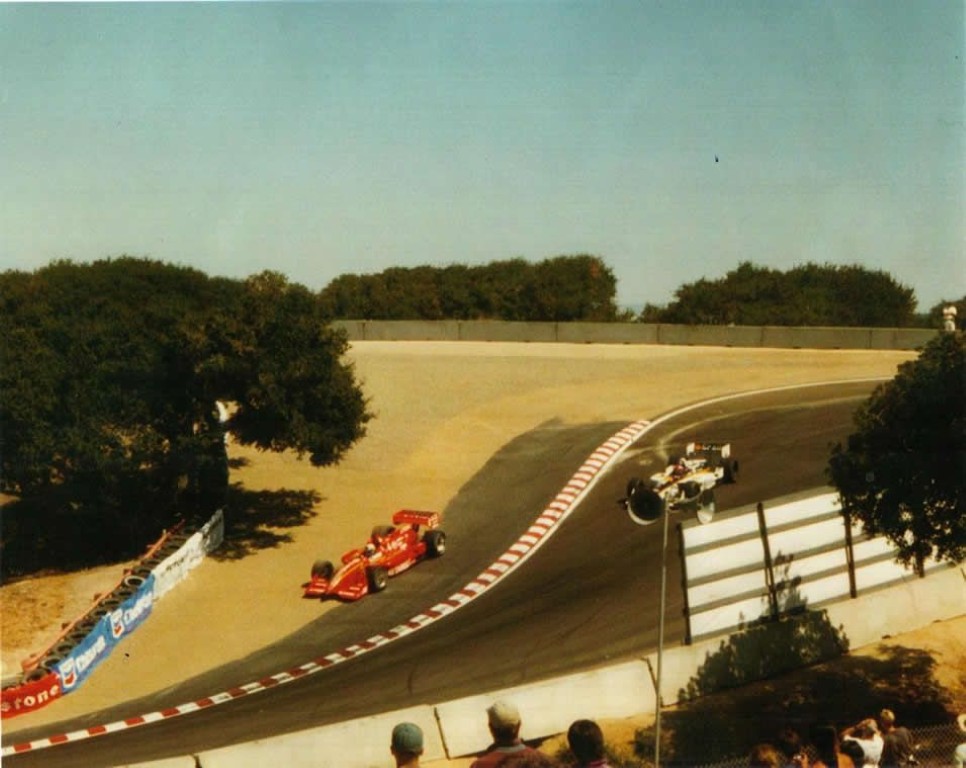
A move to the USA in 1996 saw an upturn in Zanardi’s fortunes. He joined Ganassi Racing in Championship Auto Racing Teams (CART, or ‘Champ Car’), taking pole position in his second race (then another four), winning three races in his rookie season and winning the Championship outright in 1997 and 1998. Highlight moments? An audacious pass on the Corkscrew at Laguna Seca in 1996 (a manoeuvre since banned!), and an incredible victory after starting at the back of the grid at Long Beach in 1998. His characteristic victory celebration of spinning ‘donuts’ has since been copied by many other drivers in America.
Zanardi returned to F1 in 1999, his CART success having caught the eye of Frank Williams, but it was another season without points and the contract ended. So he went Stateside again in 2001. But his racing career came to an abrupt end in 2001 at the EuroSpeedway Lausitz (formerly the Lausitzring) near Berlin, Germany.
He was leading in the closing stages and attempting to merge back onto the track after a late pit stop when he accelerated abruptly and spun into the path of Patrick Carpentier. Carpentier missed him, but Alex Tagliani, just behind Carpentier, could not, and hit Zanardi’s car behind the front wheel, severing its front section. Zanardi lost both legs (one at and one above the knee) in the impact, and nearly three-quarters of his blood volume. Only rapid medical intervention saved his life.
More than ten years on, via an incredible return to racing that saw him win the 2005 Italian Touring Car Championship (with hand controls), he has won two individual gold medals and a team silver for handcycling in the London Paralympics. Back to that question…
‘The answer varies depending on your point of view. If you imagine closing your eyes at the sight of a “dead man” leaving Lausitzring after three heart arrests and with almost no blood left in his body and then reopening your eyes now, seeing him still alive and doing the “impossible”, then you would gasp and call it a miracle. The truth is that, for me, who lived through the everyday effort, it happened step by step. It was simply a new horizon on which I focused my efforts. They might have seemed ambitious targets but from a technical point of view they were achievable, and that’s why everybody’s surprise astonishes me.’
From where did this incredible strength of character come? ‘Do not think that everything was easy. I grew up in a very normal family, with a plumber father who gave me everything he could but always asked in return for the greatest effort in everything I did. I had to fight with my fears, as when, without speaking a single word of English, I had to go to England to race. The point to me was that in England I could have the opportunity to race, so everything had to be done to achieve it.
‘I arrived in Formula 1 thanks to these rules; it’s what made me win in Formula Indy, and what made me able to walk after the crash. It brought me back to racing and gave me three medals at the last Paralympic Games. These principles taught me that the most beautiful part, the one with the most satisfaction, is the training process, where you sweat, suffer and fight every single second. The success at the end, if it ever comes, is the cherry on the cake. To me victory is the target but not the principle for which everything has to be sacrificed.’
How does Zanardi manage family life as well as the training and his work? ‘My wife Daniela, my son and my dearest friends are priority number one. There are moments when there is not enough time to do everything and you have to ask for some sacrifice from the people who love you, but as soon as I can I switch from quantity to quality of time spent together. This is why I say no to some interesting opportunities, simply because they would require staying away too much. Now, at 46, I feel time ticking away faster and I’m taking very good care not to waste it, even if I still love to stretch out my legs on the sofa.’
He laughs when he says this.
This aspect of his life became most pertinent during his recovery period after the crash, when he was fitted with prosthetic limbs. ‘The target, to walk again, was so important to me that every single effort was well worth it.’
What are his feelings following the London victories? ‘I was very, very happy, but a little sad too because I realised that the two-and-a-half incredible years spent practising were over. I thought of my father, who passed away in 1994. I imagined him trying to reach me, caged in the arena. If he was still alive, I’m sure he would have fought through the crowd to get to me, and pat me on the back.’
Zanardi talks a lot about his father and is a father himself, of a teenage boy. How does he feel in this role? ‘The only single handicap is that I can’t play soccer with him. Truth is, when you want to spend time with someone you love, there is so much to do: even going fishing is interesting. Ours is a normal relationship between father and son, only occasionally affected by me being in the spotlight and making him feel a little neglected. Teenagers have their way of looking at the world, but to me the most important point I’m trying to teach him is that, even though he’s Zanardi’s son, he doesn’t have to prove anything. I want him to find his own road, to find something that he’ll love doing.’
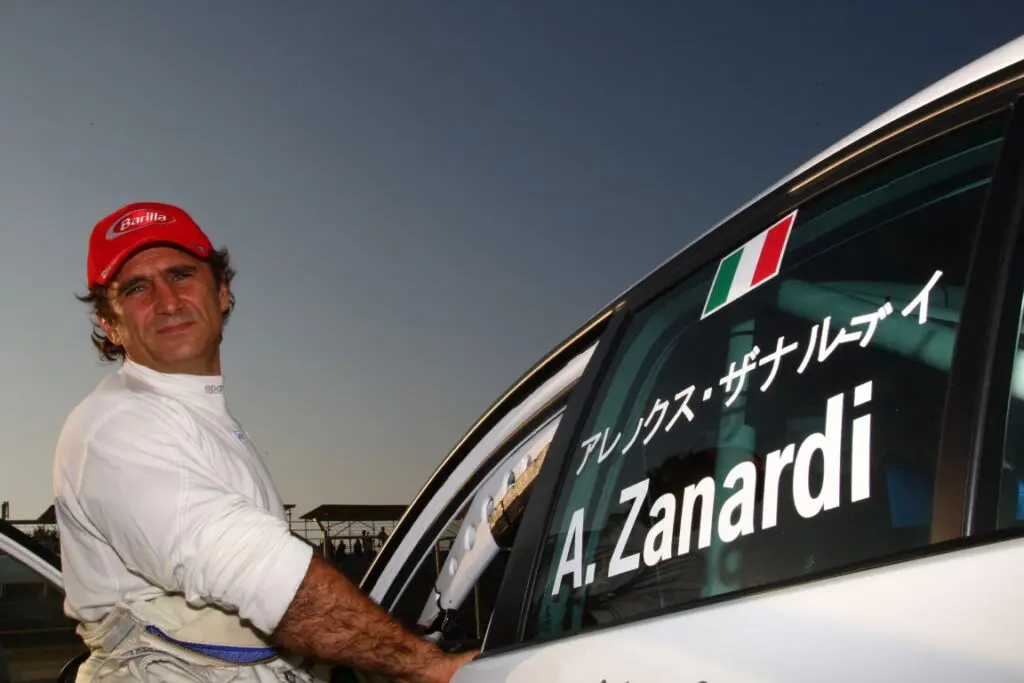
And if he came to Zanardi saying that he’d love to race? ‘If he really wanted to do it, if he would make sacrifices to achieve it, then why not? Everybody takes risks all the time, but you can’t stop living because of your fear of accidents. Our defense, as human beings, is to see them as only a very remote possibility. Look at racing drivers: today most of them get to be old, and tell wonderful stories to their grandchildren about their wonderful life and a career that never saw them have an accident. I had to pay a price, but I’ve been one of the very few, at least in recent years.’
Zanardi has even learnt from his role as a father. ‘My relationship with my son helped me a lot in understanding my relationship with my father. I became certain about his satisfaction in seeing me win, and I discovered as a father that the pleasure you feel in seeing your child doing something, even the school race, is always the same. It’s not the importance of the target, but the pleasure of seeing him fight to achieve something. I still miss my father because I miss the pleasure of sharing with him my choices, deciding which new adventures to live and work for together.’
Given that terrible accident and the struggles that followed, would Zanardi do anything differently if he had his time again? ‘I would love to see how many other activities I could have squeezed into my life, those I’ve been tempted to try but didn’t. I think I could have been a good skier, with short, strong legs, and a good attitude to trajectories. I would love to have been a race car engineer, to be on the racetrack with the driver, finding and experimenting with new solutions, inventing something to make it go faster. I’d need ten hours to tell you everything I would love to do.’