I think I learned the words “Mille Miglia” at the same time I learned to speak. My father had long retired, but our whole world still revolved around being Stirling Moss‘s family – and this incredible road race is at the heart of it.’ These are the words of Elliot Moss, fêted chef and son of the great Sir Stirling Moss. Dressed in a crisp white shirt and chinos, Elliot looks relaxed as we chat on the eve of our departure from Brescia to Rome.
This feature first appeared in Octane 267.
Seventy years ago, Sir Stirling Moss and his lovably idiosyncratic navigator, Denis ‘Jenks’ Jenkinson, made history by becoming only the second non-Italian team to win the Mille Miglia after the German pairing of Rudolf Caracciola and Wilhelm Sebastian in 1931. Not only that, they did so in record-breaking fashion, defeating the likes of Juan Manuel Fangio to complete the perilous 992-mile race in just 10hr 7min 48sec. Their average speed was an incredible 98.53mph. And within mere hours, I will begin to understand just what that really means. Over the next three days, Elliot and I will be honouring one of the most storied days in motor racing history by recreating the journey of his legendary father – each in our own cars – from Brescia to Rome.
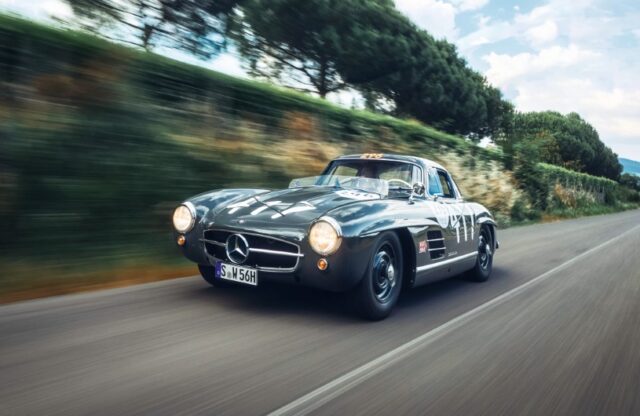
Obviously such a pilgrimage demands special machinery. My journey will be split between two cars that pay tribute to Sir Stirling in very different ways. The first stint, from Brescia to the rolling hills of Siena, will be in a 2009 Mercedes-Benz SLR McLaren Stirling Moss – a 650bhp speedster inspired by the 300 SLR that carried Moss to glory. From Siena to Rome, I will swap into a 1955 Mercedes-Benz 300SL Gullwing, a factory replica of No.417, which won its class on the Mille Miglia that same year, driven by John Fitch and Kurt Gessl.
Fittingly, the 300SL’s spindly steering wheel and rasping straight-six soundtrack will echo sensations that Moss and Jenks experienced during their recce run before the race. For that they drove chassis 198.040-4500019 – and now so will Elliot, alongside its current owner, the German collector Matthias Bonczkowitz.
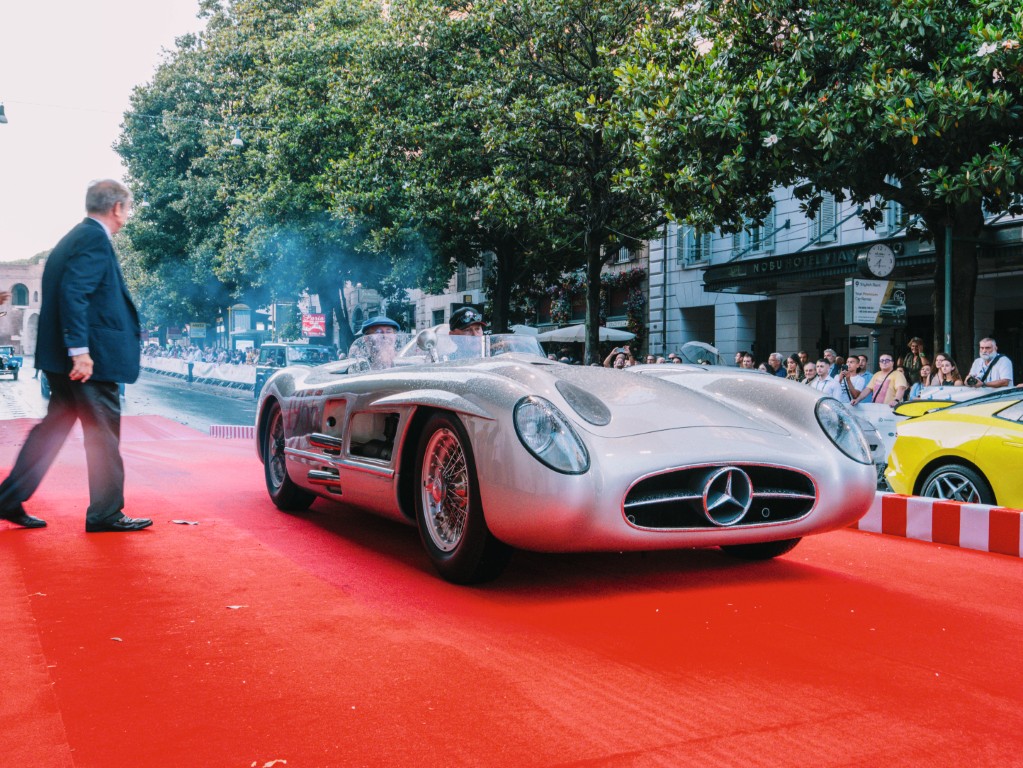
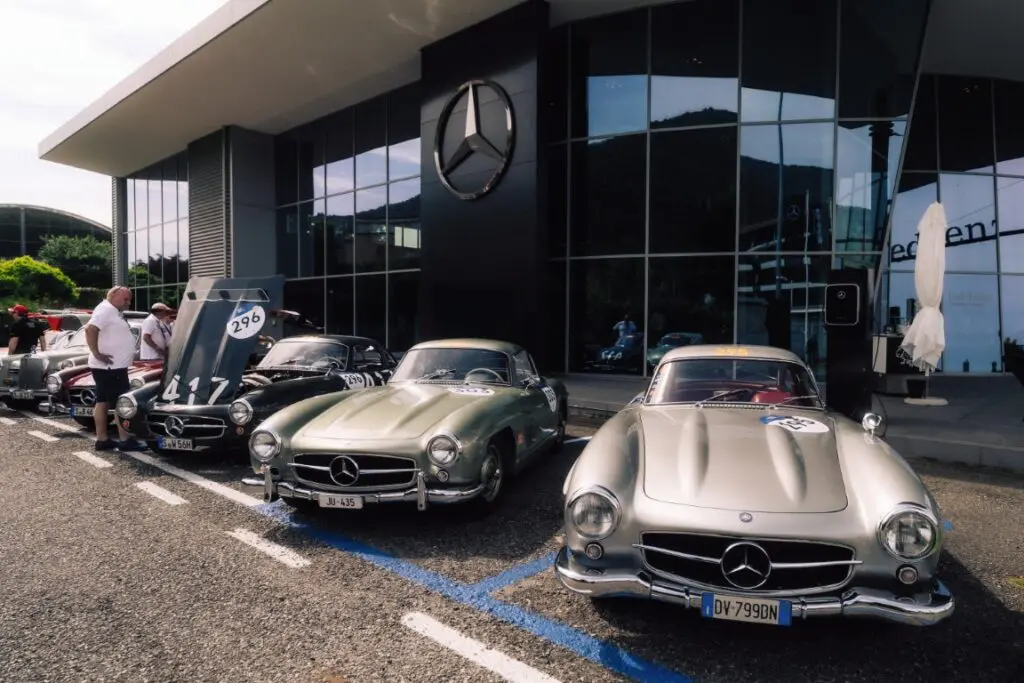
We arrive at the Mercedes dealership in Brescia to a crowd of car spotters jostling for a glimpse of the jaw-dropping machinery lined up outside the glass-fronted showroom. Parked nearby are the Gullwings that Elliot and I will be driving, joined by a formidable fleet of 19 SLR McLarens – including multiple 722s, three Stirling Moss editions, and a pair of new AMG PureSpeeds. But the undisputed star is the 300 SLR race car, positioned proudly on a red carpet. A smartphone-wielding crowd gathers the moment its 3.0-litre straight-eight engine barks into life, briefly drowning out the wasp-like buzz of drones above.
But before I can soak in the magic of the moment, I’m handed a helmet by the enthusiastic president of the SLR.CLUB. It’s time to begin retracing the wheeltracks of Sir Stirling Moss, and I feel more than a little conspicuous as I fasten my helmet, swing open the passenger-side butterfly door and lower myself into the bucket seat. The cabin blends carbonfibre, machined aluminium and leather to create an ambience both purposeful and exotic – helped, of course, by the absence of a windscreen.
The car’s proportions are cartoonish: nearly as wide as a modern Range Rover and only 232mm shorter. You sit just ahead of the rear axle, while the impossibly long bonnet stretches ahead before vanishing from view, like an infinity pool. It’s dramatic and feels every bit the modern-day Silver Arrow.
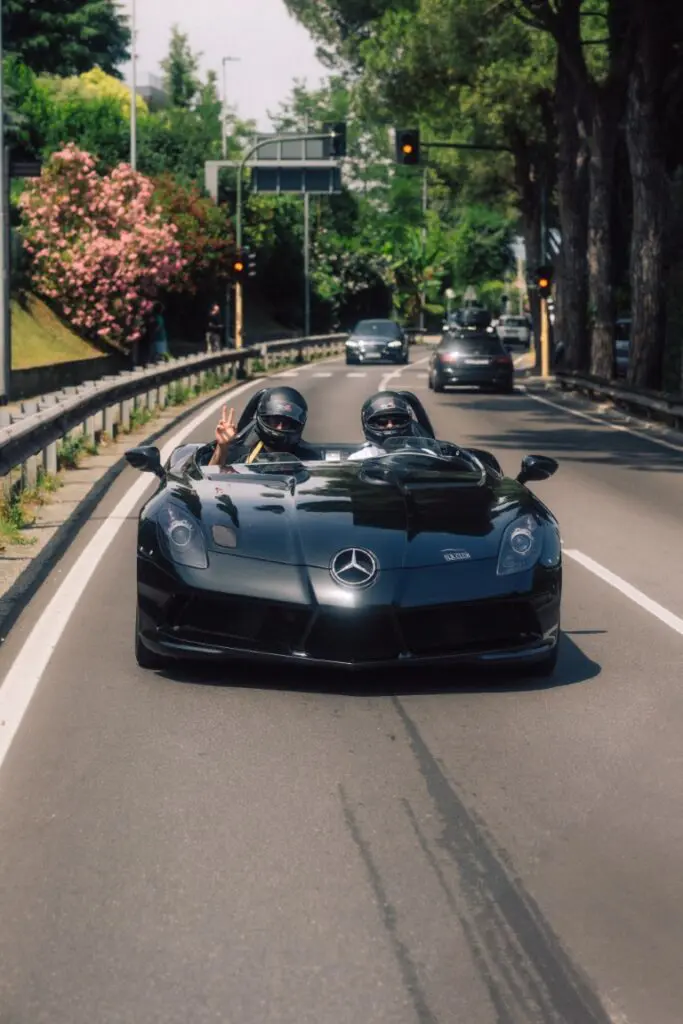
Beneath the carbonfibre bodywork burbles a 5.5-litre supercharged V8, capable of sending 650bhp to the rear wheels through a five-speed automatic transmission – 26bhp more than the standard SLR McLaren. At 1551kg, it’s also significantly lighter than both that and the sharpened 722 Edition.
For today I’m in the passenger seat. Andreas’s son Moritz is on driving duties, leading our armada of SLRs southwards towards our overnight stop in Tuscany. Much of the journey retraces the 1955 Mille Miglia route, offering everything from picturesque Italian towns, incredible lakeside vistas, sections of autostrada and serpentine mountain roads.
Under azure skies and blazing sunshine, we sweep through northern Italy to the sound of cheering crowds. Spectators young and old line the route, leaning from balconies and gathering at petrol stations and roadside cafés. Children wave and run alongside the cars. Pensioners applaud. Car-spotters point at the convoy in excitement, phones aloft. Even the Ferrari flag-waving tifosi holler with approval.
With every passing kilometre, my appreciation for what Moss and Jenks accomplished grows. It’s past midnight by the time we reach our stop and I’m sunburnt, exhausted and numb after spending so long in the thinly padded bucket seat. We still haven’t completed even half the route. And it has taken us more than ten hours.
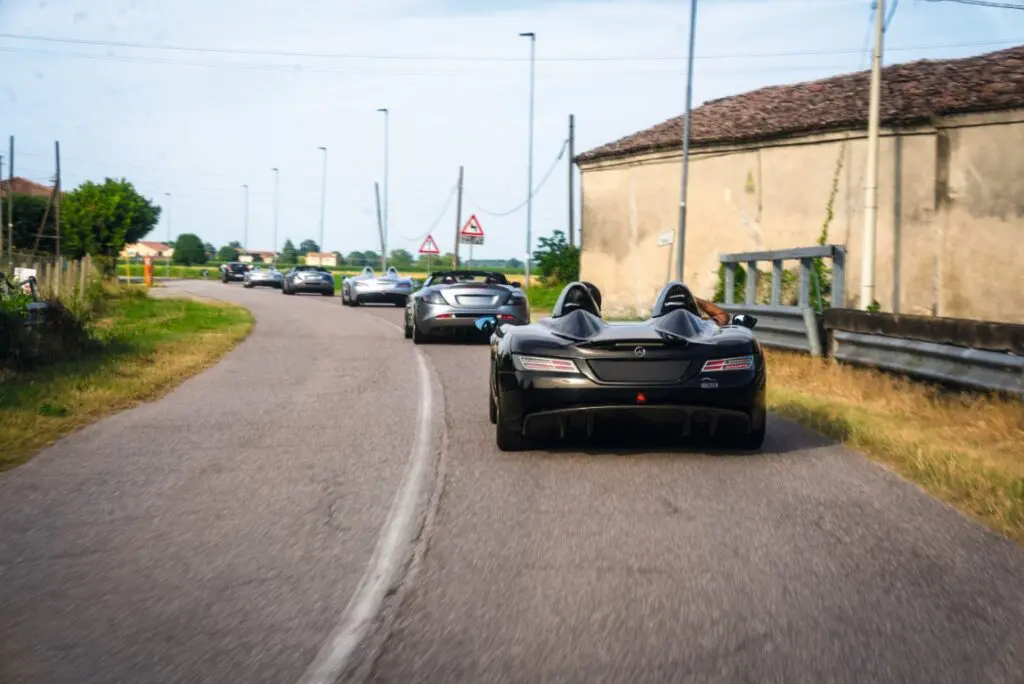
In that same time, Moss and Jenks would already be spraying Champagne after dealing with all the perilous unpredictability of public roads. In our case, that meant dodging two suicidal deer and a stray dog in the dark. What struck me most, though, was the vulnerability you feel while travelling in a car without a windscreen. Even at our generally sedate pace, you feel exposed – to think they averaged nearly 100mph is almost beyond belief.
My experience on the first day reminds me of something Elliot said before we set off: ‘Most people remember the record, the average speed. But what they forget is that it was done on open roads, with dogs and people and potholes – it wasn’t a racetrack. That’s what blows my mind.’
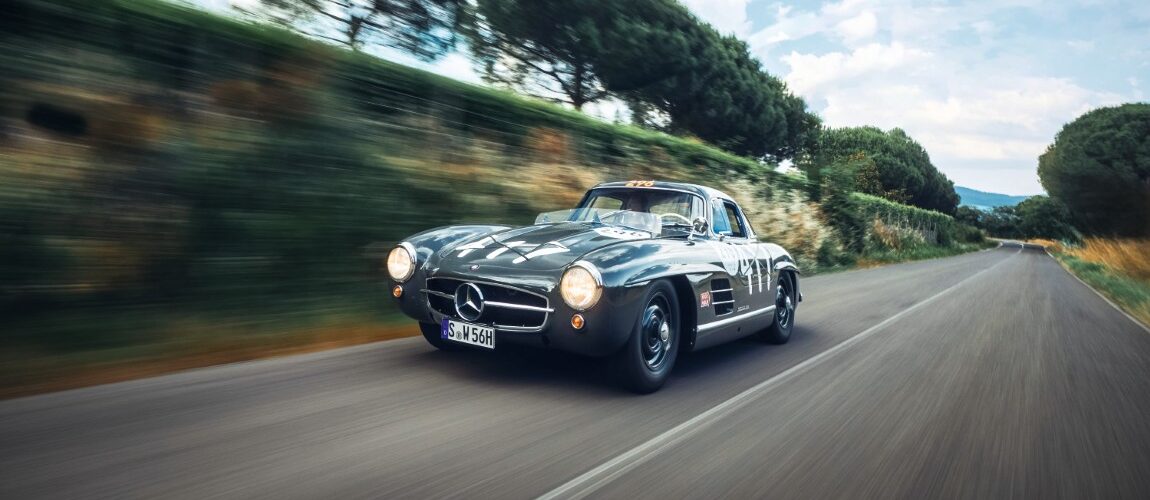
Next morning dawns: 18 June 2025 is a day I will never forget. I wake at first light, ready to drive not only the Mercedes-Benz SLR McLaren Stirling Moss but also a legendary 300SL Gullwing, too. Back-to-back. From the heart of Tuscany to Rome. That’s bucket-list territory. The SLR Stirling Moss is one of only three examples finished in menacing black paintwork, while the car in which I’d ridden shotgun is the silver pre-production prototype that was splashed across magazine pages in 2009.
You sit low down, there’s a hint of classic fighter-plane about the ambience of the cockpit, with its small wind deflectors and muscular haunches framing your vision ahead. Then your ears are filled with the rumble from the side-exit exhausts as you pull away on a wave of supercharged V8 torque. First comes a twisty descent through the Tuscan hills, before hitting the autostrada towards Florence and then on to Siena. On more tortuous roads, the Stirling Moss is a challenging beast to drive. It feels so long and wide from the driver’s seat.
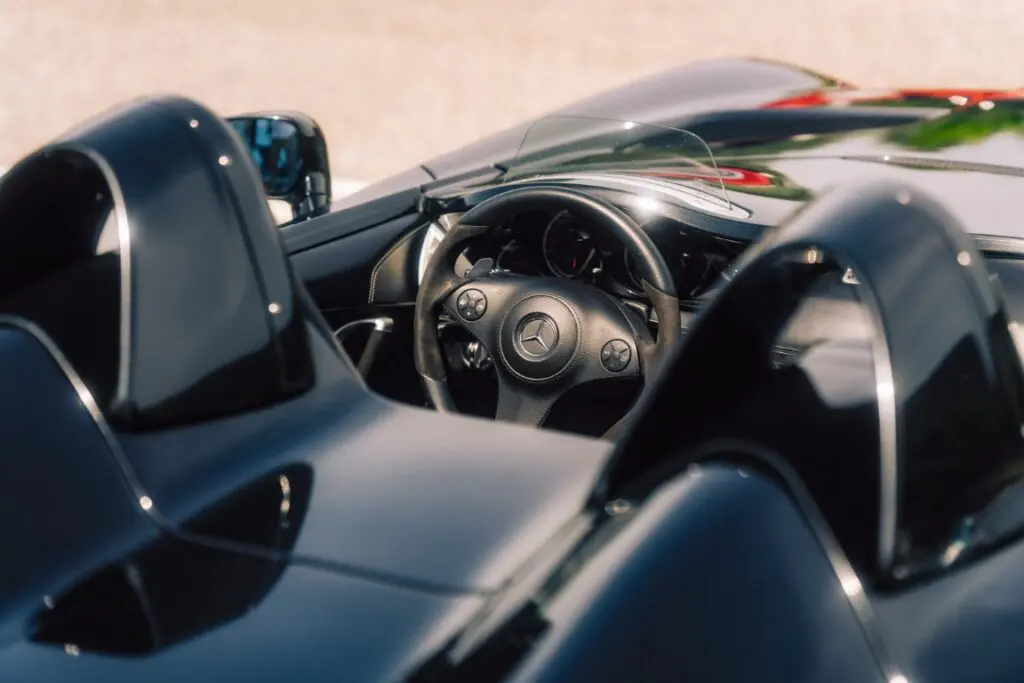
The ride is surprisingly pliant, the automatic transmission shifts smoothly and there’s effortless power and torque in any gear. The brakes, however, are trickier to master. The first 10cm of pedal travel yields little response, before the calipers bite down aggressively. I manage to adjust, though never quite feel at ease with them. But the car’s character is defined by its muscular powertrain. It’ll sprint from rest to 62mph in just 3.5sec, so it’s fast – especially with the wind ripping past your helmet as you surge towards the 7000rpm redline. It’s undoubtedly a special and evocative machine.
My three hours behind the wheel pass in a flash and we roll into Siena. From here I will complete the journey to Rome in the No.417 Gullwing – but not before enjoying a quick bowl of pasta in one of the restaurants that encircle the town’s medieval Piazza del Campo. Now a UNESCO World Heritage site, this place is breathtakingly beautiful, framed by terracotta buildings and sloping cobblestone streets. Scores of stunning classics from the world’s greatest marques sit poised to depart for Rome while their crews rest. The vibrant sea of stickered paintwork gleams in the sun against archaic stonemasonry.
Opening the 300SL’s Gullwing door and climbing over its wide sills and into the driver’s seat for the first time is a surreal experience – particularly when you’re doing so in the centre of Siena for a leg of the Mille Miglia. Intense excitement quickly turns to nervousness as I pull the door down and cast my gaze over the beautiful gauges and curvaceous bonnet.
Many millions of dollars’ worth of classic cars jostle for position in the Piazza, as navigators lean out of windows, frantically waving timecards at the marshals. A cacophony of high-pitched horns and revving engines reverberates off the terracotta. After a few breathless minutes our timecard is stamped, and my navigator and I began tailing a Talbot-Lago T26 GSL into the Val d’Orcia hills.
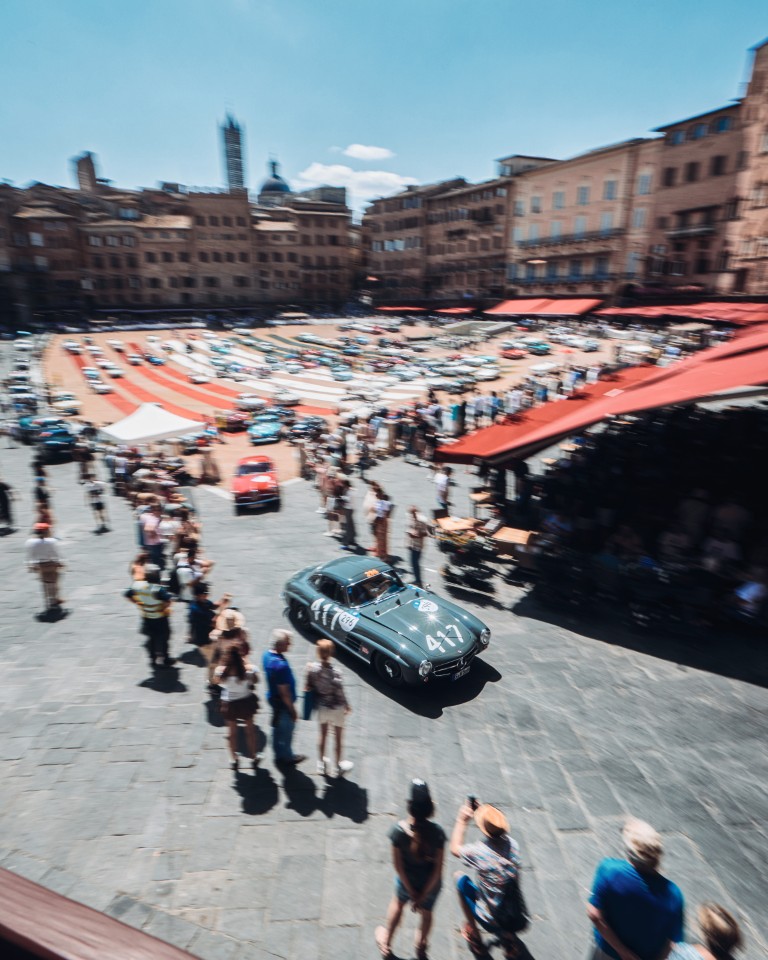
It is blisteringly hot and the Gullwing’s cockpit feels like an oven; the heated air streaming through the open front quarterlights offers no relief, and bottles of water on the parcel shelf are as warm as bathwater, but it’s important to stay hydrated. Even the car needs help, with makeshift rubber hoses wedged under the bonnet to vent excess heat.
Although no longer a flat-out race, the Mille demands unwavering focus. As a driver, you listen intently to your navigator, looking out for each landmark, junction and time control. It’s challenging and requires concentration, communication and teamwork. Whether it’s the beautiful cars, stunning landscape or the sometimes-erratic driving of fellow competitors, the sensory overload is constant.
Luckily, the 40km of Val d’Orcia’s stunning landscape provides an opportunity to become properly acquainted with the SL. It’s easy to see why this car made such an impact during the 1950s – it feels so far ahead of its time. The sonorous, motorsport-bred 3.0-litre straight-six, which pioneered Bosch’s mechanical fuel injection system, develops an impressive 215bhp, enough to have made it the world’s fastest production car of its era.
From behind the beautifully thin-rimmed, Bakelite steering wheel, the only real challenges are the brakes and gearbox. Like many cars of its era, the drum brakes require a firm, deliberate push. The four-speed ‘box feels satisfyingly mechanical but resists being hurried through its gate, demanding patience and precision. The ride is softer than you’d expect, with generous ground clearance that suits Italy’s provincial roads. Push harder, and there’s some body roll and a bit of bounce from the rear swing-axles, but overall the car feels astonishingly modern for something from 70 years ago. It’s no surprise the Gullwing finished first and second in its class in 1955.
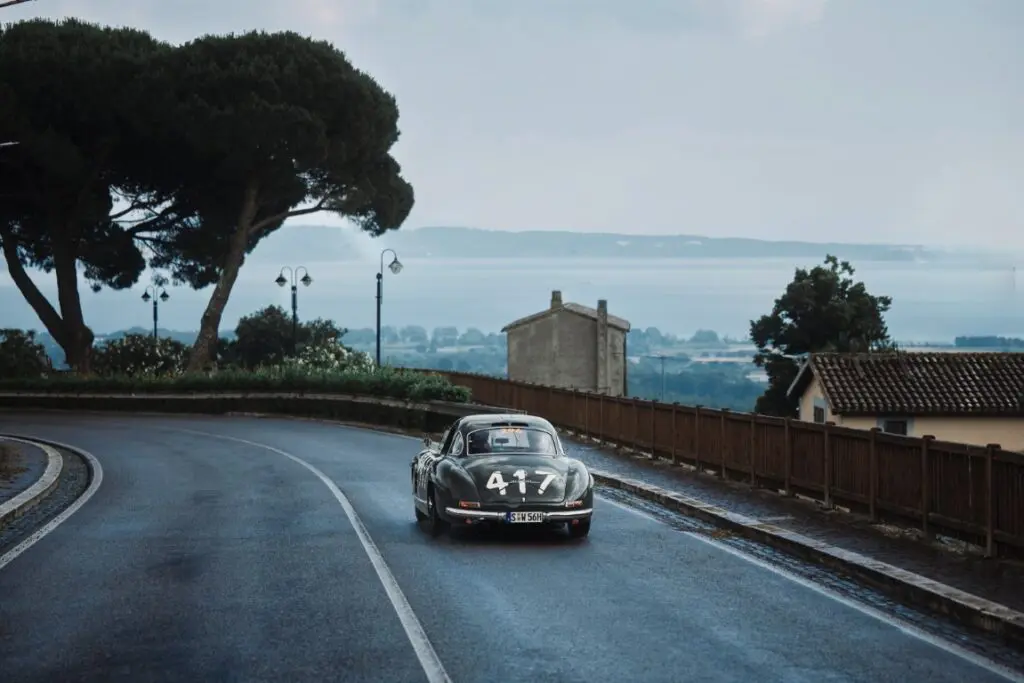
We reach the medieval town of Ronciglione around 7:30pm, our penultimate stop – ahead of schedule. I park the Gullwing on the cobbled high street and take in the surroundings before my navigator and I cool off with a chilled drink and a couple of scoops of gelato. The final stretch to Rome is ahead of us and will be the most memorable of all.
The countryside slowly recedes as we near the outskirts of Italy’s capital. The Gullwing joins a convoy of other competitors as the evening traffic thickens. I spot Elliot Moss and Matthias Bonczkowitz’s Gullwing in my rear-view mirror and can see that both are as hot and as ecstatic as we are.
Cooler air and calmer traffic make for a more comfortable drive in the Gullwing, away from the cut-and-thrust I had been a part of in Siena, yet the atmosphere is charged. The sun may be setting but the enthusiasm of the crowds hasn’t waned, and camera flashes intermittently blink from the pavement as we echo through the streets.
The final time control of the day is in the leafy surroundings of Villa Borghese – Rome’s largest public park. Predictably, it’s hectic, with cars jostling for position from all sides. With our card stamped the competitive section has officially ended – but the best is still to come. Minutes later, we roll onto glamorous Via Veneto, which transforms into a classic car catwalk with hundreds lining the barricaded street. The red-carpeted finish ramp is mere metres ahead.
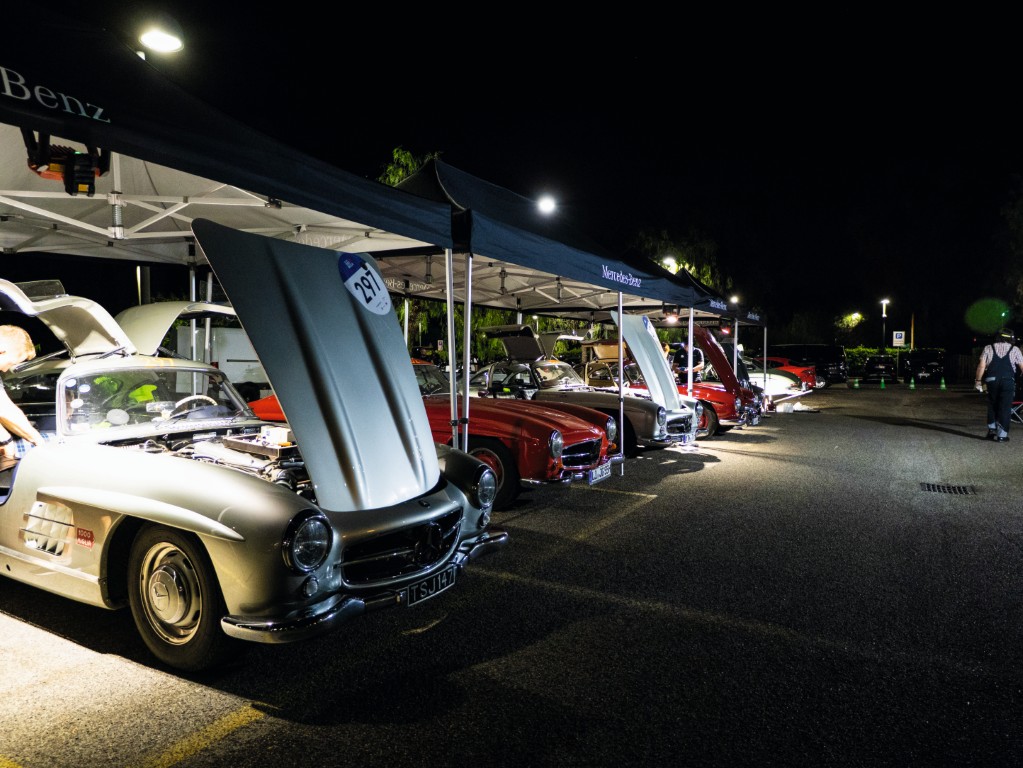
Each car is called onto the ramp one by one, and, when our turn finally arrives, I’m overcome by a wave of euphoria – and relief. After rolling gently off the platform, we rejoin the convoy and continue through the heart of Rome under police escort – past the glowing arches of the Colosseum, with Elliot Moss following just behind in his Gullwing. Such a cinematic moment, it feels like fiction And yet it’s entirely real. I can’t imagine a better end to a journey that has brought me so close to a now-mythical race that happened decades before I was born. And, while we’ll never see the likes of Moss and Jenks race the Mille Miglia flat-out again, the event and their story remain as special as ever.
I recall what Elliot said, hundreds of kilometres ago: ‘People remember the record, but it was the man who made it possible. He made a hell of an impact.’ Tired and yet elated, I can only agree.