If you’re a certain age, and from the UK, then I probably don’t need to explain why the words ‘Throbbing Purple Monster’ have just lodged themselves into my consciousness. For those who don’t fit that demographic, I should probably explain…
Through the 1990s to the mid-2000s, a particularly extreme tuning and car modification scene flourished, much of it fuelled by a magazine called Max Power. It was a cultural phenomenon that thrived on taking mundane hatchbacks (attainable to young car enthusiasts) and putting a unique spin on them with big bodykits, even bigger wheels and lairy paintwork. While huge power builds were the dream, many avoided the associated insurance premiums by sinking their money instead into sound systems. According to some, the partying that went hand-in-hand with the scene was even wilder than the cars.
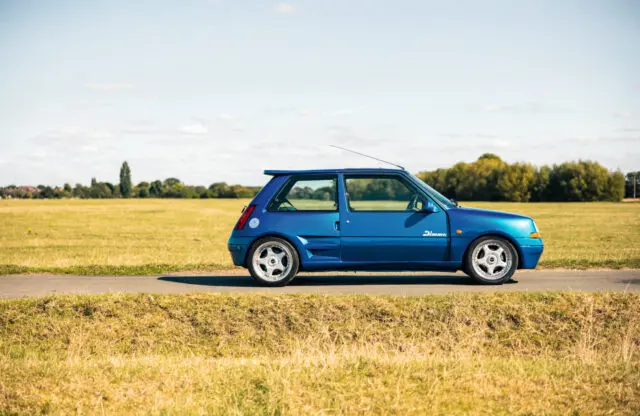
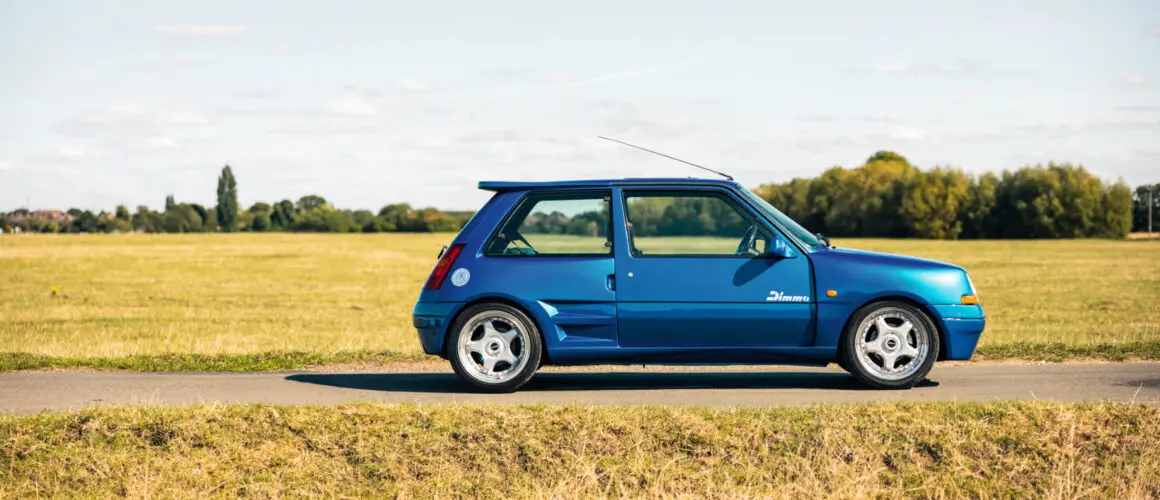
This feature is not about Max Power. And, while much of that era is best forgotten, it’s a landscape that sets the scene for this eye-catching car, one that could have made a compelling Max Power cover star: a Dimma-bodied Renault 5 GT Turbo. Those who remember the first issue might still chuckle at the ‘Throbbing Purple Monster’ coverline from time to time, which accompanied an equally memorable photo of a Dimma Peugeot 205 GTI.
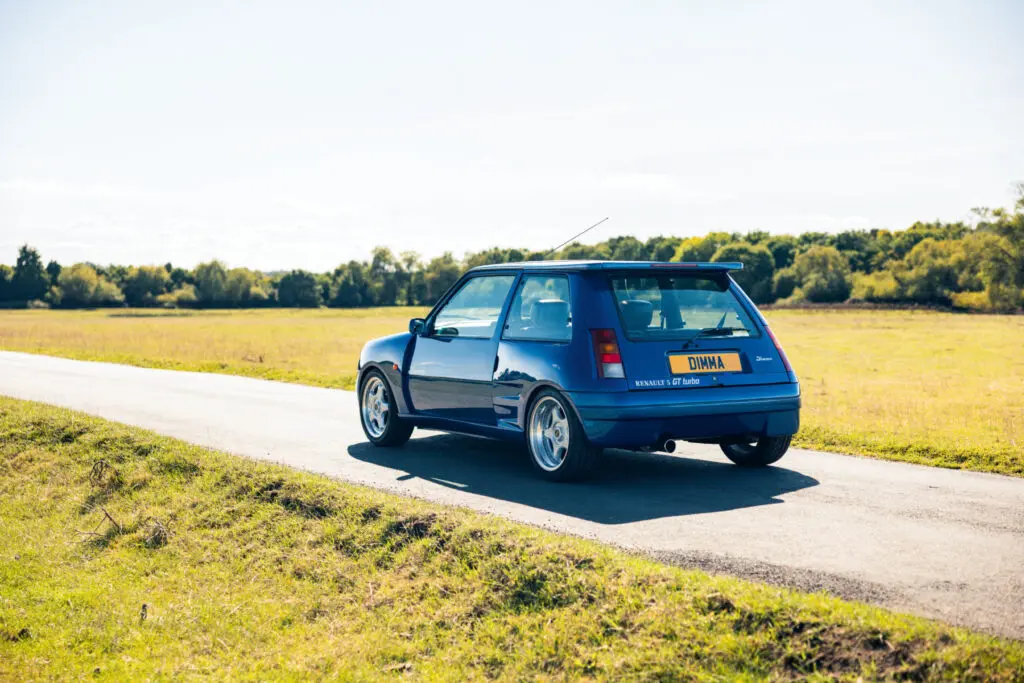
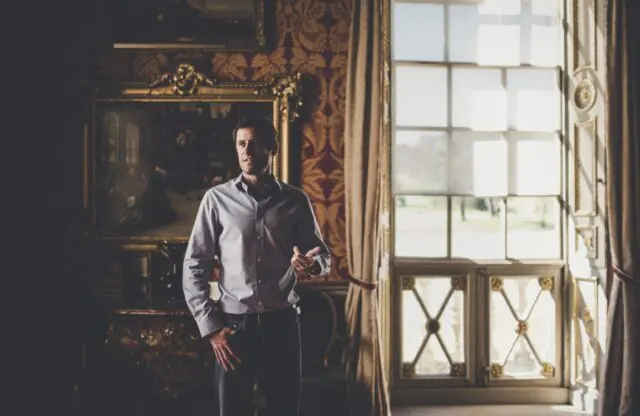
Dimma-built cars featured regularly over the years, and it’s fair to say that the popularity of Max Power helped Dimma’s continued success in the UK. We’ve been invited to Windsor to drive this survivor, one of the rarer Dimma-built cars, and also to meet the legend that originally put it together: Terry Pankhurst.
The story of Dimma is really in two parts. The original Belgian company, Dimma Designs, was founded in 1984 by Michel Baudouin with the introduction of a T16-inspired widebody conversion kit for the Peugeot 205. Unlike the vast majority of aftermarket parts, Dimma’s stylish bodywork won the approval of Peugeot Sport boss Jean Todt, who gave the kit official factory approval. Todt even ran a Dimma 205 as his company car.
Pankhurst was the man who brought Dimma to the UK. He started out at Ford in 1973, became a certified toolmaker and, having gained a decade of experience, started to put his talents to good use by building and running his own Escort rally car. With several Group 1 wins, his skill at building cars was matched by his ability to drive them. Now semi-retired, Pankhurst is still active within the Dimma community and, following this car’s restoration, was called in by its former owner Daniel Agnew to officially authenticate it – the final touch before its sale. Naturally, the man himself has turned up in something rather more extreme, his latest project, the 40th Anniversary Dimma 205-300ps ‘Carbon’. It looks like an original 205 Dimma on steroids, but in truth it’s even more extreme than that. ‘It’s not finished yet, so don’t look too closely,’ he jokes, ‘but it drives like an absolute dream, far better than I imagined it would.’
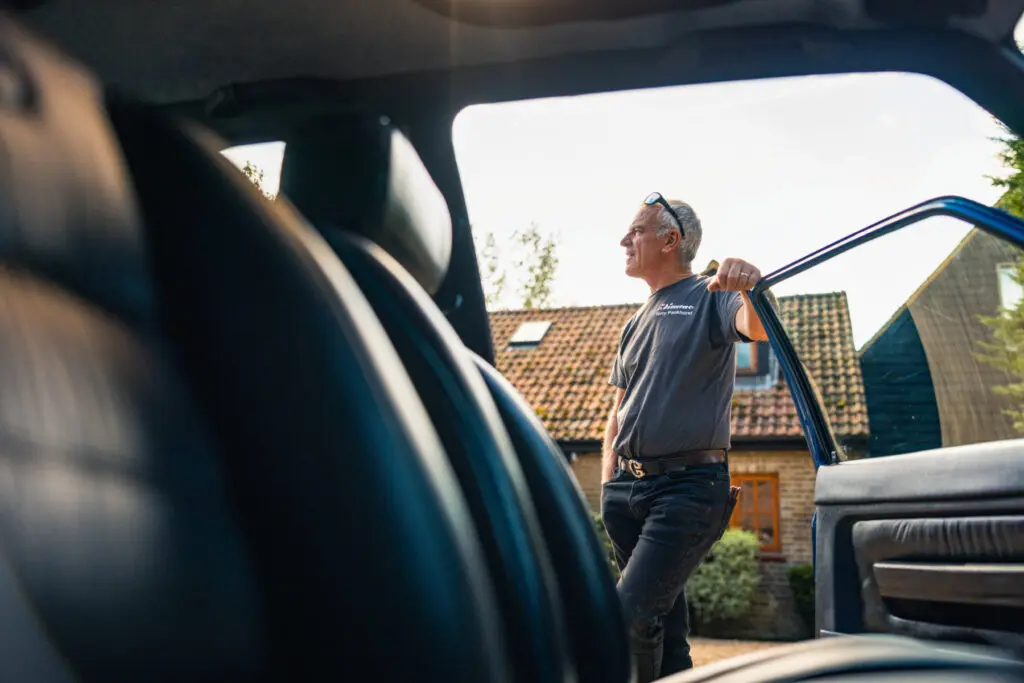
Before we get distracted by his new car, however, attention quickly turns to the Renault. ‘It’s exactly how I remember it,’ he exclaims. Agnew is quick to explain the restoration, and I think we’re both impressed by the attention to detail and the sheer level of work that have gone into it.
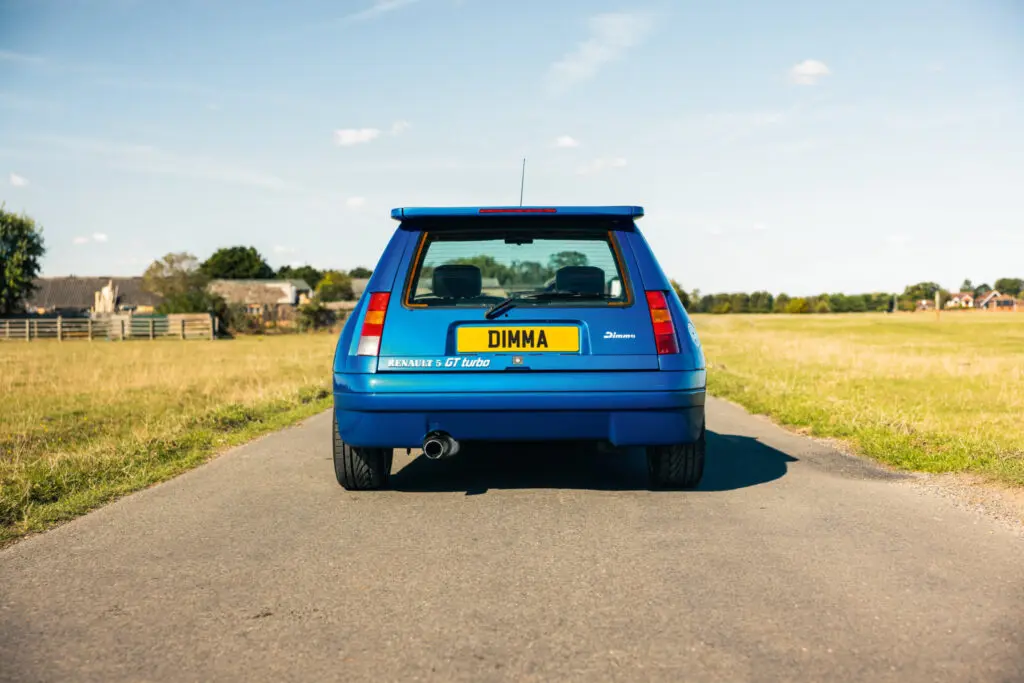
This car started its life as a standard 1987 Renault 5 GT Turbo. Owned by a single family right through to 2021, it was sent to Pankhurst at Dimma on more than one occasion. The paperwork shows that the conversion was completed in 1996, including the fitment of 16-inch Compomotive split-rim wheels, a black leather interior and Koni adjustable coilovers. The mechanicals otherwise remained standard. It returned for a number of smaller tweaks before being kept in dry storage for 20 years.
The car certainly looks the part today, and that’s because it has been fully repainted in the original shade of Sports Blue, including the underside – which was apparently in extremely good shape, requiring only two minor repairs. Just like the 205, Dimma’s widebody Renault 5 drew inspiration from its mid-engined brother, and its slightly softer, more rounded appearance is rather fetching. What’s clear is how well-finished the original Dimma conversion is. Fives weren’t the most painstakingly built cars to begin with, but the quality of the panel fit matches (or even betters) that of the original base car, which is no mean feat for a glassfibre kit of this magnitude. The leather-trimmed interior is clearly a cut above that of any regular French hatch of this era, too.
It’s also been mechanically overhauled, with many OEM parts sourced during the rebuild. Agnew opted to return the car to its most original form, leaving the quad headlights, clear indicators and DTM-style door-mirrors – all added by Dimma later in the car’s life – in a box in the garage. A wise decision. He even went to the extreme of sourcing and reconditioning the correct original spare wheel, although one of the hardest things to find was a parcel shelf without DIY holes cut in for a pair of 6x9in speakers. All the suspension has been refreshed, with polybushes all around, while the braking system has been entirely replaced with new parts. During the restoration, a pack of original Dimma stickers was found in the car and fitted as a finishing touch.
Pankhurst explains how he came into the business of building Dimma cars: ‘I worked for Skip Brown Cars, which was a Peugeot tuner, mainly rally cars including Sunbeams and stuff. I was a sales manager there, and Dimma Belgium sent me some leaflets.’ Pankhurst saw the potential of selling these as conversions into the British market, and decided to take on the task himself, starting up his own business in 1986. ‘I contacted Dimma Belgium, and I said, “Look, I think I can do something with this, would you let me be the importer for the UK and do a proper job of marketing?” Well, I sold 250 of the original 205 kits, all of which were fitted by me one way or another – either in our workshop or at a Peugeot garage. We tried to do the same with Renault, but by the time we got it up and running it was really too late with the 5. The last of the new cars were sold, and the Clio had just been launched, which is why so few were done. That was a kit I designed, which we then sold back through Dimma in Belgium as well. We also helped them with the 306 and 106 Maxi kit.’ The latter was used by Peugeot on the official Super 1600 rally cars.
This explains why I can’t remember seeing a Dimma 5 before, and Pankhurst confirms that only ten were built. During the restoration, Agnew has spent hours searching for leads to other surviving cars and could find evidence of only one plus a couple more rumoured to be in a field, rotting away. Either way, this is an exceptionally rare survivor.
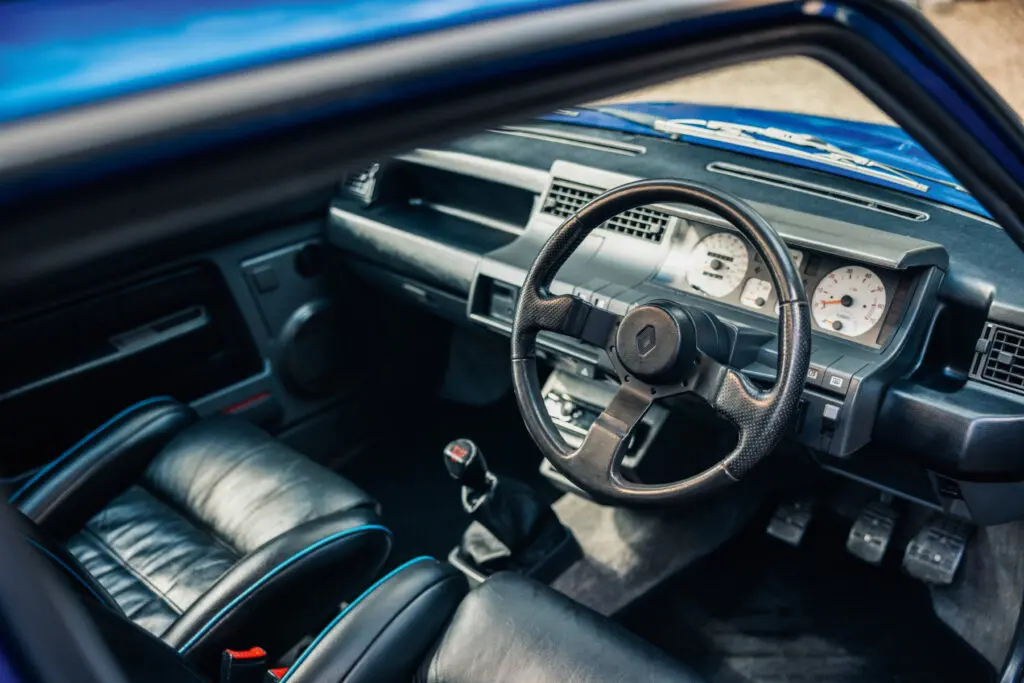
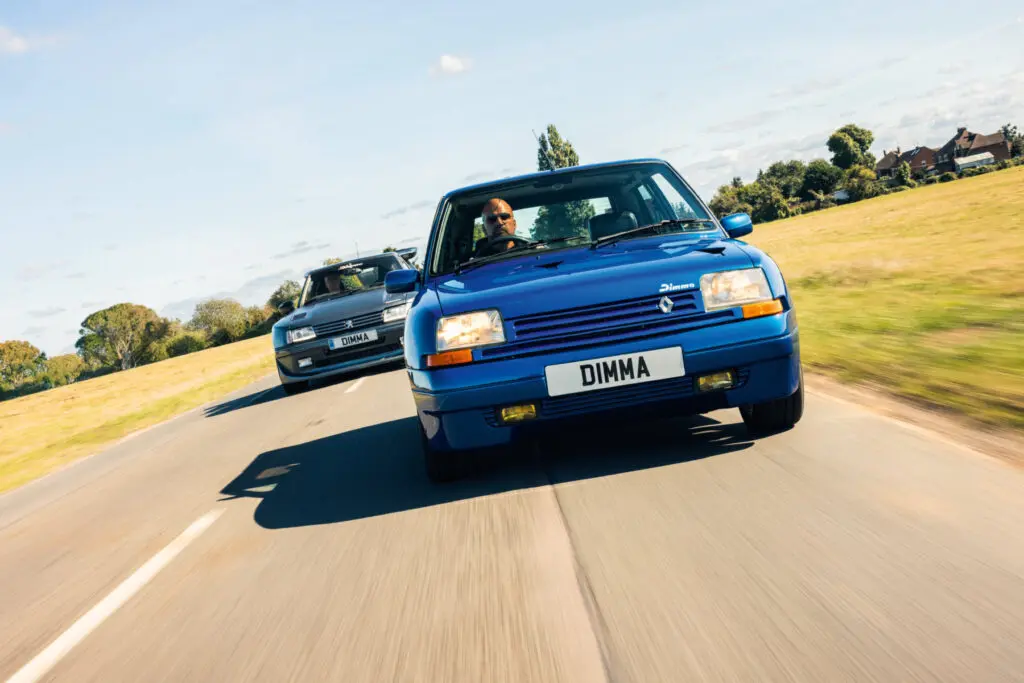
After Pankhurst has carried out his final checks on the 5, and the authentication plaque is suitably mounted under the bonnet, we head out for a drive. Firing up the engine, I quickly remember the last time I drove a standard GT Turbo. In spite of the turbocharger, the engine is a fairly uninspiring 1.4-litre eight-valve pushrod unit that breathes through a carburettor, albeit this one is a pretty sweet-sounding example of the breed. The clutch is hefty, but the steering is what really takes me by surprise – an unassisted rack with 215-section tyres requires a serious amount of upper arm strength at manoeuvring speeds.
As soon as you’re on the move, though, everything begins to make more sense. The engine is gutsy even from low revs, but when the turbo starts to spool up from 2500rpm it wakes things up with a useful surge of performance, and you whip through the five ratios with very little fuss. That steering isn’t super-alert like a 205’s, but there’s a reassuring sense of stability and composure that gives you more scope to push its limits.
It’s amusing to see just how these two cars stand out in this leafy and reserved corner of England, though not in a bad way – bystanders look on with either smiles or mild bemusement. Neither car is anti-socially loud, and the Dimma 5 is positively understated in the presence of Pankhurst’s 205.
Originally he had intended to build a run of cars underpinned by modern Peugeot 308 GTI underpinnings, but the Covid-19 pandemic meant plans never progressed beyond the first stage. ‘The idea was that this was going to be the prototype, and we were going to build at least ten. After the investors pulled out, I got to the point where I wanted to get out of that workshop and retire, so I built myself a smaller workshop at home. At that point it looked like this, pretty much, and I thought “It’s just too good to leave it.” Even though I knew how much work it was going to be – about 2000 hours at that point – I thought “I want it for myself.”‘
Pankhurst transplanted the full suspension, subframes, running gear and electrical system from a Peugeot 308 GTI into the much smaller 205 shell, which required significant surgery to make it all fit. He remarks: ‘If you make any changes to the wiring, you just upset the ECU, so that’s why I basically put everything in – even the 308 door locks so that the remote works. The beauty of it is that it’s got DAB radio, telephone, sat-nav, air-con and cruise control! It’s got 300bhp, and on the way down here it’s done 42mpg.’
Impressive figures indeed, and they’re not the only big numbers. ‘There are about 4000 hours in it at the moment, but I’ve been tracking it and driving it around and testing it and doing stuff, so it’s got a very temporary paint finish. This is my car, but I could build another when this one is done. It would still take 2000 hours to build, so it wouldn’t be cheap!’
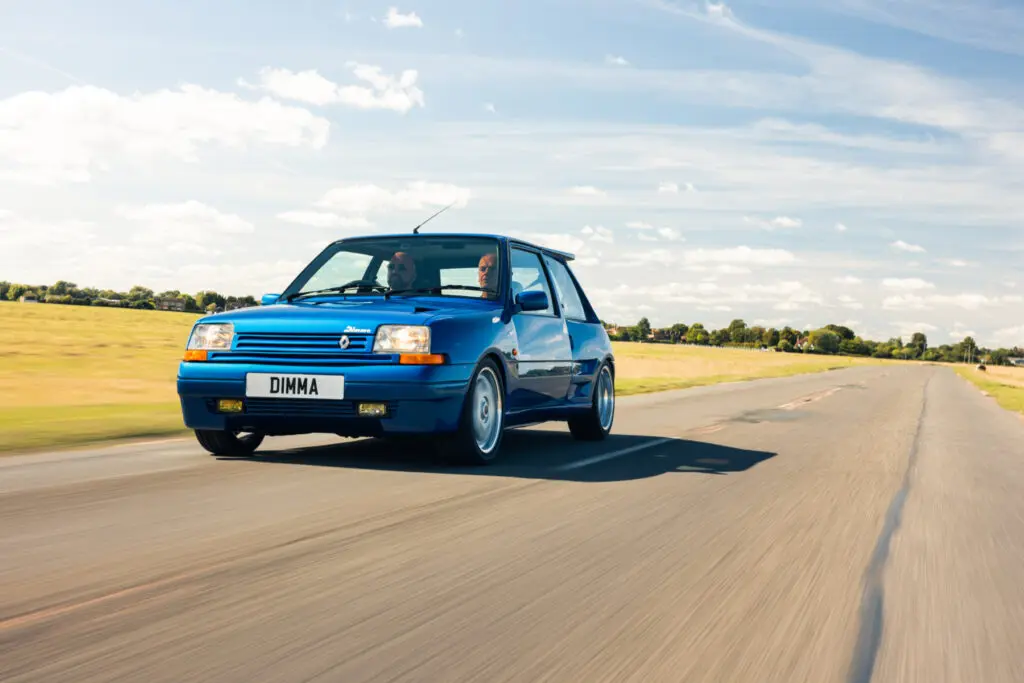
Food for thought… but as we head back, it’s the 5 that’s stolen my heart. I’ve driven and owned my share of French hot hatches over the years, yet few have transported me to a different era quite like the gleaming Dimma 5 today. While I was too young to be fully immersed in all aspects of the Max Power scene, a healthy obsession with French hot hatches when growing up certainly saw me exposed to many a modified Citroën Saxo, AX, Peugeot 205, 306 and (of course) Renault 5 GT Turbo. They were absolutely everywhere on our roads. Until one day, seemingly overnight, the world moved on. The majority of the crazy modified stuff simply vanished and, just like the magazine (which officially closed in 2011), the scene largely vanished, too.
There’s a very hungry market for 1980s and 1990s hot hatches today, but buyers generally favour originality above all else. To my mind, cars such as this Dimma sit in their own bracket with the likes of Gemballa, Gutmann, Koenig et al, and as such the normal rules don’t apply. While it’s certainly extreme in stance and presence, seeing this Dimma 5 in its purest form actually reveals it to be a very nicely executed car; given the popularity of the converted 205s, I’m surprised more buyers didn’t go for one at the time.
What’s perhaps most impressive about this example is that it managed to survive that crazy Max Power era without falling into the wrong hands and succumbing to crazy power tuning, being crashed or the simple neglect that saw many into an early grave. Like many of you, I suspect, I never cared for the less salubrious aspects of that scene, but it’s hard not to be impressed by the creativity and the sense of fun that cars like this brought to the roads. And it’s heartwarming to see that, with Terry Pankhurst’s latest creation prowling the streets, Dimma lives on to this day.
Renault 5 GT Turbo Dimma specifications
| Engine | 1397cc OHV four-cylinder, Solex 32 DIS 931 sealed carburettor, Garrett T2 turbocharger |
| Power | 118bhp @ 5750rpm |
| Torque | 122lb ft @ 3750rpm |
| Transmission | Five-speed manual, front-wheel drive |
| Steering | Rack and pinion |
| Suspension | Front: MacPherson struts, lower wishbones, coil springs, anti-roll bar. Rear: trailing arms, torsion beam, transverse torsion bars, telescopic dampers, anti-roll bar |
| Brakes | Discs |
| Weight | 855kg (standard) |
| Top speed | 120mph |
| 0-60mph | 7.3sec |