‘My life is really great at the moment and I seem to spend a huge amount of time thinking back to the times when my main mission seemed to be to f*ck it all up. Looking back to driving 180 miles per hour in a Ferrari down the M4 or some drunken cocaine-fuelled day… I would not put money on any of my great moments. But, like any man, I have had some times.’
So said Pete Townshend, reflecting in The Big Issue in late 2019 on his life as co-founder, lead guitarist and chief songwriter of British rock band The Who. Townshend lived the archetypal rock-star life, although he came through it relatively unscathed compared with, say, his fellow band-member Keith Moon, who died at the age of just 32. Moon is well-remembered for writing off his 1972 Dino 246 Spider within a month of buying it – although the story goes that he wasn’t driving; he’d simply tossed the keys to a couple of biker friends outside his local pub, and they put it into a ditch…
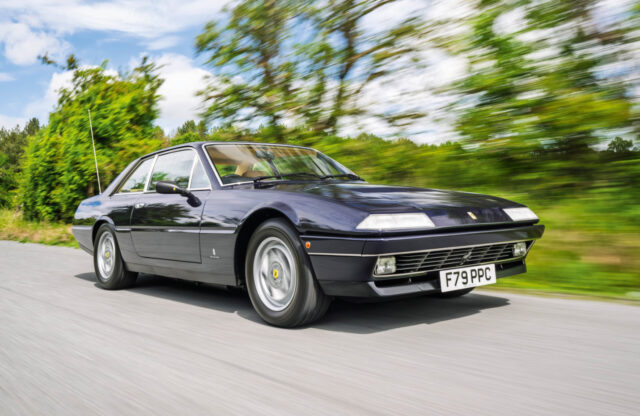
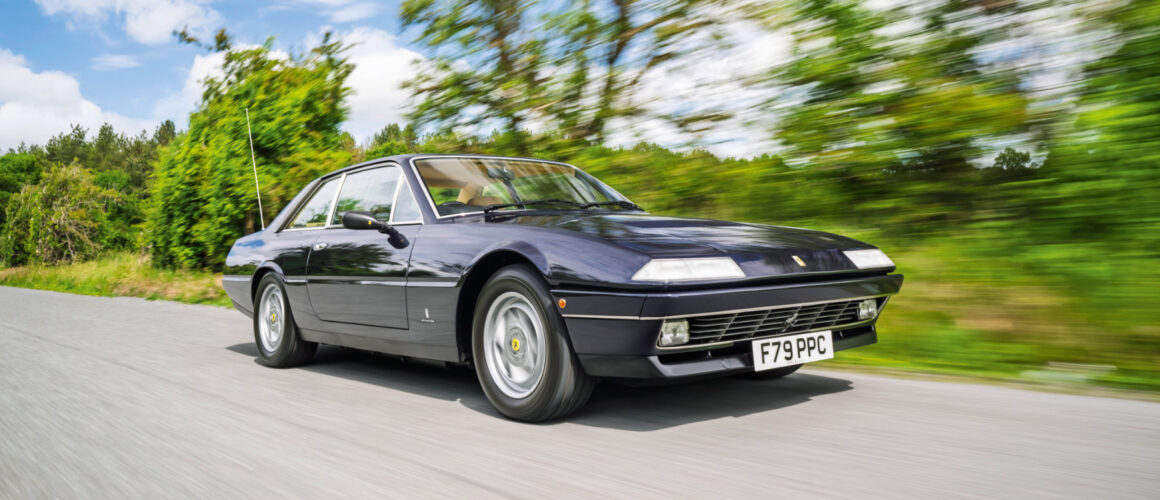
Townshend’s choice of Ferrari was rather less obvious. In 1981, at the age of 36, he bought a nearly new 400 automatic from London dealer HR Owen and had it turned into a convertible by EG Autokraft. Maybe it was his influence that led to the Rolling Stones acquiring three 400s in 1983 for Mick Jagger, Keith Richards and Bill Wyman as part of an eight-strong Ferrari ‘fleet deal’ after their Tattoo You European tour. Townshend owned his 400 for about five years and followed it with a Daytona Spider (probably influenced by fellow rock guitarist Eric Clapton, who was a Ferrari tifoso), a 550 Maranello and a 550 Barchetta, before coming full circle with the 412GT pictured here, which he bought in early 2008.
You certainly needed a mature rock star’s income to afford one of these big V12 Ferraris. They were flagships of the range, with commensurate running costs – you can get a 400 down to single-figure mpg fuel consumption if you try hard enough – which helps explain why in later years they became what now seems ridiculously cheap to buy. A journalist friend bought a usable 400 for £5000 in 2003 (‘It was scruffy but reliable… and unsaleable, I just about got my five grand back’); recent invoices for the ex-Townshend 412 show nearly £70,000 spent on it. As my friend’s £5000 daily driver proves, it’s lack of use that accounts for much that goes wrong with this type of car.
The 412 was the last iteration of a classic front-engined, rear-wheel-drive V12 Ferrari that was introduced way back in 1972 as the 365 GT4, a Pininfarina-built, angularly styled 2+2 that superseded the more swoopy 365 GTC/4 on which it was based. The wedge-nosed 365 GT4 would evolve into a 365/400/412 model line that became Ferrari’s longest-ever seller, lasting from 1972 to 1989. He may not care to be reminded of it now, but designer Peter Stevens said back in the day that the 400 was ‘the most beautiful production car of all time’.
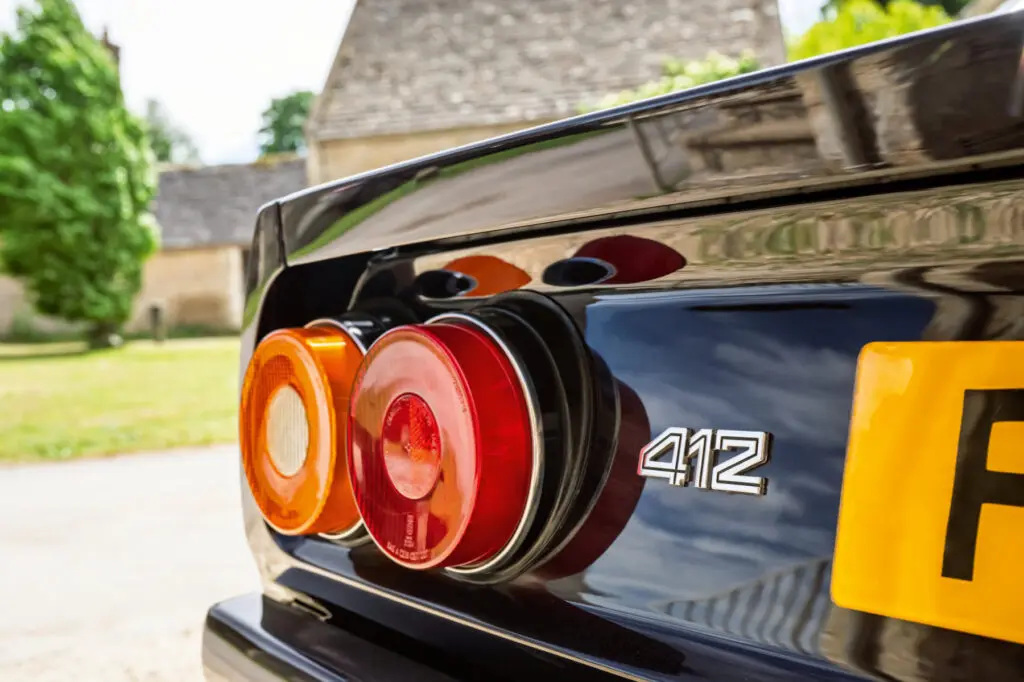
The easy way to tell them apart is that the 365 has six rear lights while the later cars have four; the 412’s rear end is also pitched higher to give more boot space and a more purposeful appearance. Naturally, their mechanical underpinnings changed a fair bit over that 17-year production run, too. The 365 featured a six-Weber but mildly detuned 4390cc wet-sump version of the Daytona’s engine, giving 320bhp; that was upgunned to 4825cc and 340bhp for the 400 that superseded it in 1976. All the 365s had manual transmission but, reflecting the big coupé’s appeal as a grand tourer, for the 400 there was an automatic option using GM’s TH400 gearbox – and it would outsell the manual 400GT by a ratio of two to one. It was a similar story for the 412 that replaced the 400 in 1985, with manual cars remaining in the minority, even though the three-speed TH400 was showing its age by then – it had first appeared in 1967.
In 1979, the 400’s six Webers were replaced with Bosch K-Jetronic fuel injection to meet stricter emissions requirements. The resulting 400i had less power – 310bhp instead of 340bhp – but the situation was redressed with the slightly bigger engine of the 412. The injected engine wasn’t noticeably more economical, however, with Ferrari’s official 1989 figures showing 9.8mpg in urban driving and 21.3mpg at a constant 56mph – making the contemporary Testarossa practically an eco-car at 28.3mpg! Curiously, the automatic 412’s economy was marginally better than the manual’s at all speeds. Not that fuel consumption was likely to worry anyone who could afford to buy a 412. In the UK, in January 1989, both versions retailed at £80,194 including taxes, when a 328 GTB cost £47,697.
This particular car, chassis 79932, actually cost its first owner £82,020 on 30 March 1989, including a tailored cover and – probably very wisely – a 24-month extended warranty. That sum was near-as-dammit the average price of a house in London at the time… although not a house in W8, where the 412’s purchaser lived, a Dr Konrad Goess-Saurau.
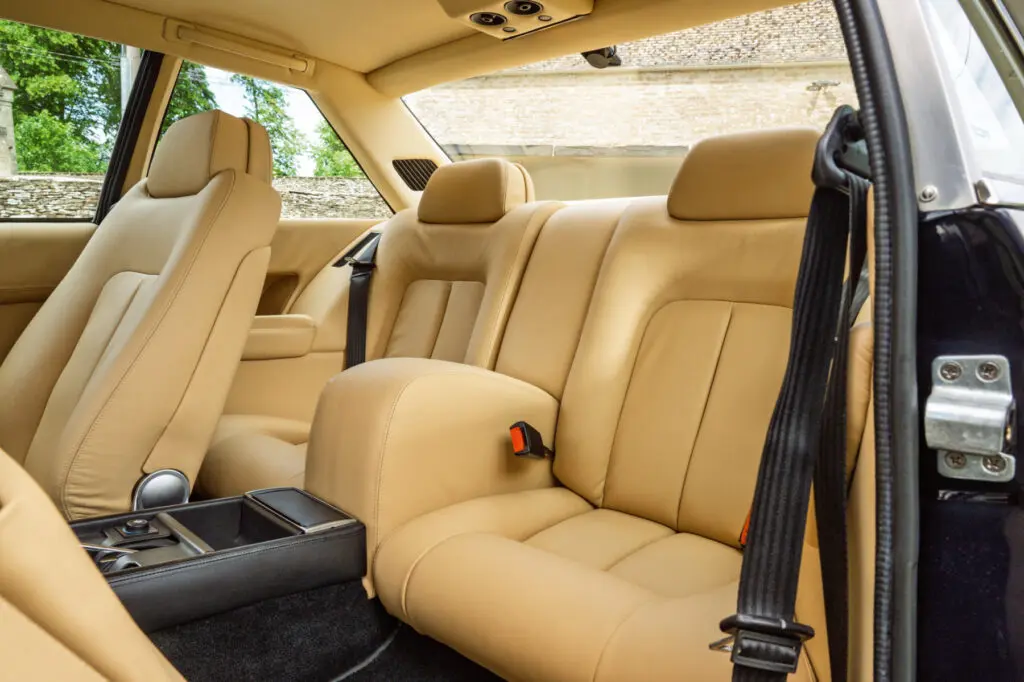
As built and delivered, chassis 79932 was finished in Verde Scuro (metallic dark green) with VM3997 Crema interior – cream leather, to you and me – and it’s one of just 21 manual cars sold new in the UK. Dr Goess-Saurau kept it only until 18 April the following year, when he sold it to a Bruce Ward, who seems to have been a car dealer, for a substantial £115,000; Mr Ward then resold it six months later with only 5139 miles on the clock to a Mr R Godin (father of classic car and motorcycle specialist Anthony Godin) for £74,500. Go, as they say, figure.
When Pete Townshend bought the car in 2008, the mileage was around 17,400 and he clearly didn’t do much tearing up and down the M4 in it before selling it in 2017, because an invoice to him that year shows the total as 18,383. The next owner spent the aforementioned £70,000 at GTO Engineering having it totally recommissioned, repainted and retrimmed, and now the car is in the care of Neil Dickens of Cotswold-based The Hairpin Motor Company. Its mileage is still under 20,000.
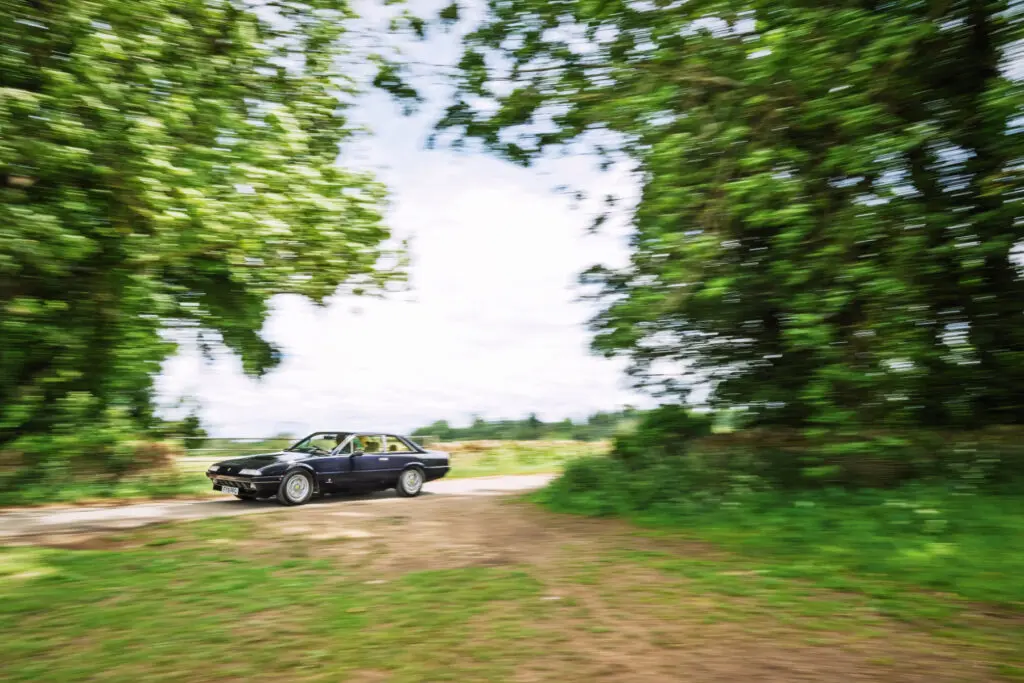
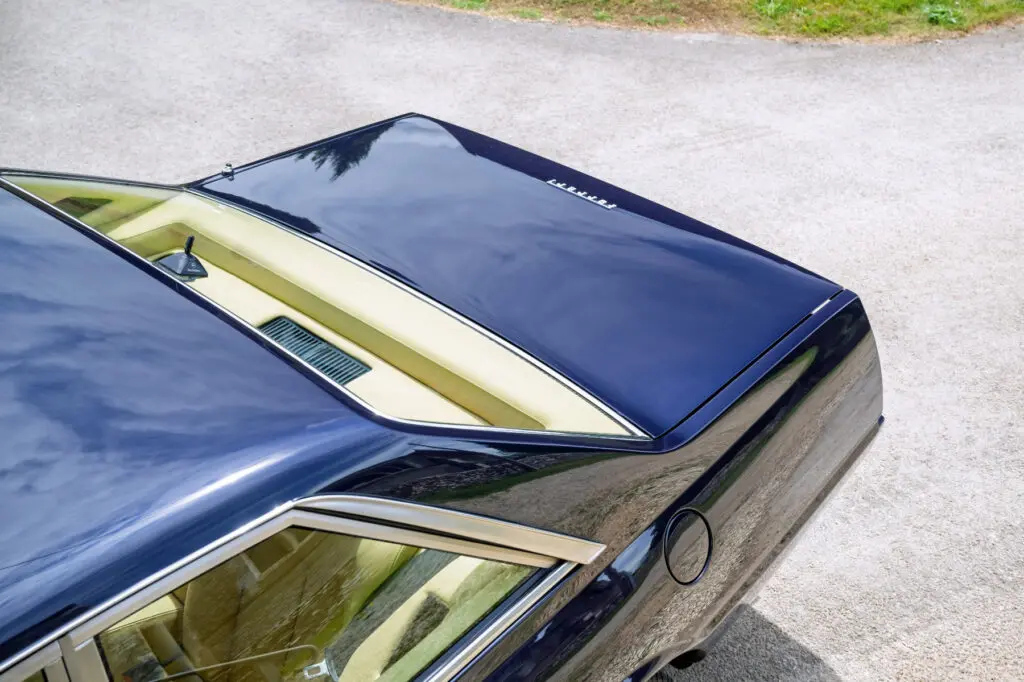
Whatever financial pain was necessary for the last owner to get it to its current state was clearly worthwhile, because this is a gorgeous example. Some, this writer included, might wish it still retained its original metallic dark green paint but there’s no doubt that the current dark blue (actually a Rolls-Royce shade called Velvet Blue) suits it very well indeed. If ever there was a car that deserved not to be painted in ‘Retail Red’, it’s a 412.
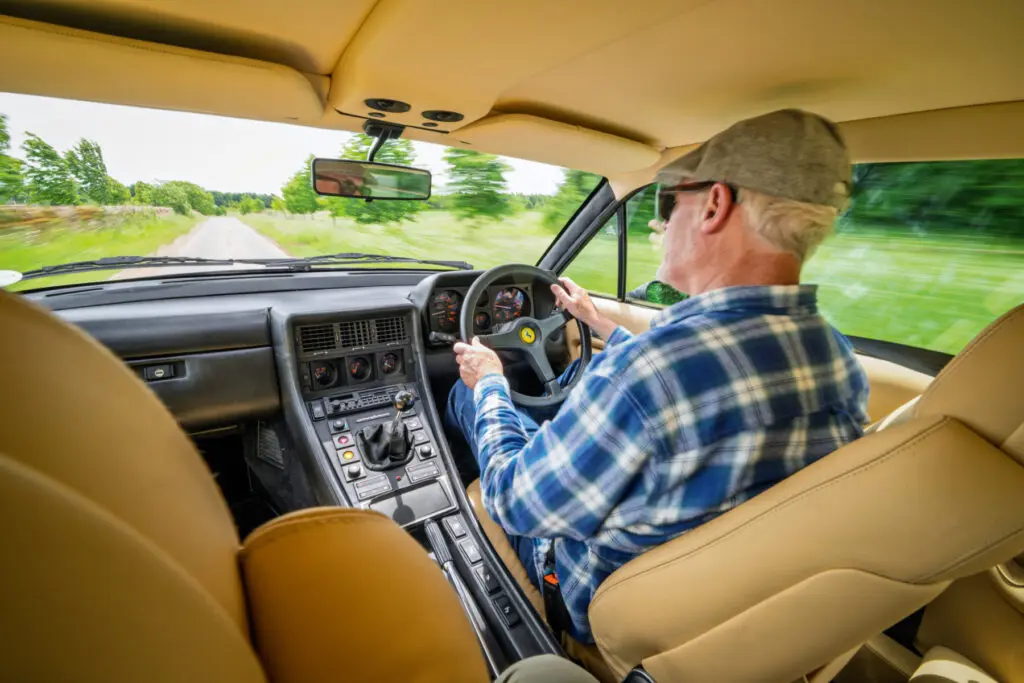
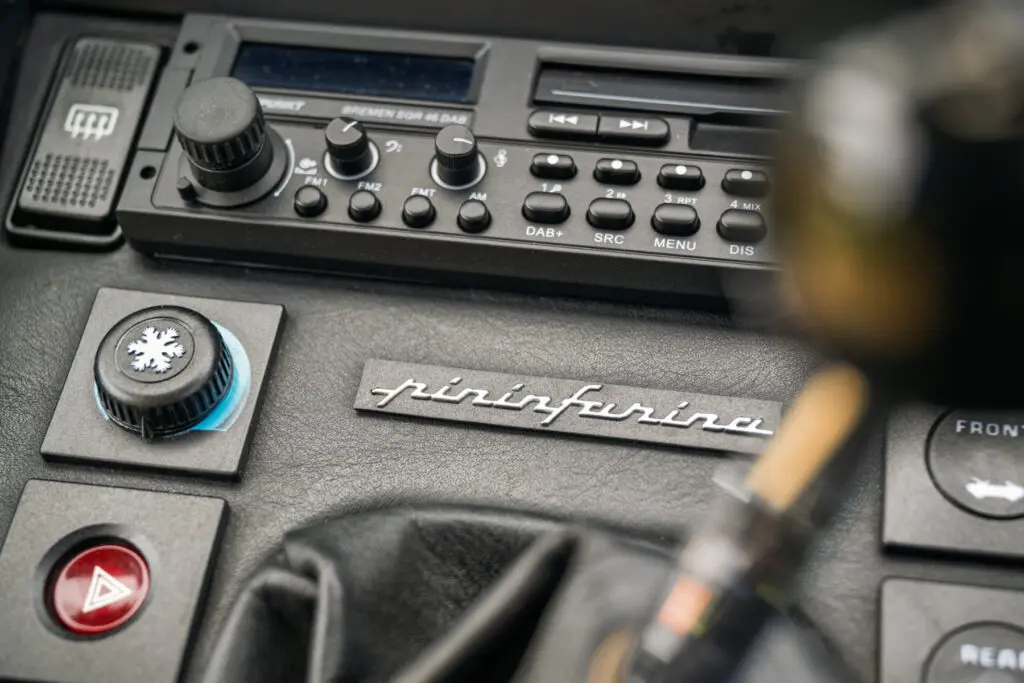
Back in 1972, the 365 GT4 that introduced this series had a slightly uneasy combo of 1960s glittery switchgear, ashtrays and wood veneer with very-’70s square-boxed black-dial instruments, but, by the time the 412 came along, that had been tidied-up into a blocky package that’s as evocative of the 1980s as power ballads and big hair. It’s very high-spec, with central locking, push-button electrical releases for bonnet, boot and fuel filler flap, power seats and windows, and separate knobs for the split-level air conditioning – glance upwards and you’ll see circular adjustable air vents set into the roof, just as in a commercial airliner. Only the tall and spindly chromed gearlever with its spherical gearknob harks back to Ferraris past, but it somehow looks (and feels) just right.
The 412 gives the impression of being a big car – but, by today’s standards, it’s not. It’s nearly seven inches narrower than a modern-era Mini and its three-box shape with a comparatively huge glass area makes it a doddle to position, even on British B-roads. There’s ample headroom for tall drivers but the pedals are massively offset to the right, such that the clutch is directly underneath the steering column. You don’t notice this so much when driving, although osteopaths might have something to say about what it must do to your lower body.
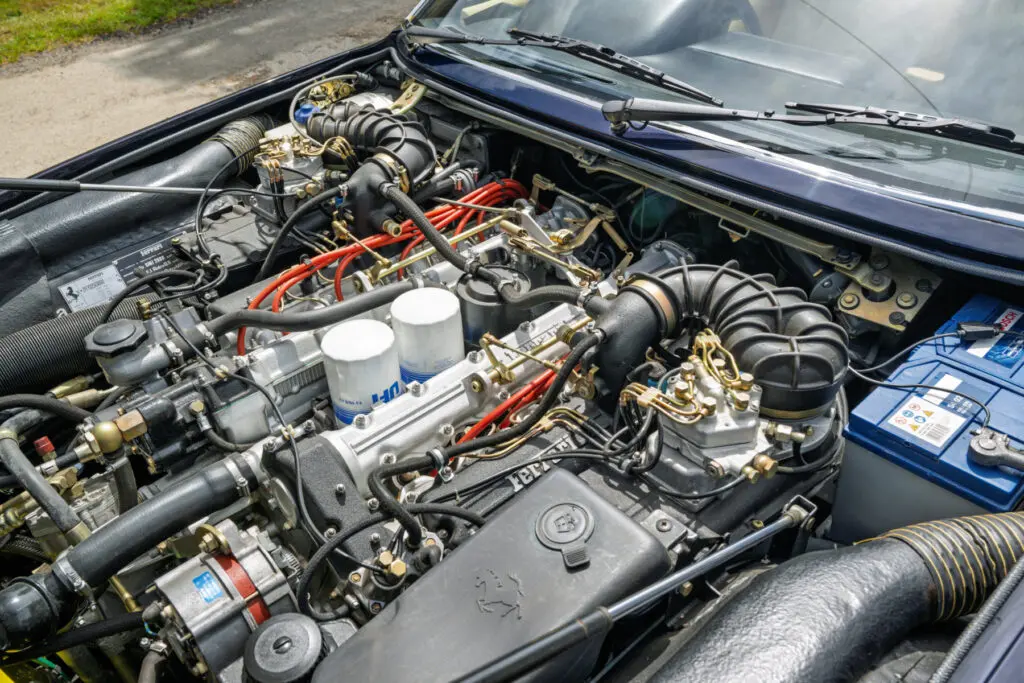
Firing up that big V12 involves none of the unnecessary theatre that characterises today’s supercars: simply twist the key, wait a few seconds while the starter motor spins furiously as fuel is pumped into those dozen cylinders, and then the motor catches easily and idles smoothly. Quietly, too. There’s just a trace of a pulse that tells you this is a ‘proper’ engine but the exhaust note is notably subdued. It’s a trait that’s maintained as you move up through the gears; this V12 never howls or snarls (although it may well sound more dramatic to those being passed) and, while its voice takes on a harder edge the more you press it, it’s always a genteel, turbine-like companion. Ninety miles per hour (don’t ask) is a relaxed cruising speed, the engine turning over at a little under 4000rpm, which is a long way off its 6500rpm redline, and there’s not much wind noise either. For once, here is a GT that really does satisfy as a continent-crossing express.
Some GTs seem to work better as automatics – having owned both manual and auto versions of the early Porsche 928, I’ll heretically propose that car as an example – but, paradoxically, the 412 is not one of them. It helps that this example’s shift is relatively pleasant: it needs decisive movements and it’s not particularly slick, but it’s not a chore to use. Likewise the clutch is not oppressively heavy, either.
By the time this 412 was built, it was the sole Ferrari still to have only two valves per cylinder rather than four but, cylinder heads aside, it’s basically a V-format version of the flat-12 Testarossa engine in a milder state of tune. Its quoted 0-60mph time is 6.4sec and the practicable top speed about 140mph; you’d be pushing the revs well beyond the redline to get to the claimed 155mph. But more important than bar-room bragging statistics is the way the V12 delivers its goods: smoothly, instantly, reliably, with over 300lb ft of torque available from just 2000rpm. On the extremely hot day of our photoshoot it never fluffed or failed to restart instantly on demand.
This laid-back performance is complemented by a relatively soft ride, perhaps a little underdamped but a welcome travelling companion all the same, and a pleasantly roll-free cornering attitude; the understeering bias of the previous 400 was dialled back for the 412, and the steering tweaked to be more direct. It’s a car you can hustle when you’re in the mood without ever feeling that it’s just waiting to bite you. Yes, ultimately you could corner faster in a Testarossa – but would you want to roll the dice and find out whether your own limits are higher than the car’s?
While we’re unlikely to see those heady days of a sub-£10,000 Ferrari ever again, buyers don’t quite seem to have cottoned on to the 400 and 412 yet. Worldwide auction results in 2023-24 show nice cars still hovering around the £50,000-70,000 mark, which is less than similar examples of the contemporary 328 GTB – a car that was pitched far below the 412 in period. Neil Dickens has since sold our feature car for considerably more than that, however, for it’s an exceptionally fine example and arguably still undervalued even at ‘top money’. Whoever bought it clearly has good taste and an appreciation of quality.
Back in 1989, Fast Lane magazine featured a then-current 412GT on its front cover with the strapline ‘The Forgotten Supercar’. The writer of the accompanying article, Peter Dron, drily remarked that it might be more sought-after if, like its Daytona predecessor, it didn’t have power steering and you needed the biceps of a superhero to wrestle it at speeds below 100mph. He concluded: ‘The 412 is really too subtle to be described as a supercar. In fact, it may be that it is altogether too subtle ever to be properly appreciated in an age of raucous vulgarity.’
You could say much the same about its classic status today: are you a 412 or a Testarossa kind of petrolhead? With apologies in advance for the contrived segue, to quote a song lyric by this particular car’s famous previous owner: ‘Who are you? Who who who who?’
1989 Ferrari 412GT specifications
| Engine | 4942cc front-mounted V12, DOHC per bank, Bosch K-Jetronic fuel injection |
| Power | 340bhp @ 6000rpm |
| Torque | 332lb ft @ 4200rpm |
| Transmission | Five-speed manual, rear-wheel drive |
| Steering | ZF worm and roller, power-assisted |
| Suspension | Front and rear: unequal-length double wishbones, coil springs, telescopic dampers, front anti-roll bar, self-levelling at rear |
| Brakes | Vented discs, ABS |
| Weight | 1805kg |
| Top speed | 155mph (claimed) |
| 0-60mph | 6.4sec |
THANKS TO Neil Dickens at The Hairpin Company, +44 1249 760686.