You’d rightly assume that being handed the keys to a 1067bhp, £1.2m Porsche restomod – one of just 26 that will ever exist – would be the highlight of any motoring journalist’s year. So it’s odd to find myself quietly relieved that I’ll get only one flying lap of the Goodwood Motor Circuit and, to stay on the right side of its decibel sensors, won’t be allowed to fully open the taps until the exit of Madgwick.
Let me explain. The first proper performance car I ever rode in was my dad’s 1989 Porsche 930 Turbo. To a nine-year-old, this frog-eyed, whale-tailed machine possessed cartoonish acceleration. Every time the laggy turbo hit, the shove pinned my head towards the rear parcel shelf as I sat giggling in the back seat. With around 300bhp, that 930 may be meek and mild by modern standards, yet its penchant for snap-oversteer earned it the ‘Widowmaker’ nickname.
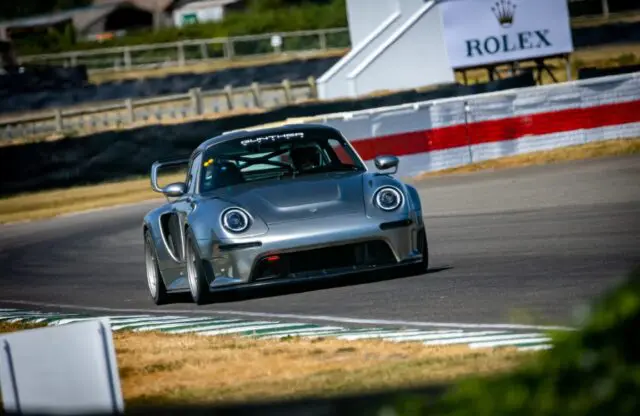
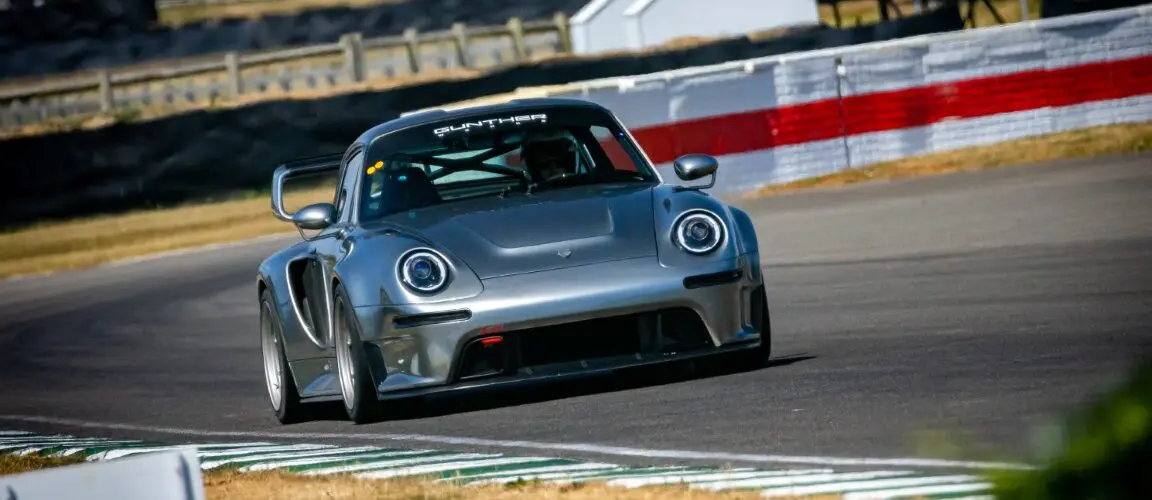
If the 930 was the Widowmaker, I’m not quite sure what sinister nickname the car waiting for me in the Goodwood paddock deserves. It has three and a half times the power, is 103kg lighter and remains rear-engined with a short wheelbase. This 993-based creation, the F-26, is the most extreme machine California-based Gunther Werks (GW) has ever conceived.
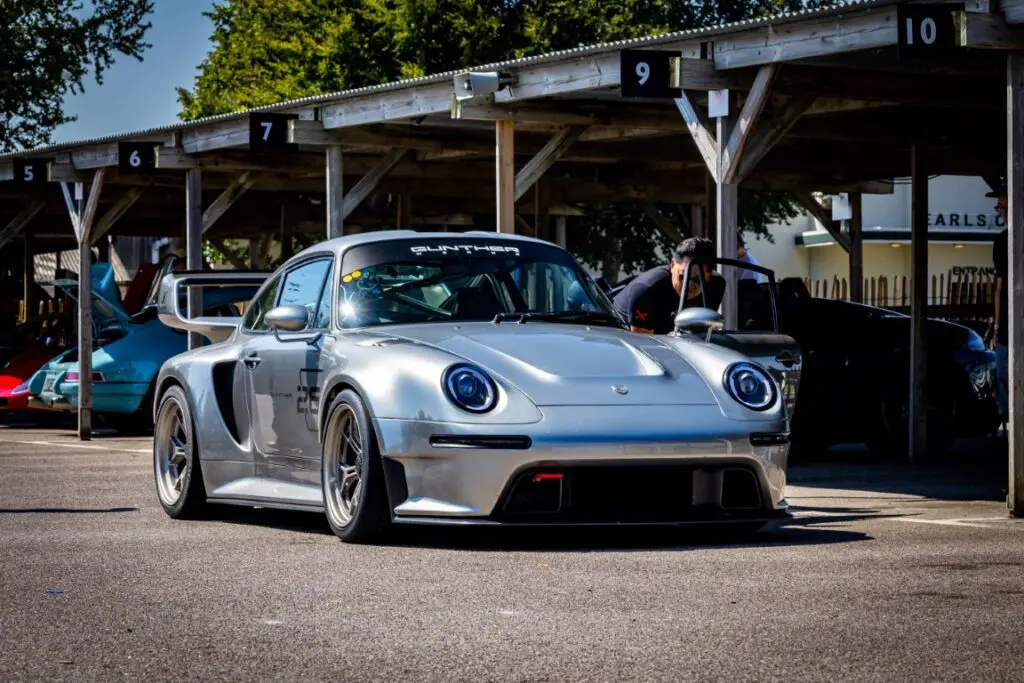
While four-figure outputs are hardly a novelty these days, it’s remarkable that the F-26 generates up to 1067bhp and 750lb ft from the air-cooled engine slung behind its rear axle. More impressive still, the flat-six retains just two valves per cylinder and is directly related to the 3.3-litre Mezger in my dad’s old 930 Turbo.
To achieve that kind of power, GW enlisted Oregon-based engine builder Rothsport Racing. Unsurprisingly, the engine block is essentially the only original component left. Bored and stroked to 4.0 litres, it benefits from forged internals and is governed by a custom-programmed Motec ECU that allows an 8000rpm redline. The headline power figure does come with the caveat of filling up with E85 fuel, although 1000bhp is still achievable with regular high-octane petrol.
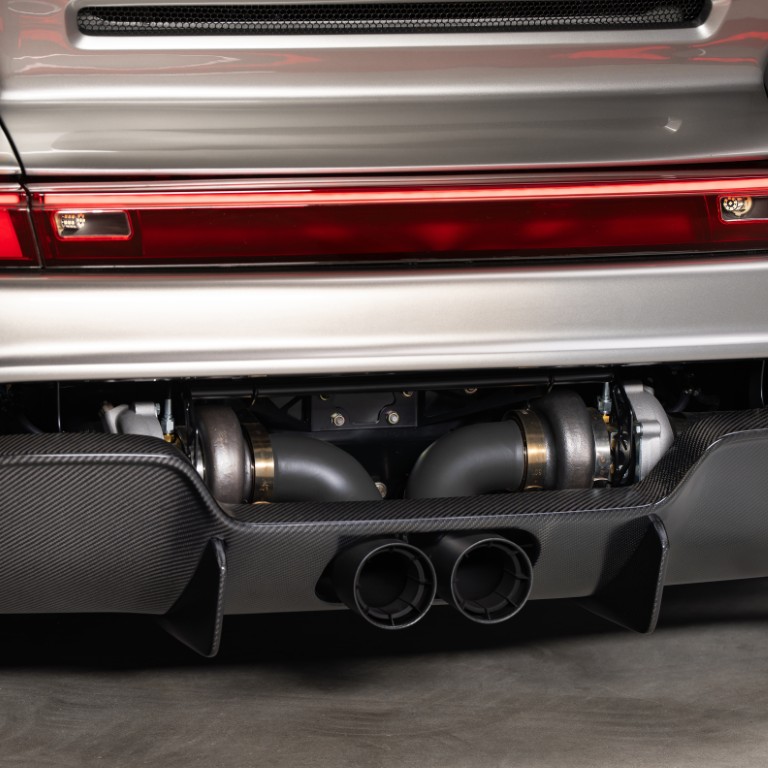
Feeding the engine are twin Garrett turbochargers that peek through the F-26’s rear bumper. Their low-slung positioning deliberately apes the layout of Porsche’s fearsome 935 race cars and keeps the exhaust tubing shorter and straighter to free up yet more power.
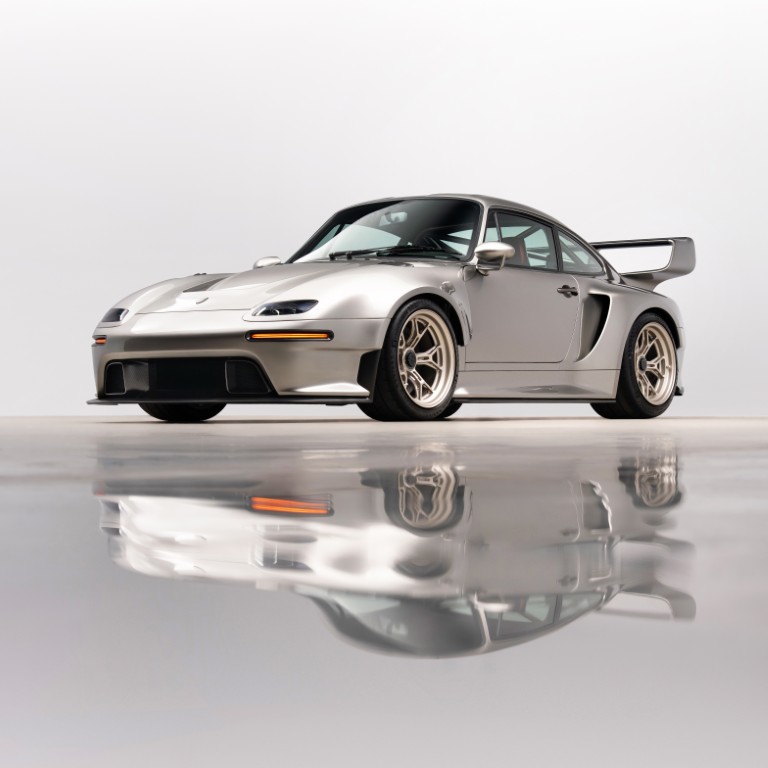
Despite being equipped with a traditional 993 front end at Goodwood, the 930 Flachbau (slant nose) was another source of inspiration. GW opted for a slant-nose front end primarily because it’s more aerodynamically efficient. It’s worth mentioning that the F-26 wore traditional round headlights to satisfy EU regulations during its visit to the UK. GW supplies the car with both front ends, allowing owners to swap between them.
The lightweight carbonfibre bodywork is manufactured entirely in-house, with every surface honed using computational fluid dynamics (CFD). The digital work was then validated on track by former Porsche factory driver Patrick Long, whose lap times and feedback confirmed the computer’s calculations.
Consequently, every cutaway, vent and duct in the carbonfibre is there to aid cooling or aerodynamics. Chief among them is the vast S-duct scalloped into the bonnet – a piece of downforce-generating trickery pioneered by Ferrari’s championship-winning F2008 Formula 1 car.
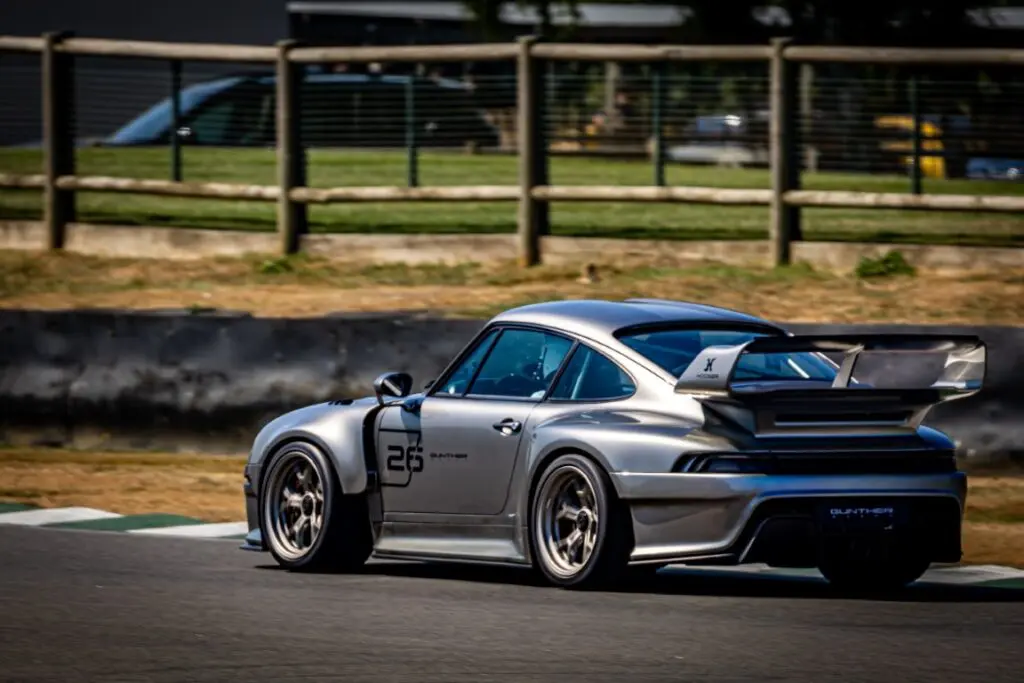
The gigantic rear wing is the most attention-grabbing feature of the entire car and, arguably the only place where aesthetics trumped outright performance. GW admits the design was ultimately chosen because it looks right, passing over alternatives that would have generated a few more points of downforce. Physics wasn’t entirely ignored, though – hence the neat Gurney flap running across the mainplane.
No amount of cleverly shaped carbonfibre can disguise the shortcomings of a chassis nearing its 40th birthday, although GW argues the 993 is a better starting point than its age might suggest. Even so, blessing the 993 structure with modern levels of rigidity posed a significant engineering challenge.
To overcome it, GW called upon veteran US race engineer Trevor Harris, whose CV includes the innovative AVS Shadow Mk1 Can-Am racer and Nissan’s IMSA-winning GTP ZX-Turbo and NPT-90 machines. Harris bolted a bare 993 chassis to a bench and physically twisted it to zero in on its weak points.
His solution was a trio of structural ‘boxes’ at the front, middle and rear, tied together with bracing concealed beneath the carbonfibre panels. Combined with seam welding, the work brought a torsional stiffness improvement of more than 150 per cent, at the cost of the rear seats and just 30kg of weight, including the optional roll cage.
The suspension is similarly uncompromising. Double wishbones replace the 993’s MacPherson struts at the front, a bespoke multi-link arrangement sits at the rear, and every pivot is rose jointed. Adaptive JRZ dampers capable of adjusting their rates 1000 times per second work with a track-focused geometry running three degrees of negative camber at the front.
Complementing the suspension hardware are massive carbon-ceramic discs clamped by six-piston front and four-piston rear calipers borrowed from the R35 Nissan GT-R. They sit behind lightweight 18-inch magnesium monoblock wheels, shod in racing slicks for the car’s Goodwood outing in place of the usual Continental ExtremeContact Force rubber.
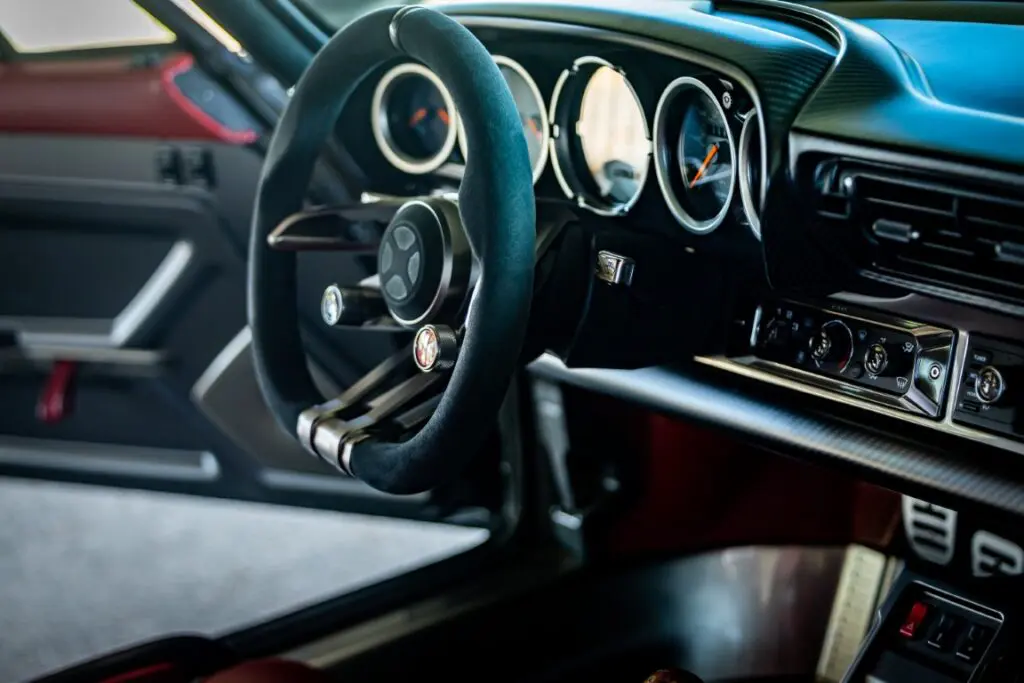
Climb inside and the F-26 is still recognisably a 993. The driving position retains its familiar skew, with pedals offset towards the car’s centreline, and the five-gauge instrument cluster sits exactly where Stuttgart left it. Look closer, though, and almost every component has been upgraded, modernised or remade in carbonfibre.
The effect is stark, but it never feels austere. GW designs and manufactures its own figure-hugging carbonfibre bucket seats and the pedal box is ideally spaced for heel-and-toe downshifting. For me, the futuristic Alcantara-trimmed steering wheel is the least convincing item aesthetically, but it sits nicely in the hands and its rotary selector for the Comfort, Sport and Track drive modes adds a dash of modernity. Between the seats, the six-speed manual transmission’s exposed shift linkages are topped by a wood-turned gear knob reminiscent of the Porsche 917’s.
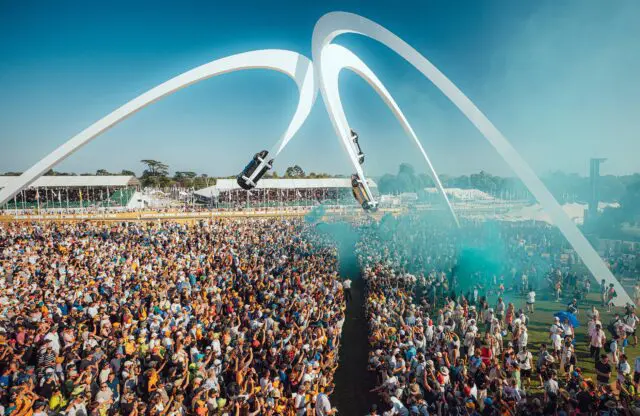
Strapped in with a four-point harness, it’s time to reveal the results of all that engineering. Well, most of it, anyway. Following a mis-shift during its Festival of Speed Shootout runs – with former F1 driver Scott Speed at the wheel, no less – GW has wound the boost back to 900bhp as a precaution. That’s still an indecent amount in a rear-engined, rear-wheel-drive Porsche, and the fact the company pressed ahead with media drives at all says everything about its faith in the engine.
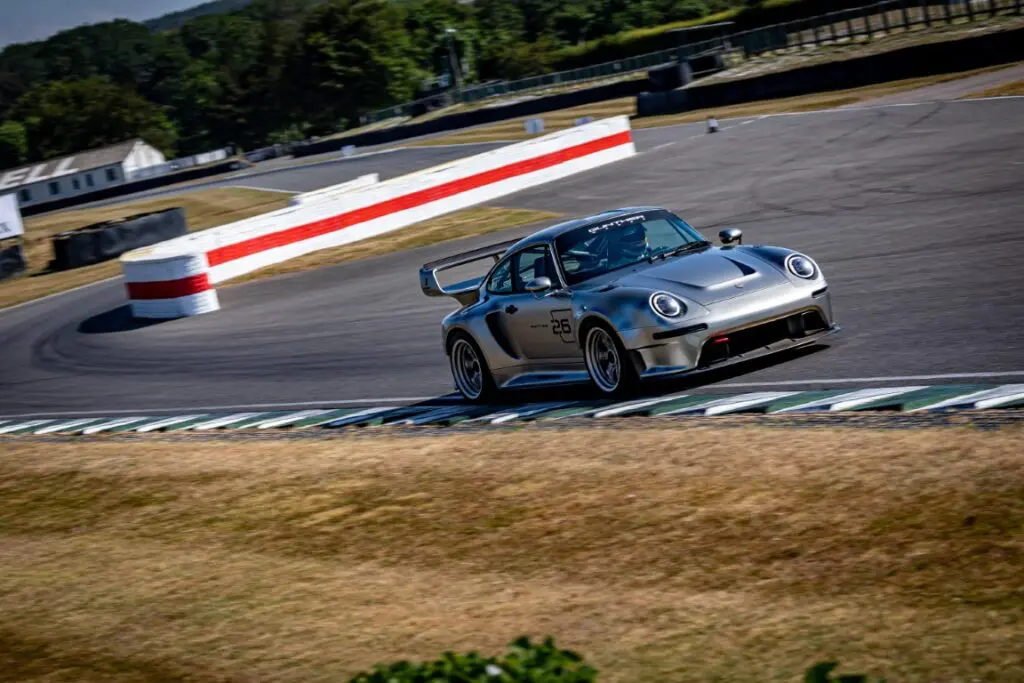
The first surprise comes on the ten-second drive from paddock to pit lane. Machines like this are often recalcitrant at low speed – heavy controls, grabby clutches, noise and vibration fired straight into the cabin unfiltered. Not so the F-26. It’s certainly no grand tourer, but it’s jarringly civilised, happy to creep along at walking pace while you acclimatise. And the view out, thanks to that upright 993 glasshouse, is excellent.
Once on track, it takes very little throttle for the real F-26 to reveal itself. Squeeze the accelerator and there’s no noticeable turbo lag – the car simply surges towards the next corner, acceleration punctuated only by each satisfying snick of the gear lever.
Even at 900bhp it feels hypercar-fast. Adding to the drama is the boosted bark of the flat-six sitting behind you, which emits pops and crackles with a proper mechanical edge when you lift. No wonder the car has been flirting with the circuit’s noise limit.
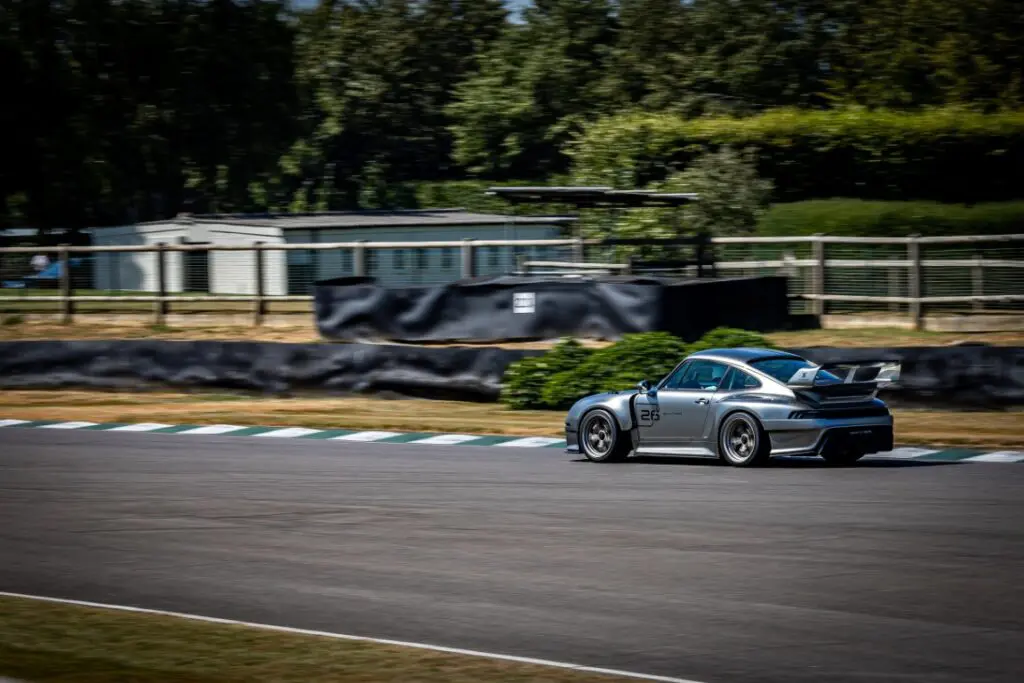
The chassis is similarly convincing. There’s a touch of body roll to communicate what the tyres are doing – but no more than that – before everything settles and the F-26 slingshots out the other side. The brakes are powerful, firm and progressive, the engine responding keenly to downshift blips.
The front end is the sharpest I’ve experienced this side of a GT3 Cup, biting into the track with little discernible understeer. But this is still a car that demands respect. Feed the throttle in calmly and progressively, or you risk provoking the pendulum that lives out back.
Less than ten minutes of seat time is nowhere near enough to take the measure of any car – let alone one this motorsport-focused. But the fact I climbed into the F-26 with a head full of Widowmaker tropes and climbed out frustrated I couldn’t get deeper under its skin says a lot.
A post-drive chat with GW founder Peter Nam confirms I’m not the only one left wanting more. Mere days after watching the F-26 charge up the Hill at the Festival of Speed, he’s already focused on next year’s entry, which he promises will be even faster.
Whatever he creates next, I’ll be queuing up for a drive – and hoping for a lot more seat time.