Only the most ardent enthusiasts would recognise many of the marques in Motor Sport‘s report from the 1951 Earls Court Motor Show. Allard, Jowett, Lea-Francis, Frazer-Nash, Hotchkiss – the list goes on. And there, buried between MG and Riley, a few polite lines are devoted to a curious newcomer, a pair of small German cars brought over by the Connaught Engineering racing concern, their humble Volkswagen-derived engines positioned in the boot.
The press of the day were quietly impressed. Autosport praised the little coupé’s speed and slippery aerodynamics, and the crowds took notice. But few in the hall that October could have guessed what this curious newcomer would become. Porsche would not only outlast most of the major British manufacturers on show, but would grow into one of the most loved and influential carmakers in the world.
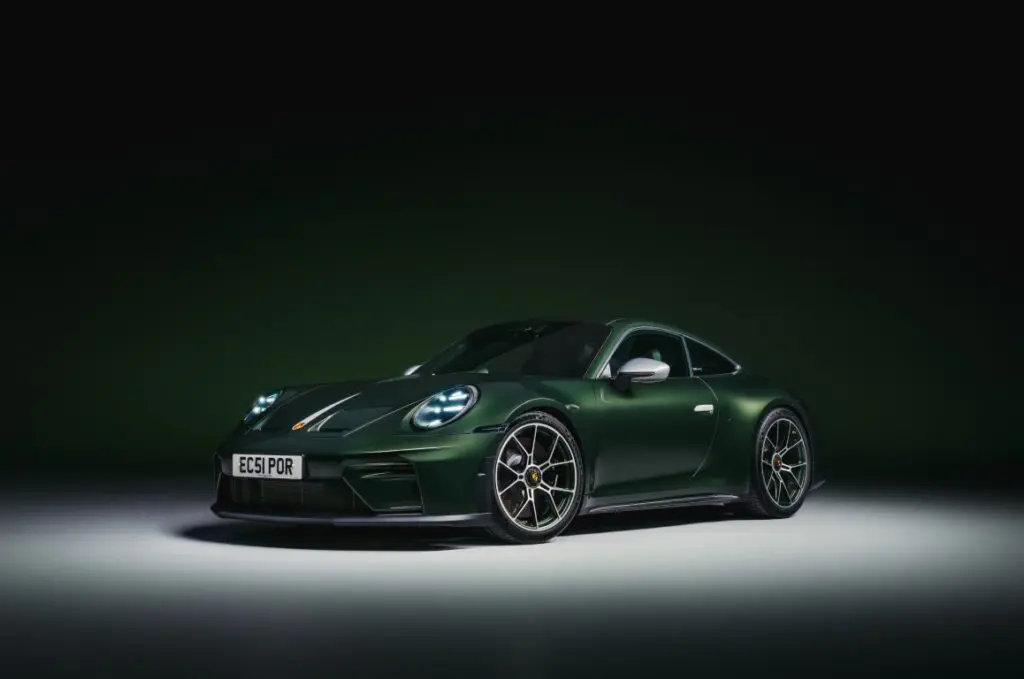
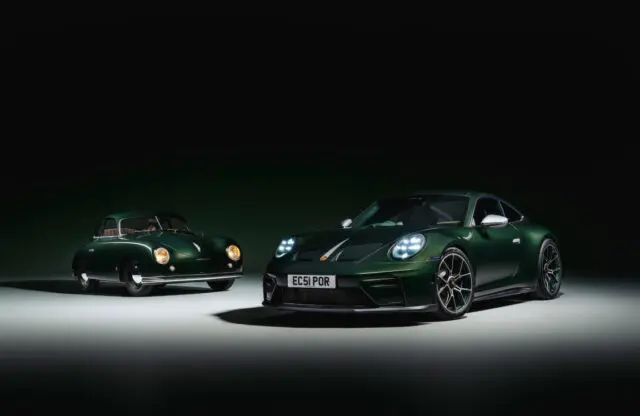
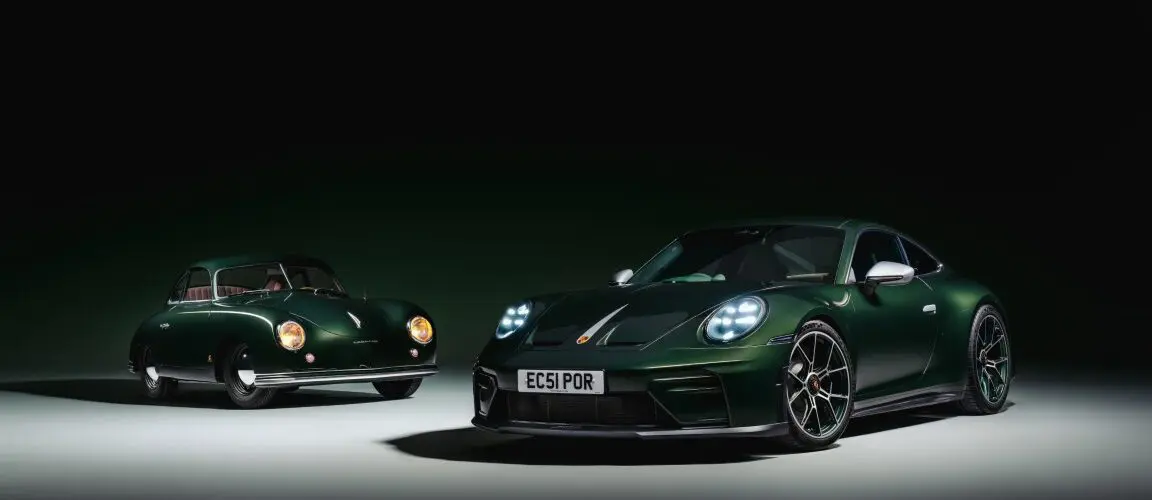
Seventy-five years on, Porsche is marking the anniversary of its Earls Court debut with a pair of very special machines that bookend its presence in the UK. The first is the 911 Earls Court 51 Edition, based on the current 4.0-litre naturally aspirated flat-six-powered 992 GT3 Touring, with no mechanical changes. Conceived by Porsche Cars GB and limited to just 51 examples, the special edition will be allocated through the brand’s UK dealer network. Each is finished in a bespoke shade of Earls Court Green inspired by the 356 coupé that graced the stand. Even the car’s £251,951 list price serves as a nod to history.
The second car – a 1951 356 Pre-A Split-Window – is equally significant. This left-hand drive example was originally imported into the UK by an American serviceman and was campaigned in period by race and rally driver Betty Haig, before joining Porsche GB’s heritage fleet, its home for nearly half a century since. After decades on display at the company’s Reading headquarters, it was quietly delivered to Porsche’s Sonderwunsch division in its native Germany. It returns to UK soil wearing the same Earls Court Green as the GT3.
A few weeks before the official reveal, Octane attended a private studio preview with both cars and the two men who led the project: Porsche GB product manager James Swarbrick and Porsche Classic manager Paul Kitchen. Although the cars are separated by 75 years, the family resemblance is plain to see, emphasised by their mirrored specifications. And the pair’s enthusiasm needed no prompting, with Kitchen confessing the preview was the first time he’d seen the finished GT3 in the metal.
Both cars look stunning wearing their deep green metallic paintwork – particularly under bright studio lights. The colour is a modern interpretation of the flat shade worn by the Earls Court coupé, rather than a faithful copy, and that philosophy runs through the specification of both machines. ‘We didn’t want an exact replica,’ Swarbrick explains. ‘Everything was along those lines – how could it be modernised?’
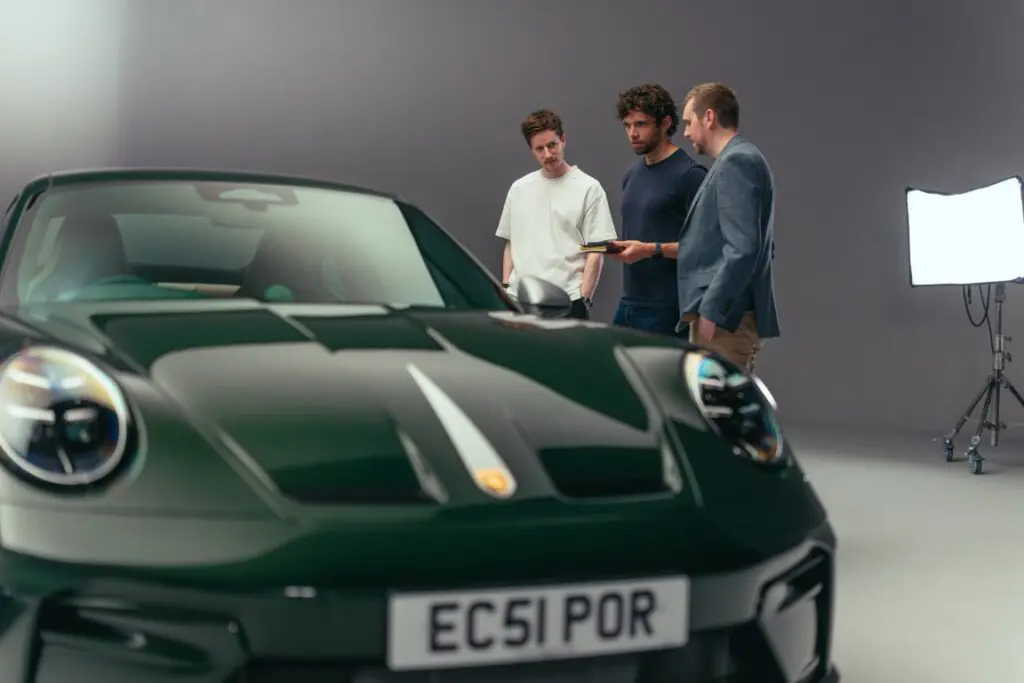
Subtle homages to the 356 are everywhere on the GT3. A Brilliant Silver stripe cuts through the middle of the bonnet, mimicking the chrome strip that decorates the 356’s nose, while the door handles and mirrors are finished in silver to reference the classic Porsche’s chrome metalwork. The alloy wheels are painted in the same colour as the bodywork, with contrasting silver lines that nod to the 356’s green-painted steel wheels and polished hubcaps.
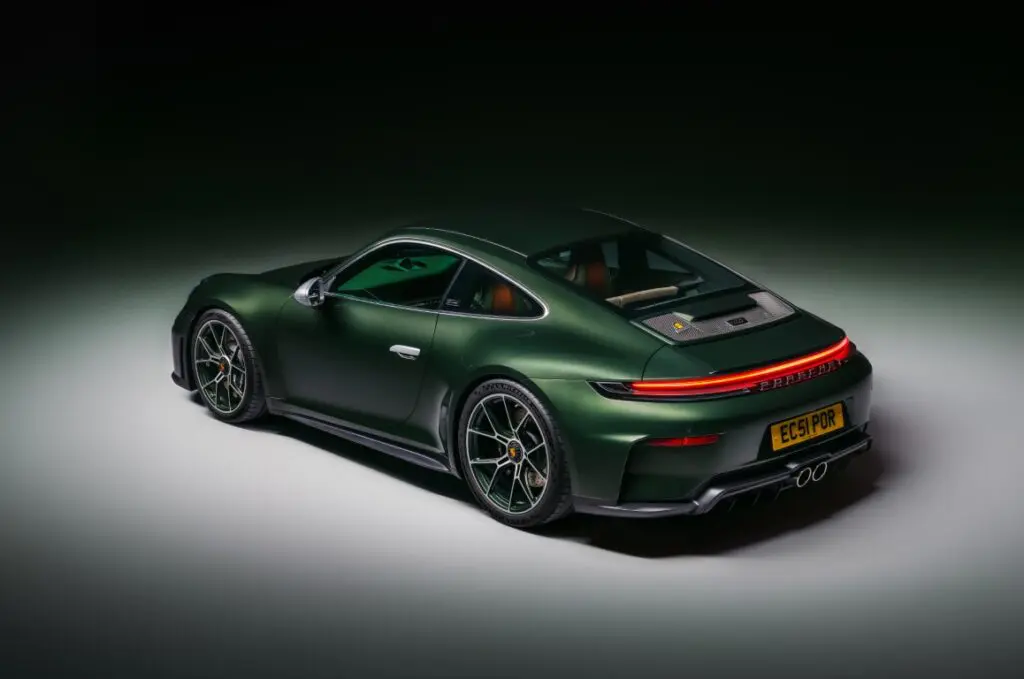
At the rear, the GT3’s flat-six engine cover grille is framed in green with a silver mesh, echoing the brightwork of the older car’s tail end. The engine cover is embellished with a bespoke ‘Earls Court 51’ badge inspired by the plaques of Reutter, the Stuttgart coachbuilder that bodied early 356s. A genuine Karosserie Reutter emblem is riveted to the 356’s front wing just a few feet away.
At first glance, the 356 could pass for a concours restoration. It isn’t – and the distinction matters to Porsche. ‘If it was back to original factory specification, it would be a restoration,’ Kitchen says. ‘We call it a recommission – we’ve changed the paint colour, the interior and everything around it.’
The car’s flawless presentation belies a harder early life than its decades in the heritage fleet might suggest. ‘The front and rear sections were about an inch and a half too short, because of repairs over time,’ Kitchen continues. ‘Someone had nicked off the lower sections front and back – I’m pretty sure that happened when it was racing. The bodywork alone took close to six to eight months.’
The thoroughness of Sonderwunsch’s work becomes more impressive the closer you look. Everything – from the brightwork to the trim rubbers, brake lines, wiring and fuel system – has been renewed. Even a new battery box has been fitted, where for years the battery simply sat loose. Mechanically, the original 1.1-litre flat-four has been serviced and treated to a gentle tune – ‘just to make sure that it would work if we had the opportunity to drive it,’ Kitchen says.
Many of the highlights of the project are found in the cabin. Wood was a prominent feature of the 356’s interior – most notably along the door tops that double as door handles – and the material is used to link the two cars. ‘We used the inspiration of the wood from the 356 and translated it into the GT3,’ Kitchen explains, ‘but then used the materials of the modern-day car in the old car, to make sure the two finishes are the same.’
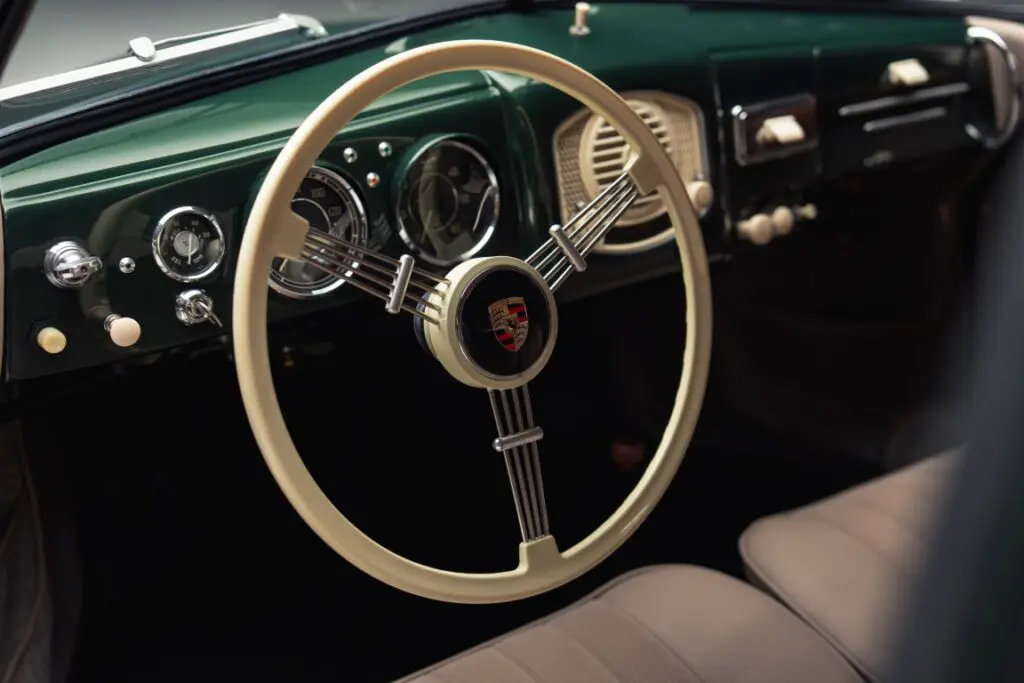
So, while the original wood in the 356 was pale and glossy, it now wears the same satin-finished Paldao veneer that cascades across the GT3’s dashboard, doors and centre console. It marks the first use of wood in a GT3 interior. ‘It’s unusual to see wood finish on a modern sports car,’ Kitchen smiles. ‘It’s usually reserved for big wafty cars.’
The rest of the GT3’s cabin represents a similar departure from the current catalogue. Night Green and Chalk Beige upholstery is paired with corduroy seat inlays and door panels to reinterpret 1950s fabrics. ‘Even with the GT3 Touring, you’ve got a slightly less racy interior, but we’ve never had a proper heritage interior on a GT3,’ Swarbrick says. ‘It’s very bespoke. If someone came along with a Touring and wanted to recreate this – you can’t, very easily.’
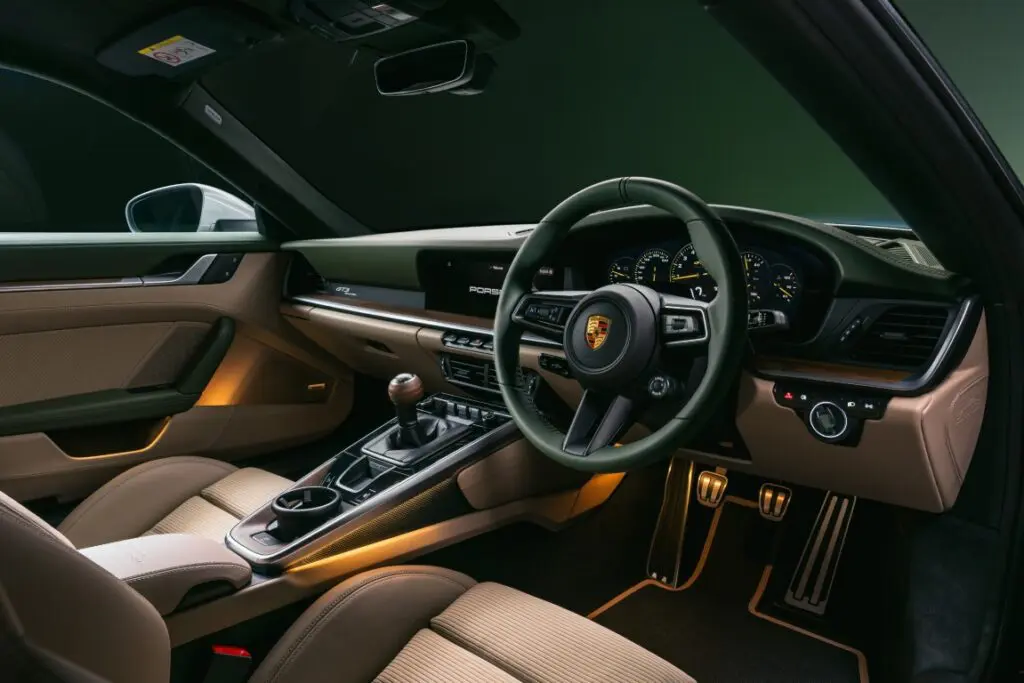
A subtle flourish is embossed into the driver’s end of the dashboard: a 356 silhouette above the motto ‘driving in its purest form’, the model’s original period tagline rendered in a Porsche designer’s own handwriting. When asked whether they had to hunt down the designer with the neatest script, the pair laugh – but don’t entirely deny it.
The 356’s interior follows the same obsessive attention to detail and some of it, surprisingly, happened in public. At last year’s Goodwood Revival, Porsche quietly brought along the car’s door cards, where they were trimmed in the open by the young upholsterer entrusted with the interior at Sonderwunsch. ‘People had seen it – but they didn’t know what they were looking at,’ Kitchen grins.
Then there’s the gear knob. The 356 left the factory with a Bakelite item, but it’s now fitted with a hand-turned wooden version inspired by the 917 race car that matches the GT3’s bespoke knob. ‘It’s such a small detail, but it was hand-turned on a lathe by one of the guys at the facility,’ Kitchen says.
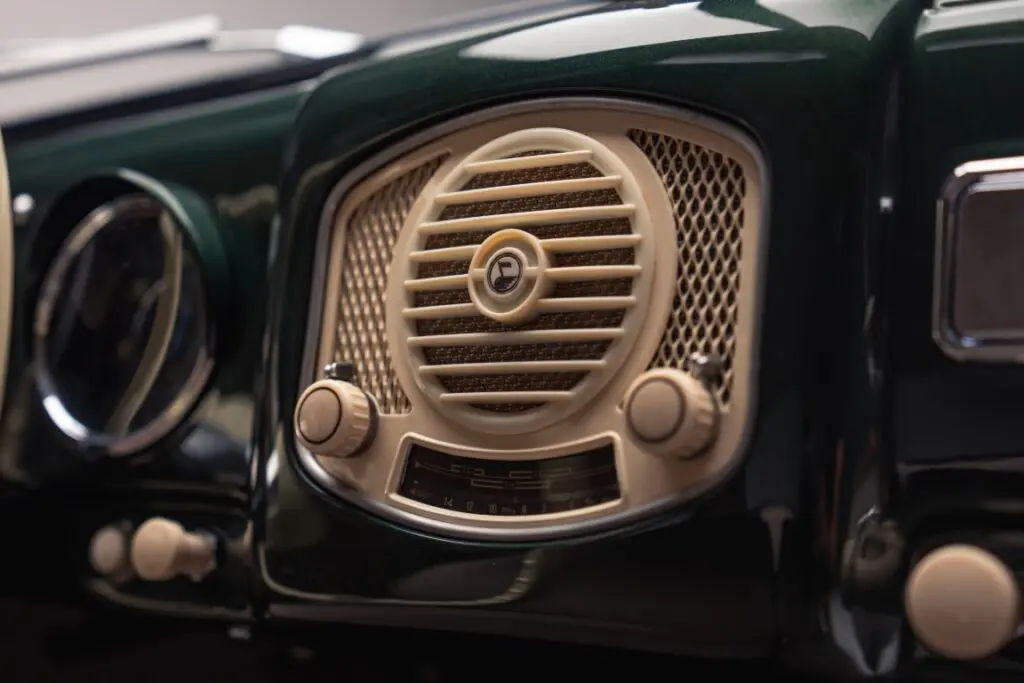
One of the most charming touches, however, is the radio. The original Becker Monza remains in the dashboard and, as in period, can still be removed from the car for a roadside picnic. Despite the period appearance, the team introduced a touch of modernity with an AUX socket concealed beneath the dash. ‘Not that we’re planning on any long road trips,’ Kitchen admits, ‘but if we wanted to, we could at least listen to some music.’
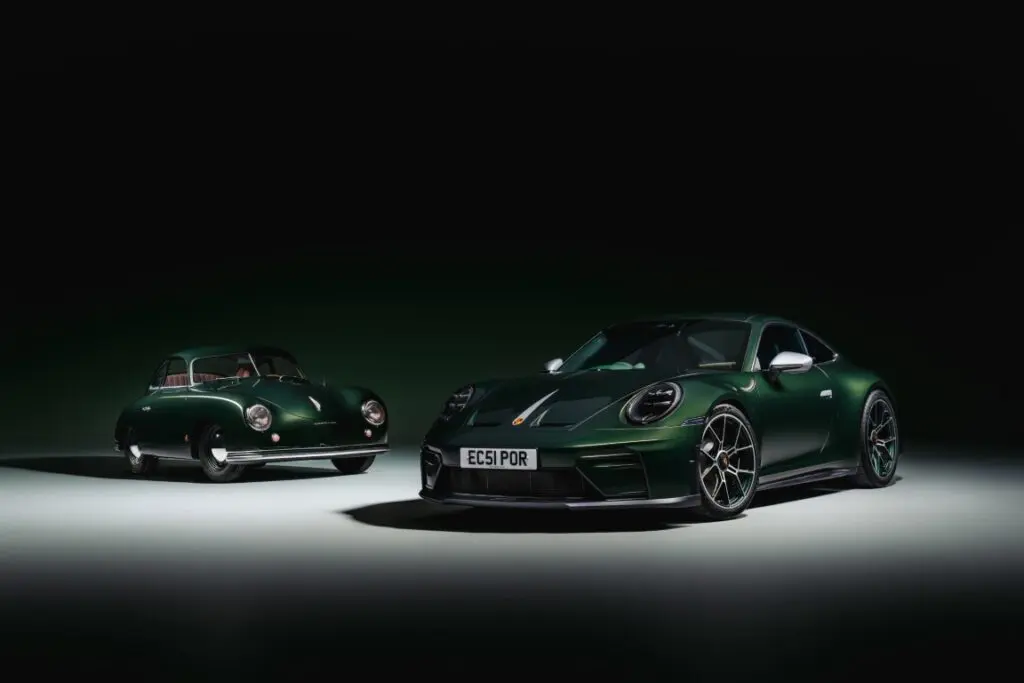
Both cars will remain in Porsche GB’s heritage fleet, with the GT3 serving as the pre-production prototype ahead of the 51 customer cars. They will make their public debut together at Icons of Porsche: Sunstede Silverstone Edition on 21 June, celebrating the marque’s 75 years in Britain.
Displayed side by side, they tell the story of a little-known German marque whose modest stand at Earls Court quietly heralded the beginning of one of the motoring world’s greatest success stories.