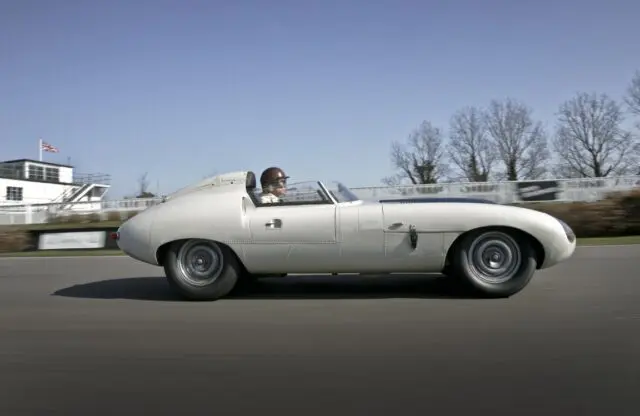
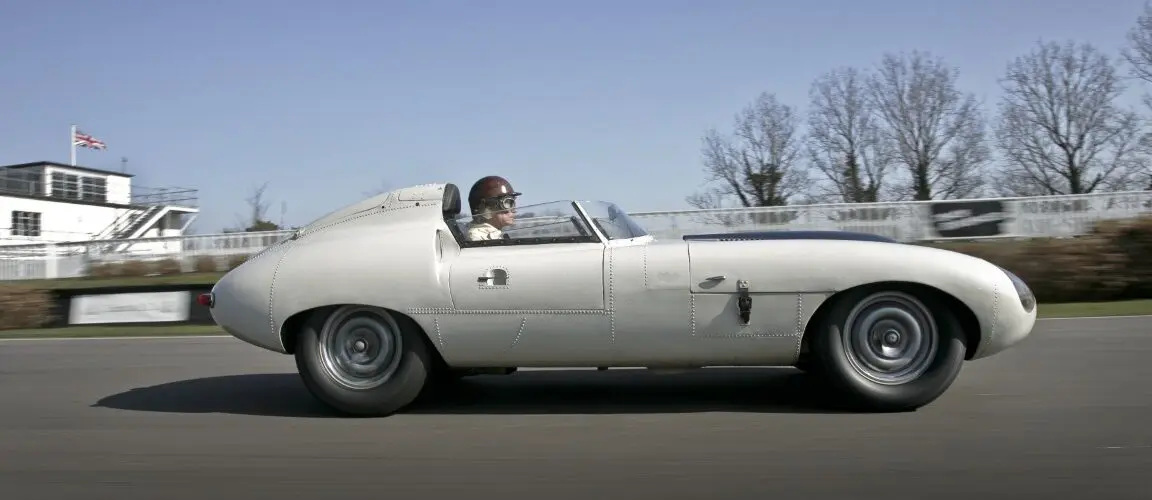
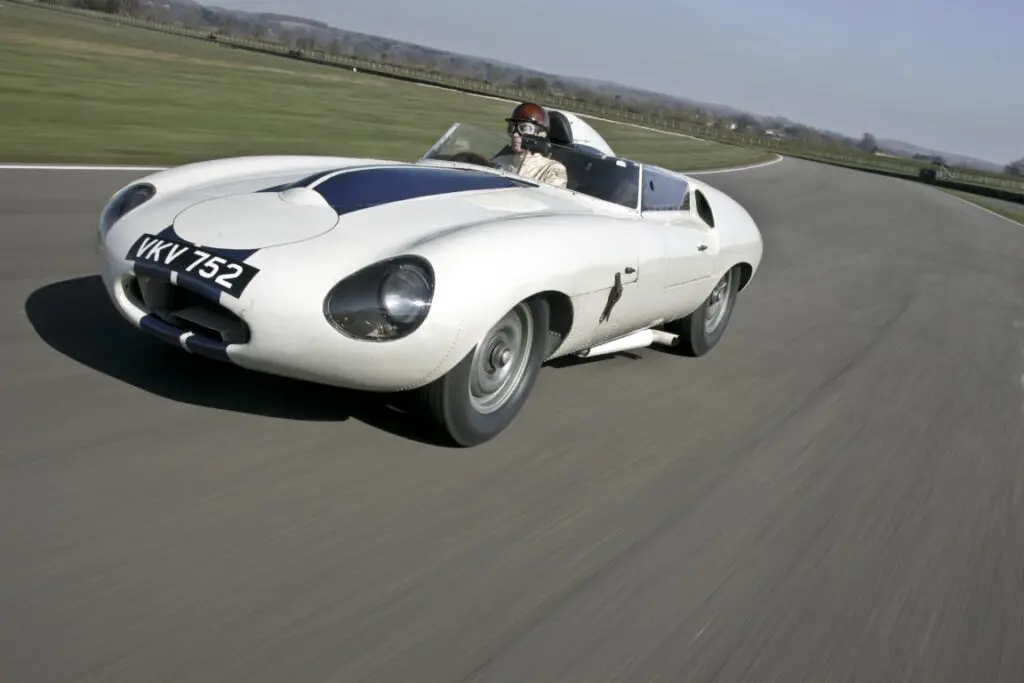
People call it the missing link between D-type and E-type but this 50-year-old Jaguar prototype never went missing. This is the one and only E2A, a Jaguar of huge significance. Former employee Roger Woodley and his wife Penny Griffiths saved it from routine scrapping in 1967 and, thanks to them, it was neither lost nor left to rot in some barn.
This feature first appeared in Octane issue 85.
In 2008 it went for $4,957,000 at Bonhams’ Quail Lodge sale, making E2A the most valuable Jaguar ever sold at auction. Its discerning owner now is Stefan Ziegler and the car is properly cared for by leading historic Jaguar experts, CKL Developments.
Back in 1960, the Jaguar public relations people worked hard to stress that E2A was not a works entry in the Le Mans 24 Hours. Jaguar had withdrawn officially from competition after 1956, claiming to rest on its laurels. Two days before Le Mans 1960, The Autocar published full details of the ‘Jaguar New Competition Car…Logical Development of D-type’, including the words, ‘The position is that Briggs Cunningham has persuaded Sir William Lyons to place at his disposal one of the several models on which the company have continued development during the past five years.’
That flowery, indigestible mouthful was subtly misleading. You can just hear that PR man: ‘Now look, old boy, this isn’t a works car, you know, and it would be frightfully helpful if you could make that clear.’ Well, they all fell for it.
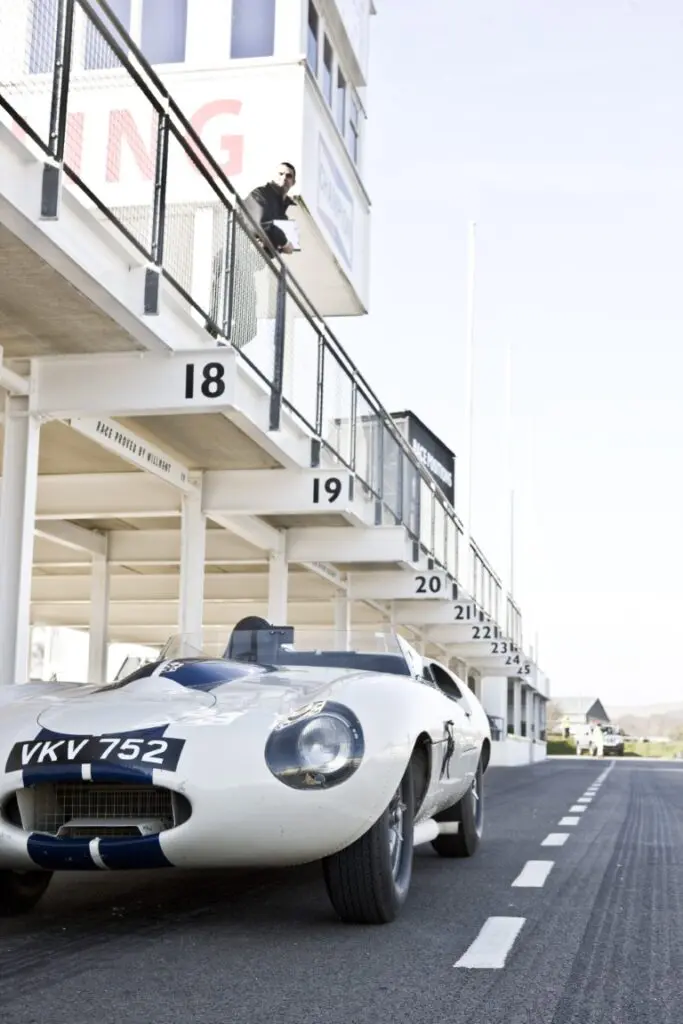
Far from being closed down in 1956, Jaguar’s Competition Department remained secretly active, as Peter D Wilson revealed in his most readable 2008 book, Cat Out of the Bag. Peter joined the Competition Department in September 1961, recalling a clandestine operation which built prototypes and prepared ‘competition Jaguars, all ostensibly raced by privateers, but invariably amongst them lurked works cars, attended by works mechanics…’
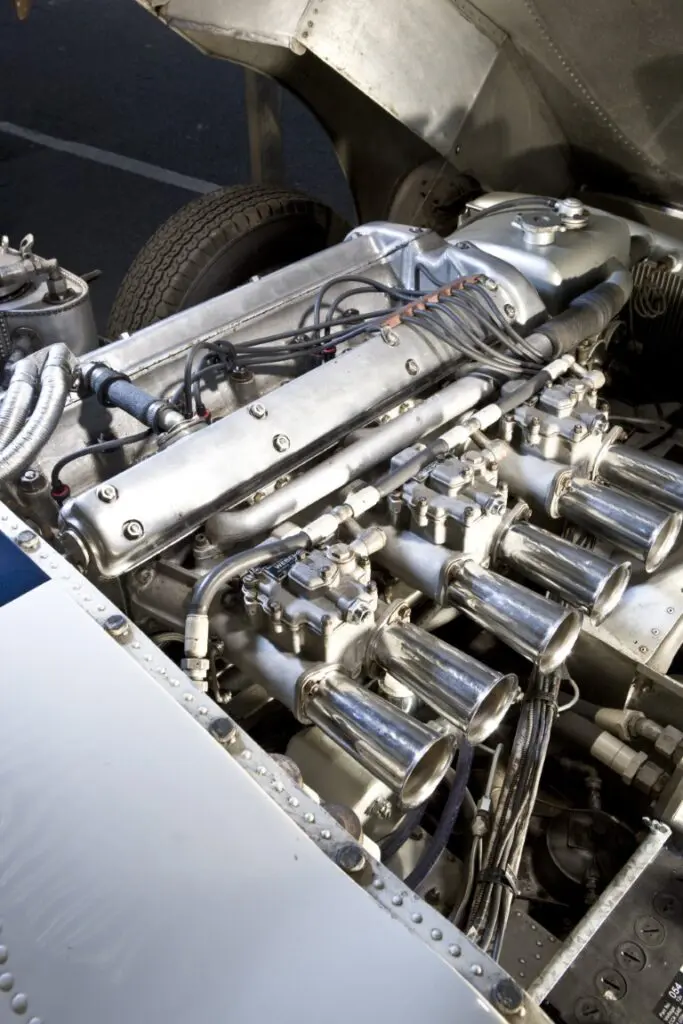
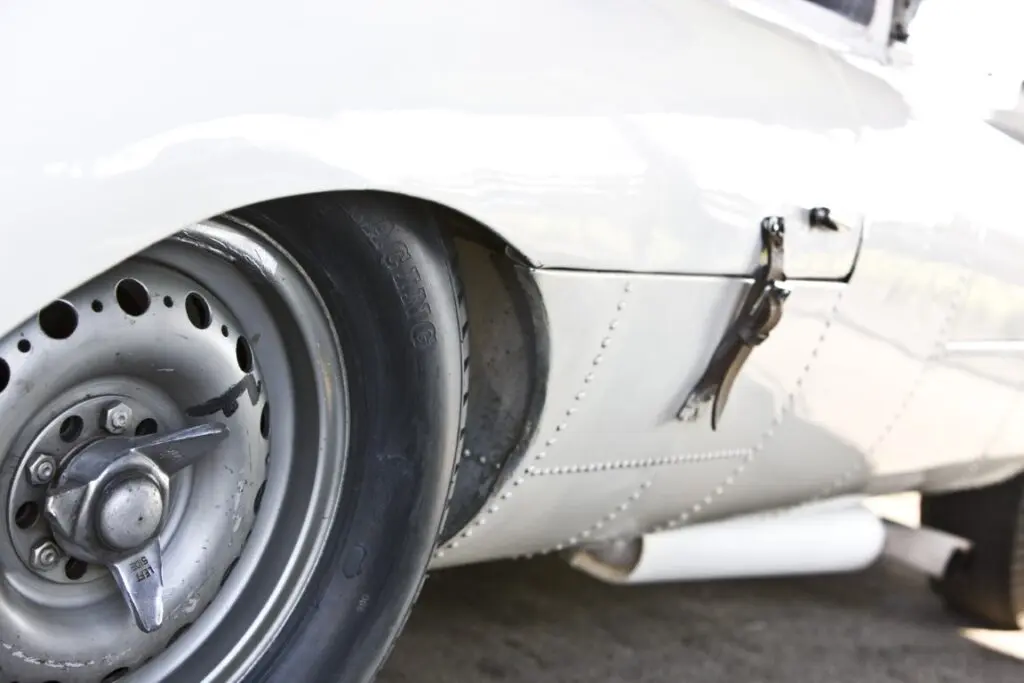
E2A was indeed a works racing car, a one-off competition prototype version of the new E-type, which was to stun the world in 1961. E2A’s monocoque central section, extended to the rear, was of aluminium instead of steel. Following the trend in international sports car racing towards a 3-litre engine limit, E2A had an exquisitely built, fuel-injected, all-aluminium, DOHC straight-six of 2997cc. With a rev limit of 7000rpm, it produced 295bhp at 6800rpm.
When Briggs Cunningham, famous American sportsman, visited Jaguar before Christmas 1959, the mocked-up E2A was in Department 21, the innocuous name assigned to the Competition Department. Was it hurriedly prepared after Mr Cunningham’s approach to Sir William regarding Le Mans 1960? It would, of course, be rude to imagine a carefully stage-managed set-up for anything so vulgar and un-English as a sale. Nevertheless, Mr Cunningham bought it. Well, he bought the project and agreed to fund its entry at Le Mans. He was not permitted to buy the car itself, which naturally remained the property of Jaguar, being a works prototype. Oops.
With the deal sealed, E2A was built properly through January and February 1960, then tested extensively by Norman Dewis at MIRA. It was a condition of its use that the legendary factory driver should oversee the car at all times. Some senior Jaguar people probably wanted Norman to drive in the 24 Hours itself. Quick and reliable, Norman was well up to that but it was never on: Cunningham, understandably demanding an all-American driver line-up, had hired the famous veteran Walt Hansgen and Ed Crawford, a winner of minor US events.
At the Le Mans test weekend, E2A was fast, with talk of 190mph. At full revs, the nominal top speed would have been about 179mph but with the ‘tyre growth’ in those days a considerable increase in actual speed occurred. The tailfin, higher than a D-type’s because of the windscreen demanded at Le Mans in 1960, was fitted between the test weekend and the race. Jaguar claimed it reduced turbulence, adding nearly 8mph to top speed.
E2A wasn’t the quickest car at Le Mans but it was probably fastest on the straight. The unfortunate Ed then destroyed the engine, probably by missing a gear. The Jaguar people pulled long faces, Cunningham dropped Crawford and, probably through Jaguar’s Lofty England, approached Dan Gurney, a rising young American GP star. The softly spoken young Californian F1 driver was, unexpectedly, available to drive at Le Mans.
Despite E2A’s well-documented history, some corrections wouldn’t go amiss. I’ve also found the odd new anecdote. In the pits during the early part of Le Mans qualifying, Norman Dewis noticed that Dan Gurney looked pretty groggy. After what he’d been through in the previous month, that’s hardly surprising. On 22 May, Dan had won the Nürburgring 1000km, sharing a Camoradi-entered Maserati Birdcage with Stirling Moss.
On 6 June he drove a privately entered BRM in the Dutch GP at Zandvoort, suffering total brake failure at 130mph and a spectacular accident at the Tarzan hairpin. Flying over the bank, the BRM demolished a barbed-wire fence and unfortunately killed a young spectator who was in a prohibited area. Incredibly, Gurney emerged with only cuts, bruises and a supposedly sprained wrist, but there was a minor fracture. Nevertheless, Dan drove in the Belgian GP at the old Spa on 19 June, where his BRM’s engine failed. That was the notorious meeting with four separate accidents in which Stirling Moss broke his back, Mike Taylor’s racing career was ended, and Alan Stacey and Chris Bristow were killed.
A true professional, Gurney was at Le Mans for scrutineering two days after Spa. When I spoke with him recently, Dan preferred to discuss E2A: ‘It seemed an excellent new car, breaking new ground on the aero side and in aesthetics, and I had the greatest regard for Jaguar’s outstanding record of victories at Le Mans. I felt very positive about the whole deal, and was deadly serious, wanting to do a good job for a company that I really respected.’
Dan was impressed by the technical support that Jaguar put into that 1960 race. When I suggested that it was a works entry in all but name, but paid for with Briggs Cunningham’s money, he agreed.
Dan also got on well with Briggs Cunningham’s technical man, Alfred Momo, and he very much appreciated sharing a car with the veteran American hero Walt Hansgen. Then 40, Hansgen was old-school, the strong silent type who let his driving do the talking. Norman’s notes suggest that Walt was happy with E2A but more recent statements by Dan reveal that, while Walt kept predictably quiet, Dan complained of straight-line instability. The Jaguar people probably didn’t enjoy Gurney’s criticism. It made him thoroughly unpopular, but he was right.
Bonhams’ Quail Lodge auction catalogue included this quote from Dan: ‘Through my constant questioning we finally found that they’d set up the car at the MIRA testing ground with a fair amount of toe-out on the rear wheels. If the car leaned just a little, one way or the other, it was leaning on a wheel, which would direct the tail in a different direction. We got them to change it, and it became a normal, good-handling car.’
Dan cannot remember to whom his ‘constant questioning’ was directed but his story rings true: it seems the car’s rear suspension was dismantled shortly before the event for measurements to be taken. On reassembly, the geometry wasn’t checked. The rear toe-out was indeed found and corrected at Le Mans during qualifying.
With that done, Dan set about serious qualifying but he was hampered by rain. He told me: ‘I was trying really hard and, gritting my teeth, I’d managed to keep my foot flat down from Arnage to the old White House Corner. Next time round, coming up to White House, I ran into one of those curtains of rain you get at Le Mans. I was going really fast and could just see two balls of spray ahead, indicating two cars. They were going much slower than I was and, had they been in the way, I could not possibly have missed them. I shot past them, struggling on lock to lock, and made it through the corner okay. That got my attention, for sure.’
Maintaining a calm sense of control through such moments is the mark of the hardened ace. Had E2A proved reliable, Gurney and Hansgen could have won that Le Mans 24 Hours. Checking the results carefully, I found the little-known fact that Dan Gurney set the equal fastest race lap, matching early leader Masten Gregory’s 4min 4.0sec in a Birdcage Maserati, which retired. As for E2A, a hairline crack in a high-pressure injection line led to lean running and engine failure. According to Norman’s notes, E2A ran for just seven hours and six minutes.
How did Dan rate E2A against the Maserati he’d driven just before? ‘It felt completely different but Le Mans and the Nürburgring are so different as circuits that I’d be guessing. Still, the Jaguar certainly had more top speed and it was much more comfortable. It felt more refined, more like a passenger car.’
Six years later, in 1966, brave Walt was fatally injured at Le Mans, qualifying a 7-litre Ford MkII and going all out with slick tyres on a damp road. In 1967, of course, Dan Gurney and AJ Foyt won at Le Mans in a Ford MkIV.
In 1960, Briggs Cunningham made arrangements with Jaguar to extend the loan of E2A. Back in the factory, a 3.8-litre iron-block racing engine was fitted in place of the aluminium 3-litre. To accommodate the bulkier 3.8 a new bulge, in the now familiar E-type style, was pop-riveted to the original bonnet. As Norman recalls, the factory wanted to supply a fuel-injected 3.8 but Alfred Momo insisted on carburettors. With three twin-choke Webers, Peter D Wilson says this engine gave 294bhp at 5500rpm. After the bad experience in France, perhaps Momo didn’t trust the new-fangled injection. The ugly big screen, meeting Le Mans rules, was replaced by a wrap-around Perspex job. E2A, still with its tailfin, was dispatched to the USA in July 1960.
Running on 15in wheels, in place of the 16in wheels used at Le Mans, Hansgen put in some great drives, including one outright victory at a relatively minor Bridgehampton meeting at the end of August. On normal road racing circuits, unlike Le Mans, E2A was no match for the much lighter, purpose-built sports-racing cars of the day. Bruce McLaren and Jack Brabham both raced it without success and it was returned to Jaguar after the 1960 season.
The redundant E2A was left gathering dust until sometime in the summer of 1961, when instructions came down for it to be taken to Silverstone. David Hobbs, son of the Hobbs Mecha-matic gearbox inventor, was to test it on the Grand Prix circuit. Then 21, David had been an apprentice at Daimler when Jaguar took that company over. He had thus become a Jaguar apprentice but in 1960 he had also started racing a Jaguar XK140 with Hobbs transmission.
Driving to work, he frequently raced another Jaguar from Leamington Spa to Browns Lane. His rival, he discovered, was Lofty England, Jaguar’s former racing manager but by then director of the Service Department. I tracked David down in his Milwaukee base: ‘The only slight fly in the ointment,’ David told me, ‘was that I was supposed to be there an hour before him, but I digress. Lofty seemed to think I was quite good.’
Through 1961, his final year as a Jaguar student apprentice, David raced an Elite, winning 14 of his 18 races. Lofty was probably curious to know how young Hobbs would cope with E2A. The excuse for testing was a comparison between E2A and a standard production car but it was surely the driver rather than the cars being tested at Silverstone on that occasion.
‘I was not a good apprentice,’ admits David, ‘spending all my time preparing (a loose term in my case) and racing cars. I passed no exams at all and missed quite a few days of work, though I was blessed by the fact that Lofty was a fan. However, Mr Barker, the apprentice supervisor, was not and the day I left, in December just before my wedding, still sticks in my mind. He had me in his office, telling me that I was the worst apprentice he had ever had under his care and that if I never set foot in the doorway at Jag ever again it would most certainly please him immensely.
‘It was particularly pleasing when Lofty asked me to test the E2A. I didn’t know anything about it really, just that it was a sort of cross between a D- and an E-type. Imagine my pleasure as, dressed in my apprentice’s brown overalls, I walked through the workshop and past Mr Barker’s office, accompanied by Lofty himself, chief engineer Bill Heynes, Wally Hassan the engine man, and Mike MacDowel, who was responsible for all competition cars. Very satisfying!
‘Anyway, they did send me to Silverstone and in those days testing was done from the trackside at Abbey. Well, this was the quickest car I had driven to that point and it felt a bit nervous. To cut a long story short I had an enormous long slide, half-spinning at Abbey, right in front of everyone, with the brakes hard on. I’m sure Mike Parkes, who could be a bit pompous, had also turned up. I have a memory of him saying “Silly boy” or something along those lines and then we all went home. I had flat-spotted all four tyres and they hadn’t brought any spares. I might have done about ten laps but it was worth it, just to see Barker’s face.’
Next I rang Mike MacDowel, who told me: ‘I warmed the car up first and it felt decidedly loose at the back. Hobbs went quicker and quicker until his huge spin, which ended literally at Lofty’s feet!’ Mike added that the car still had the tailfin and was still in Cunningham’s colours.
David was criticised at the time for braking during his spin, wrecking the tyres, but locking up the wheels at the proper moment was correct to prevent an accident. Shortly afterwards, Stirling Moss himself defended David to the Jaguar hierarchy on that point.
In Cat Out of the Bag, Peter D Wilson mentions this test, saying that David put up respectable times before his spin, but he goes on to relate that on the way back from Silverstone to Browns Lane, with Bob Penney driving, a rear hub broke and the wheel came away. Mike MacDowel had mentioned to me that Jaguar competition cars were always driven on the road in those days.
Maybe the hub was already failing when David was driving, causing that spooky feeling. As the innovative rear end used the driveshaft as a suspension arm, he was lucky it didn’t let go at Silverstone. The point of this little story, as Peter says, is that racing improves the breed. Back in the chassis design office, where Peter was working at the time, Ray Kenney redesigned the hub to be stronger and simpler to service. The modification, which proved trouble-free, went into all subsequent Jaguar production independent rear suspension applications.
This failure was carefully hushed up and, even 26 years later, Andrew Whyte was told that E2A suffered a mere puncture with Bob Penney at the wheel. Whyte faithfully reported that yarn in his famous book on Jaguar competition cars.
In the second half of 1961, E2A was prepared as a test vehicle for the Dunlop Maxaret ‘wheel slide protector’ system, an early anti-lock device that was applied to the rear brakes only of E2A. For this, the Cunningham livery and the tailfin were removed and, when Peter D Wilson joined in September, E2A had a normal bootlid and had received a ‘rather rough’ respray in British Racing Green. The Maxaret tests in early 1962 proved inconclusive and the world had to wait for modern software before a genuinely practical ABS system could be devised.
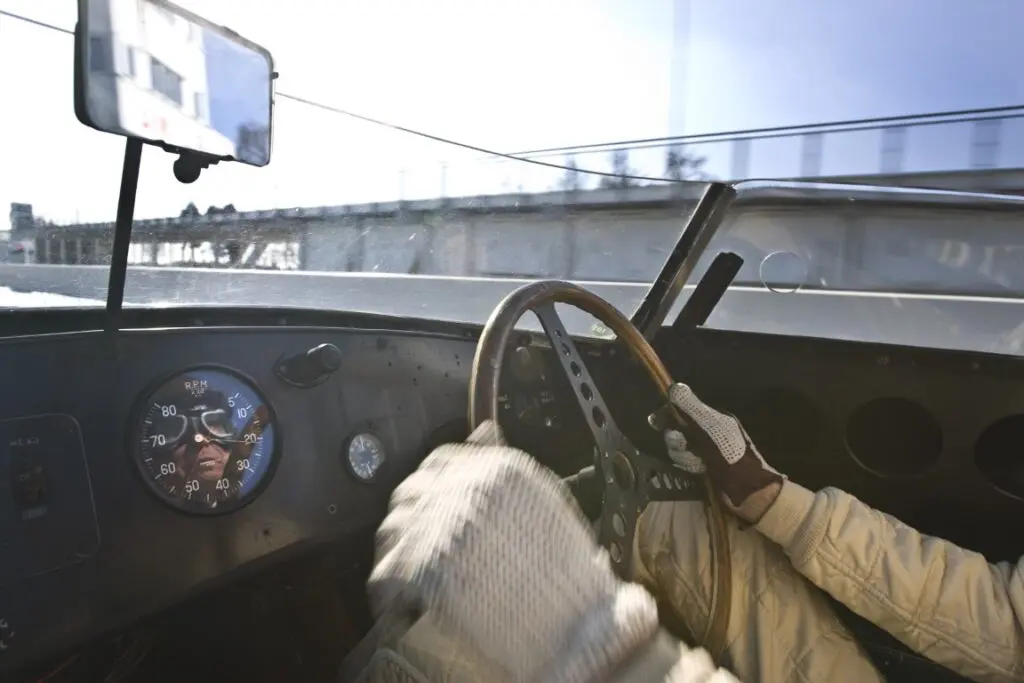
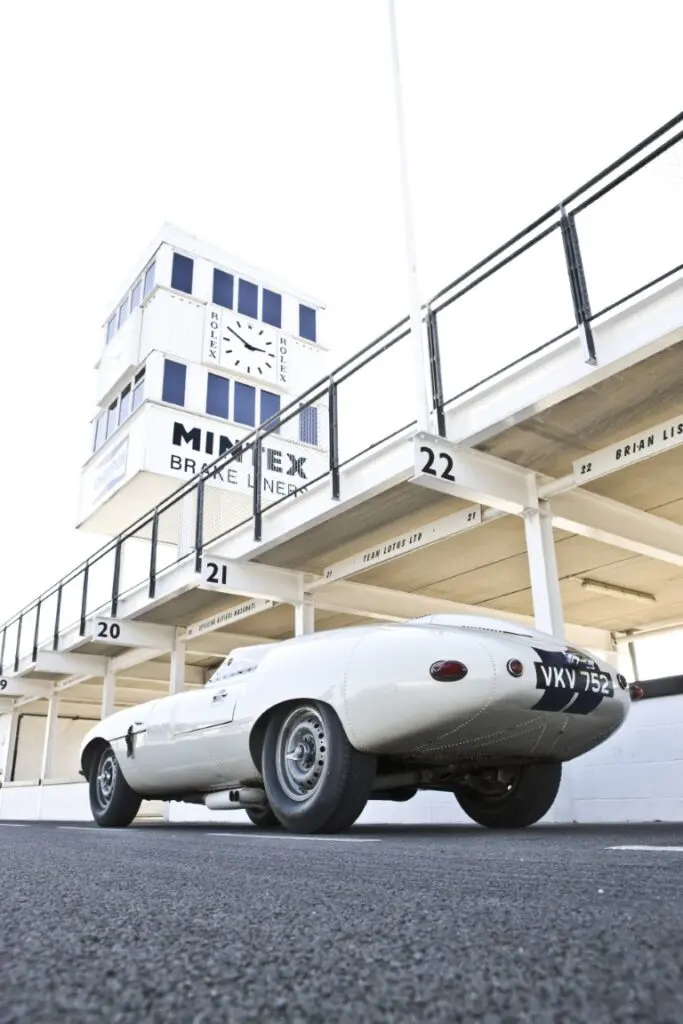
E2A today still has a hole in its dash beside the words: SHOT FIRING ‘PULL’. On this incredibly original car, that was for the chalk-firing gun that left measuring marks on the road during the Maxaret tests. The car was repainted in Cunningham colours many years ago and, probably, the long-lost tailfin should be recreated now. Roger Woodley and Penny Griffiths even saved the buck on which the original fin was made, so it wouldn’t be hard to reproduce.
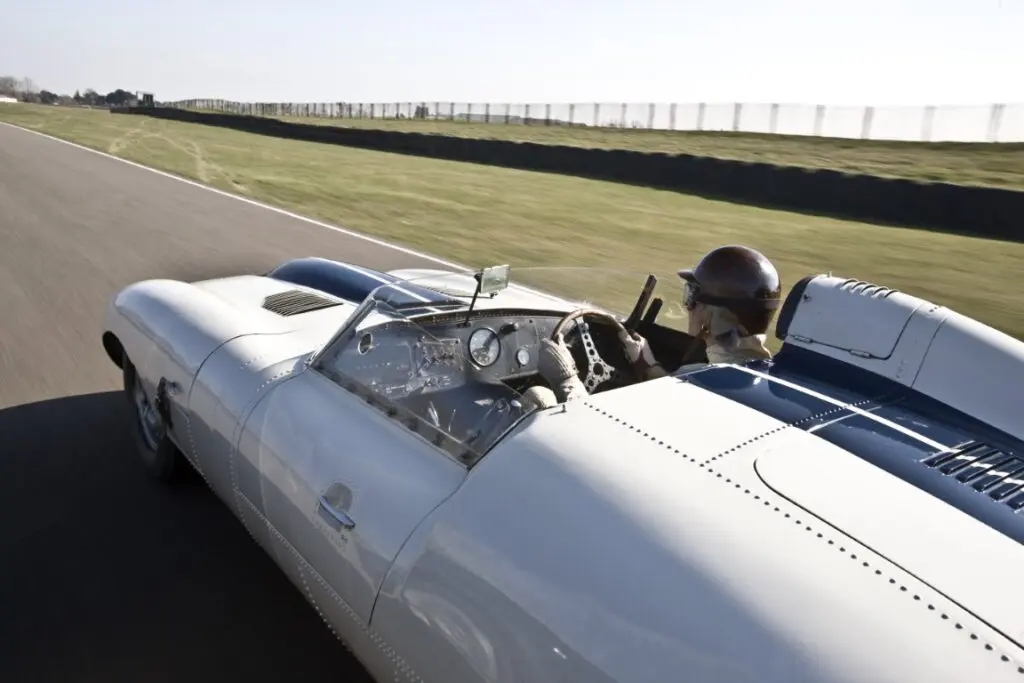
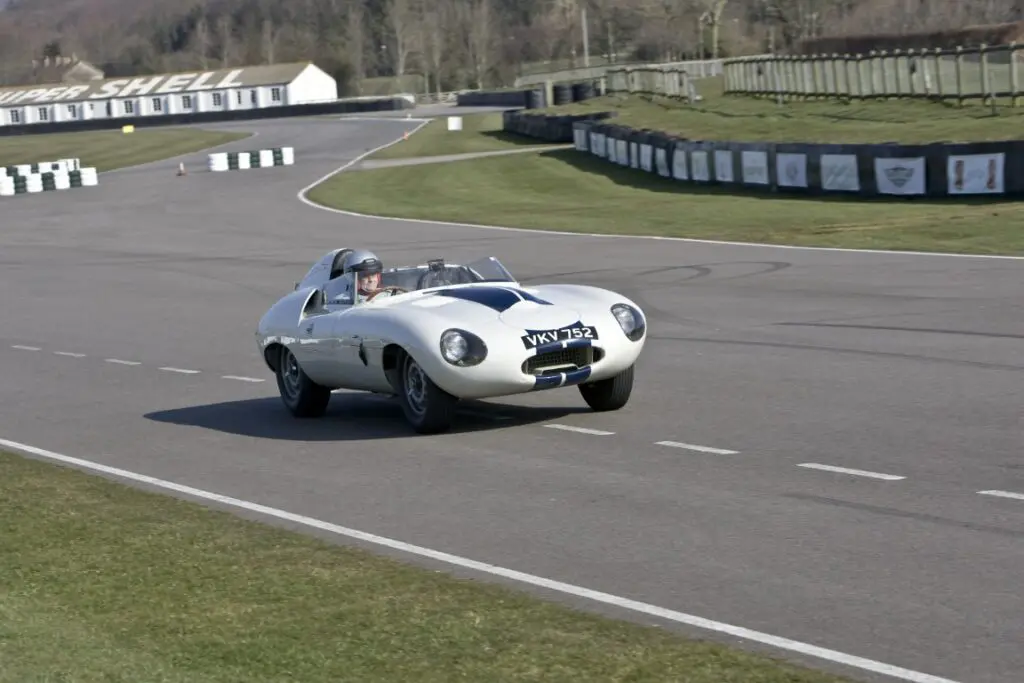
At Goodwood, one sunny spring day, I did some quick laps in E2A. It had been checked and serviced with meticulous care by Chris Keith-Lucas and Barry Burgess at CKL. Nothing was modified but this was no ordinary service – they check the lot, right down to the rivets in the monocoque, which proved, surprisingly, to be perfect.
With close to 300bhp in an aluminium chassis, E2A feels predictably quicker and more responsive than a standard early E-type road car, which weighed about 300kg more. The old dampers are perhaps slightly worn in the middle of their travel, making it feel briefly vague when turning into the faster corners – perhaps CKL will have to change them. Once the car has been settled into a corner, however, it feels superbly controllable and confidence-inspiring.
Through Goodwood’s tricky, top gear Fordwater bend, a fast car like E2A is unlikely ever to be absolutely flat out but, given a carefully chosen line, I was surprised at how fast it could go through there. There’s plainly nothing wrong with the geometry now and, although the grip on its old-fashioned tyres is relatively modest, the handling is excellent. You can encourage a little understeer or choose to hang the tail out at will if necessary. The ‘quick change’ D-type brakes work well, too. The future for this gem from Jaguar’s past is clearly one of preservation but it would be very tempting to race it in the Le Mans Classic, just for old times’ sake.
Jaguar held all the aces in 1960, including a world-class ability in engineering and design to go with its glittering reputation on road and track. Despite that, and despite the new affluent society, by 1966 Jaguar was being swallowed up in mergers leading to the British Leyland nightmare. Was Jaguar too cautious, ‘resting on its laurels’ and pinching pennies when it should have been forging ahead? I think so. The factory fire of 1957 was a setback but Jaguar should have recovered from that more quickly. In E2A, Jaguar’s engineers created a potential world-beater, and the company wasted it.
Later in the 1960s, it was the same story with the XJ13: the engineers produced a possible winner, the management dithered and the moment was gone. It’s said that E2A’s last official factory task was to distract attention while XJ13 was being tested at MIRA in 1967. Then Roger Woodley and his wife stepped in to rescue it.
E2A was an advanced car which could have won at Le Mans 50 years ago, had it been thoroughly sorted and reliable, but it was all alone and crippled by a half-hearted company attitude. There should have been a proper works Jaguar team with half-a-dozen E2As, ready to face the hordes of Ferraris.
The once-charismatic Sir William Lyons, then nearly 60, had formed the view that Le Mans was the only worthwhile race and he was reluctant to enter it unless Jaguar was guaranteed to win. Obviously, no such guarantee is possible. The spark had gone but Sir William remained as MD until 1967. In 1960, with conditions perfect for confident investment, Jaguar behaved as if it could not afford to go racing. The reality was that Jaguar couldn’t afford not to go racing. It could have been so different.