He was unimaginably wealthy. He ruled over a landmass that was larger than England and Scotland combined. His collection of precious gems and jewellery was worth the equivalent of well over a billion euros in today’s money. And over the course of six years during the 1920s he bought 17 Rolls-Royces – to add to the seven early Silver Ghosts that were already parked in the family garage.
This feature first appeared in Octane issue 258.
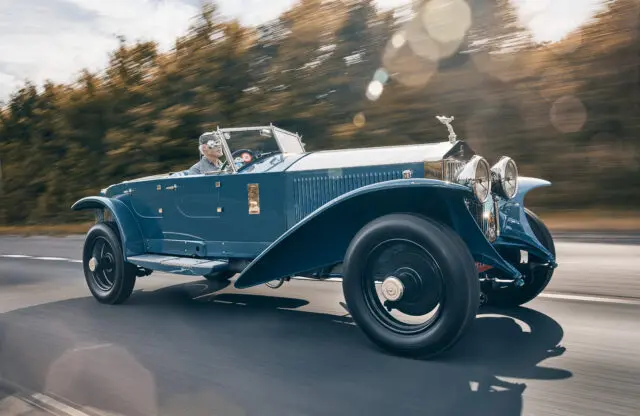
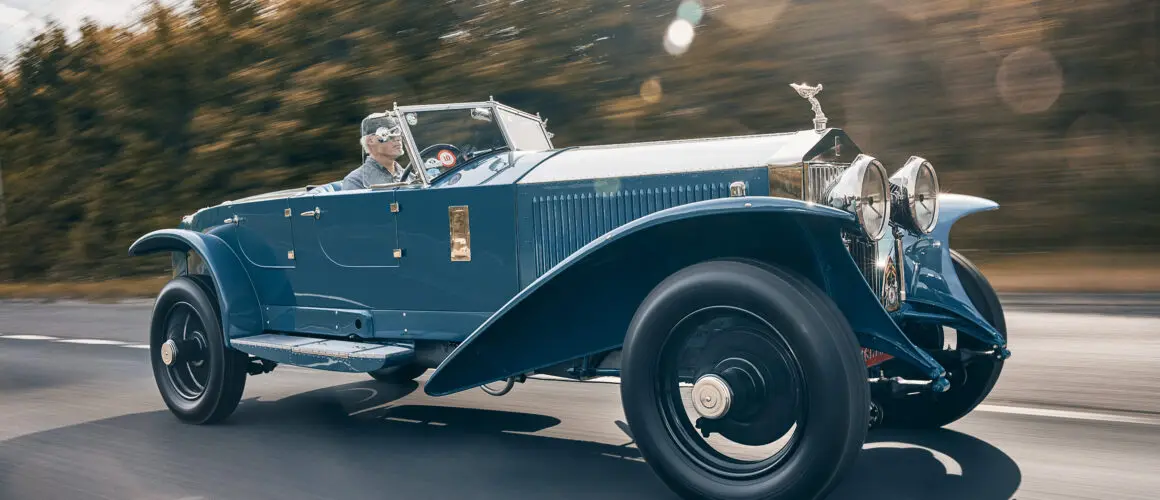
It’s easy to see why (deep breath) Colonel His Highness Shriman Rajrajeshwar Maharajadhiraj Sri Sir Hari Singh Indar Mahindar Bahadur, ruler of one of the five most important states in British India, was a particularly favoured client of Rolls-Royce. So favoured, in fact, that Hari Singh – as he was known to his friends – was allowed to buy one of the company’s experimental Sports models, 17EX, the car you see here. And now, after decades of much later European ownership, it is back in Indian hands.
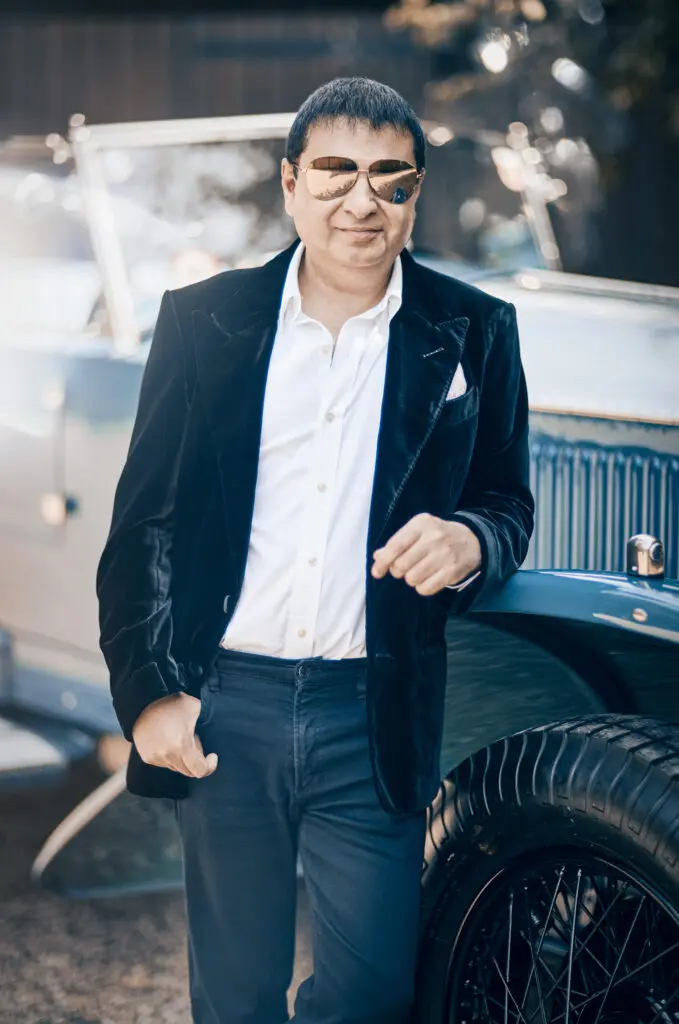
Today’s keeper is Yohan Poonawalla, a billionaire industrialist and classic car enthusiast; the latter so much so that he was named Classic Car Ambassador of the Year at the 2023 Historic Motoring Awards. ‘I have an affinity for all things Rolls-Royce,’ he confirms during our photoshoot. ‘This one is a particular gem, which I am proud and privileged to own. Maharajahs and British Royalty ordered special bespoke Rolls-Royces, which were very advanced in their day and age. Engineering, appearance, design, elegance – they offered a complete package.’
Like Yohan, who was the subject of our Autobiography page in Octane 252, we’ve featured this Rolls-Royce before. That was way back in 2006, Octane 42, when the car was fresh out of restoration and making its mark on the concours circuit at Pebble Beach and Villa d’Este. It wasn’t available to drive then and it’s taken 18 years to put that right, but now Yohan has very generously offered us the chance to try it.
A whole century ago, Sir Henry Royce was fretting that his company’s cars were losing out in sporting appeal to rival Bentley. While the 1925 ‘New Phantom’ had a 7.7-litre straight-six that would urge it up to around 80mph, even a standard Bentley 3 Litre could manage the same, and tuned 3 Litres could crack the magic ton. The Autocar said in its 22 May 1925 review of the New Phantom that ‘The Rolls-Royce… is not a very fast car considering its engine size.’
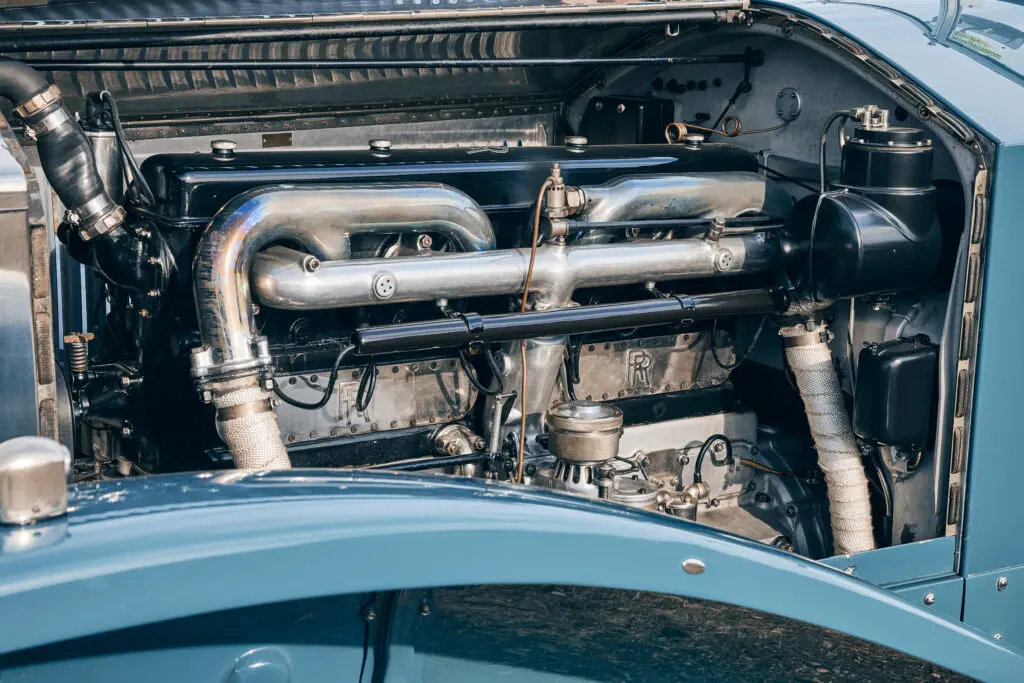
Ouch! By the restrained standards of the day, that was a metaphorical slap in the face with a leather driving gauntlet. Something had to be done, decided Royce. He proposed a sportier experimental version of the Phantom to take the fight to Bentley, and wrote to newly appointed managing director Basil Johnson in 1926: ‘The object of preparing this chassis is that, if speed merchants in the form of English peers or Indian Rajahs or others doubt the capacity of the Rolls-Royce Phantom, this specimen… can be tried by them… we do think that the owners of the smooth and silent models within their large bodies capable of 80mph will be pleased to know that the same chassis and engine when fitted to a touring car will be capable of 95-100mph.’
In fact, Royce had already given the go-ahead for such a car in 1925 when Basil Johnson’s late brother, Claude, the founding MD of Rolls-Royce, was still in charge. The first so-called Sports Phantom was built in late 1925 and given the Rolls-Royce experimental number 10EX; it was followed by several others, but the ones most relevant to this story are 15, 16 and 17EX respectively. They were bodied by three different coachbuilders, but all to a new lightweight design that had been foreshadowed by the Barker four-seater touring body fitted to 10EX.
After some modifications in December 1926 to make that 10EX body more rakish – a new, shallow and raked-back vee windscreen; skimpy, lighter wings; spare wheel moved inside a new aerodynamic tail – that shape would become the template for the ones fitted to 15, 16 and 17EX. It was penned by chief project engineer Ivan Evernden, known as ‘Ev’, and these simple improvements to aerodynamics raised the otherwise stock Phantom’s top speed to almost 90mph. Weight was still holding it back, however, and this is where Royce made his own, very significant contribution. He patented a new lightweight body construction that involved deep laminated body sills made from sheet steel and plywood, with plywood also used for the body panelling.
No one’s sure why Rolls-Royce chose three separate coachbuilders for the improved lightweight variations of 10EX’s body that were fitted to 15, 16 and 17EX. The first car, 15EX, was bodied by Hooper, and 16EX by Barker; both were ready by early 1928. 17EX, however, was bodied – unusually, for a Rolls-Royce – by Jarvis of Wimbledon. Jarvis did have experience in making lightweight bodies, not least for Malcolm Campbell’s Blue Bird record-breaker, and here’s an interesting coincidence: all three of the later EX cars were painted in various shades of light blue, and 17EX’s colour is remarkably similar to the recently constructed Blue Bird’s. Did Jarvis use the same paint?
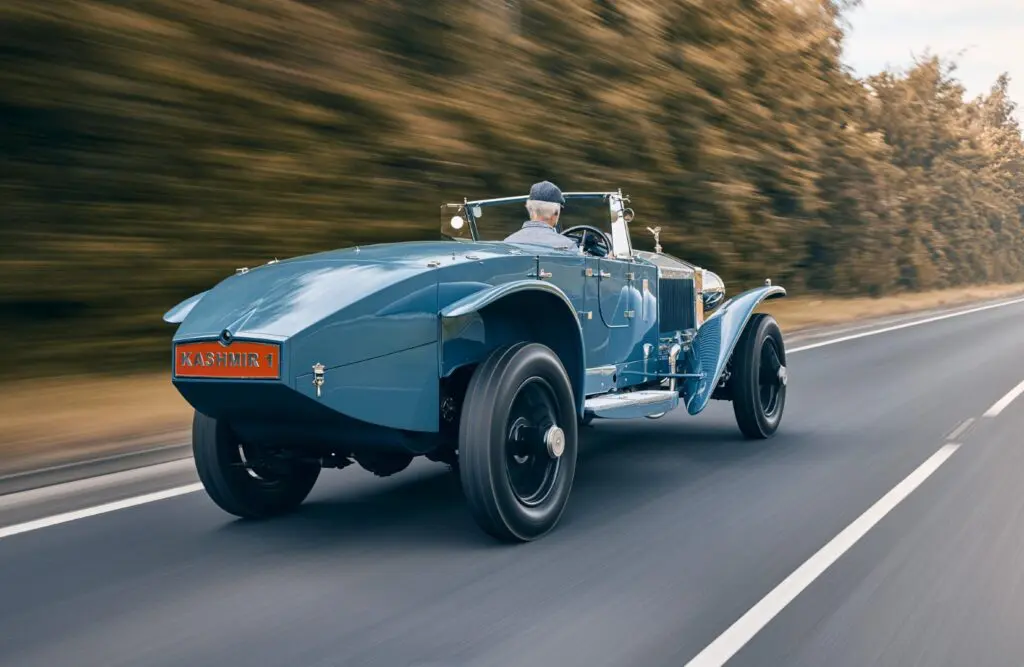
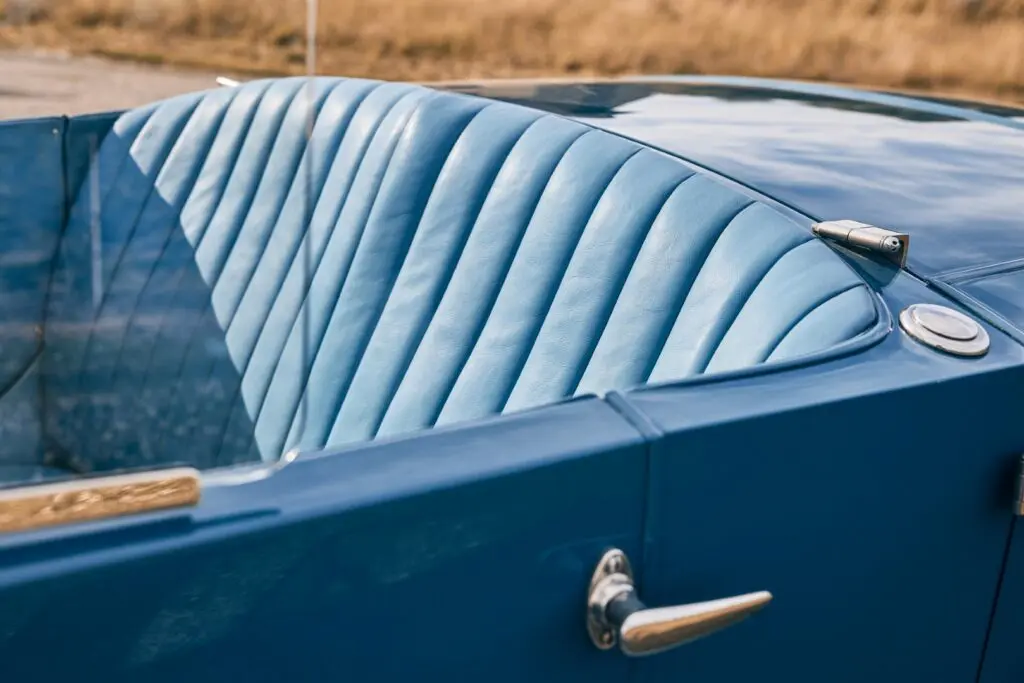
Today, beautifully restored as closely as possible to its original specification, that bright blue paint and matching blue interior trim give 17EX an unusually vivacious appearance. Opinion may be divided on whether ‘Ev’s attempt at an aerodynamic shape is classically beautiful, particularly from the rear three-quarter angle, but it’s certainly striking, those enormous scoops that are the front wings appearing to lunge forward to devour the road.
Climb up into the car via the inverted-aerofoil running board and featherweight driver’s door and you’re left in no doubt that this roadster means business. Ahead of you is a plain black dashboard stuffed with gauges and dials, while the steering column presents an assembly of knobs and levers for adjusting carburettor mixture strength, ignition timing and throttle position. Its nickelled skeleton frame is like a pilot’s control yoke, and the steeply peaked dash coaming and raked vee-screen are similarly aeronautical; you could be sitting in a fuselage rather than a car body.
There’s no rev-counter, but you’re never in any danger of not hearing what the engine’s doing because 17EX is much more vocal than a regular Phantom, its soundtrack somewhere between a burble and a genuine snarl when you goose the throttle. The vast torque produced by that 7.7-litre straight-six means that smooth pull-aways with minimal clutch slip can be achieved by letting the clutch in at idle speed and just catching it with a few extra revs at the moment it bites, while the right-hand gearchange is challenging enough to be satisfying without being impossible.
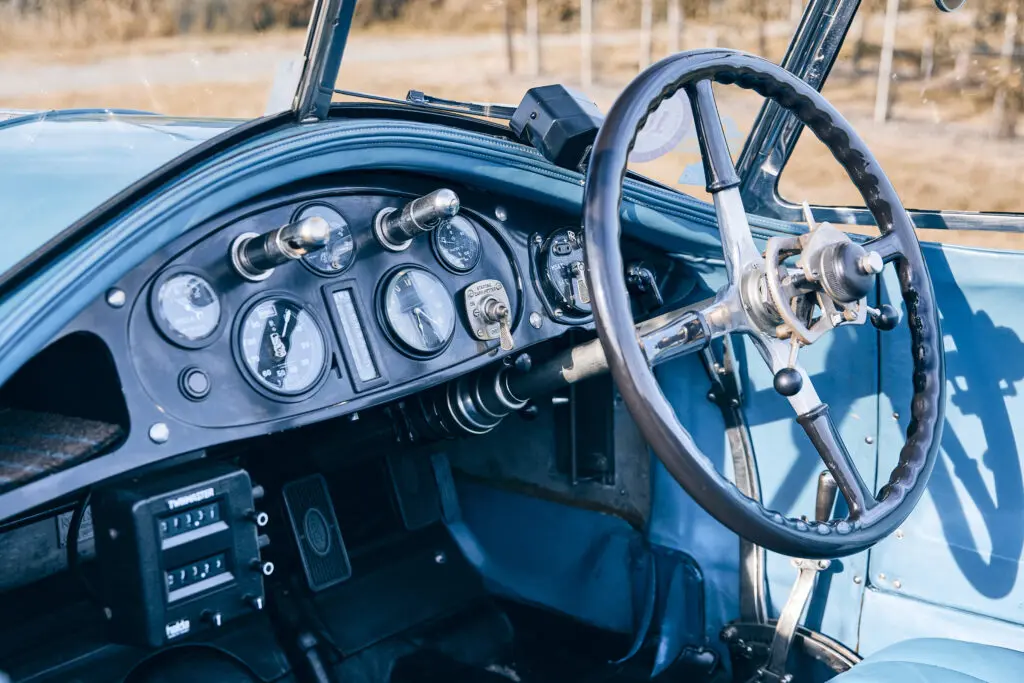
Although 17EX will in theory trundle along as slowly as you wish, the spark plugs don’t like prolonged stop-start pottering. Better by far to keep the momentum up, when the heavy-ish steering lightens and the car really comes alive. How alive? Well, after cruising steadily along a dual-carriageway at an indicated 60mph, the driver of our camera car later remarked that 17EX was doing closer to 75-80 – and there was plenty more to come. Sitting at a lorry-like elevation, gazing down that long bonnet at a preternaturally large Spirit of Ecstasy, it’s hard to resist imperious ‘master of the universe’ emotions as you control this huge statement of a car, the embodiment of an era when much of the world’s map was coloured pink.
Appropriately, when 17EX was offered for sale a few months after its completion in July 1928, it caught the eye of what Henry Royce had speculated might be an ‘Indian Rajah’ or, more accurately, a Maharajah, our old friend Hari Singh. Rolls-Royce had already embarked on the next generation of Phantom and its sportier Continental sibling, so 17EX was now redundant for testing purposes and it was duly shipped to Bombay, as it was then known, in November.
Oddly, though, it seems that Hari Singh wasn’t actually that interested in cars, despite having a fabulous collection. Historian Gautam Sen, who is an expert on cars owned by the Maharajahs, suggests that he may have bought this particular Rolls-Royce ‘as a case of one-upmanship’ and didn’t drive it much. He sold it on after just three years.
The next long-term owner was much more of a petrolhead. Provat Kumar Mitter was one of five brothers born to a very prominent Calcutta lawyer, whose death in 1930 left them with plenty of money to spend on toys. When Provat acquired 17EX, it replaced the Isotta Fraschini 8A that he’d bought when aged 21, and joined a fleet that included two Duesenberg Model Js and two Mercedes-Benz 38/250s. The regular family journeys to their properties in the lusher, cooler areas away from the heat and congestion of Calcutta made full use of all these supercars, as Gautam Sen describes: ‘[The drivers] would invariably race the last leg, with the Duesenbergs blasting away on the straighter stretches, the Mercedes-Benzes accelerating past with their superchargers howling away, the 17EX gracefully tucking and nipping within them… thundering by, flashing past in a blur of sound, fury, exhaust fumes and colour.’
Times and tastes change, of course, and in 1944 Provat Kumar Mitter decided to sell 17EX in favour of a 100mph Packard. The car moved around India in the hands of various owners until 1967 when, by then in a poor state, it was acquired by classic car enthusiast Protap Roy. Originally from another very wealthy Calcutta family – his grandfather owned a Phantom I – Protap Roy’s fortunes were, literally and metaphorically, affected by the partition of India in 1947 and he had to get a job ‘in commerce’ where, fortunately, he flourished. By the 1960s his hobby was scouring India for rare or exotic old cars, which led to him acquiring a Mercedes 500K and a Hispano-Suiza short-chassis Boulogne, to name just two.
Securing 17EX was his major coup, however, and a lucky one. Having heard rumours in 1967 that it was owned by the Rajasaheb of Bhadri, a remote princely state in north India, Protap Roy realised that the Rajasaheb would be judging the annual dog show in Calcutta that year. Since Protap and his wife had a pedigree dog themselves, they entered the competition, took Best in Show and consequently obtained the perfect low-key introduction to the Rajasaheb. As part of the deal, the Rajasaheb reputedly asked Protap to try to obtain a pair of corgis for him from England…
The corgis may never have materialised but Protap Roy did start to contact various Rolls-Royce specialists and enthusiasts in the UK, among them dealer and expert Christopher Renwick. Stymied by the difficulties of obtaining parts for 17EX’s restoration, Protap Roy sold the car to another Indian in 1972, and in 1977 Renwick acquired it. He sold it the same year to Italian collector Dr Veniero Molari, who finally got around to commissioning its full restoration in the 1990s by coachbuilder Gianni Pena.
During its many decades in India, 17EX had been repainted cream and black, and a surviving fragment of blue paint found on the car’s underside wasn’t a clear enough guide to the exact original shade. The problem was solved when Anthony Hussey of Connolly Leather, which had supplied 17EX’s trim back in 1928, told Molari and Pena that his company produced only one shade of light blue at that time – and they still had the colour code. Because leather and paint were known to have been the same colour back in the day, the Italians then had an impeccable reference for the paint, too.
17EX was still a work in progress, however, when Molari sold it in 1999 to would-be motor magnate Victor Muller, who was about to revive the Spyker marque. Muller asked Pena to complete the restoration and 17EX duly debuted at Pebble Beach in 2004, and then appeared at Villa d’Este in 2006. But Muller still wasn’t completely happy with the car and in 2009, when he needed to raise capital to buy Saab, he placed 17EX in RM Auctions’ London sale that October.
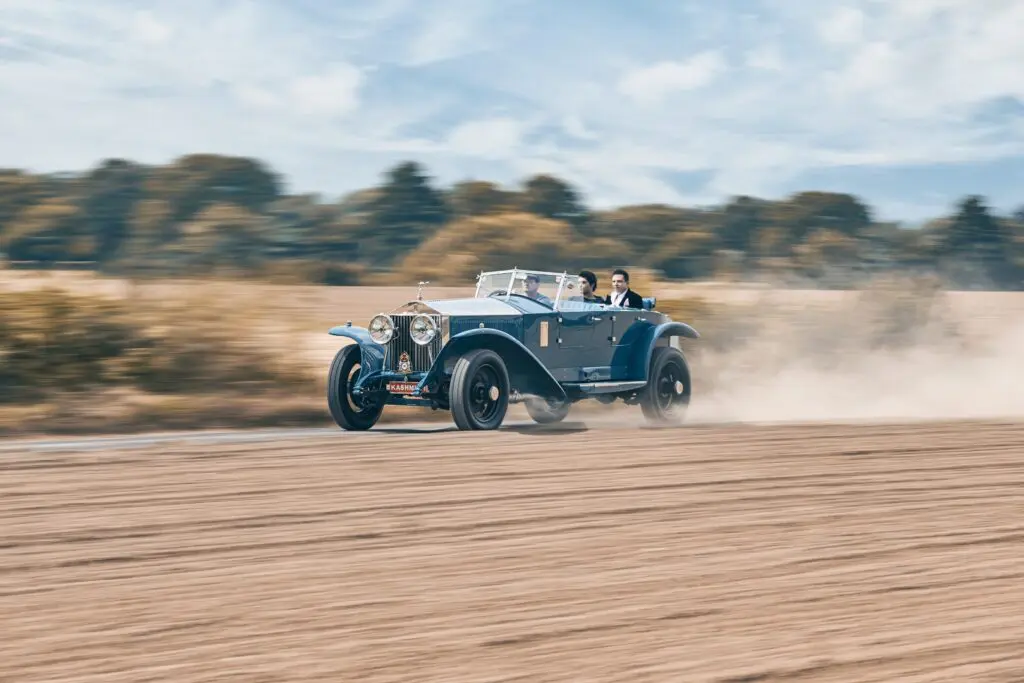
The successful bidder was Austrian enthusiast Alexander Schaufler – and, at last, 17EX would again be used frequently and energetically in a way that it hadn’t since those epic trans-India dashes of the 1930s. Schaufler loved doing demanding rallies and in just a few short years he put 17EX fully to the test. Beginning with the 2010 Flying Scotsman, in three years he covered 15,000 miles in no fewer than ten events, most of them in the mountains of Europe. He then took the thoroughly well-used 17EX to Pebble Beach again in 2012 as part of its Cars of the Maharajahs display, where it wore its battle scars proudly.
Now 17EX is back in Indian hands almost a century after Hari Singh took delivery. After being refreshed to perfect condition by P&A Wood, it earned Yohan Poonawalla a Best in Show at the Valletta Concours in June – the first time an Indian collector has won such an award outside their native country – and Best in Show at the ICONS Concours in Mallorca, Spain, this October.
One question remains. Could 17EX genuinely reach 100mph? It seems entirely feasible, even likely, but it’s never been proven. Hmm, now there’s an idea…