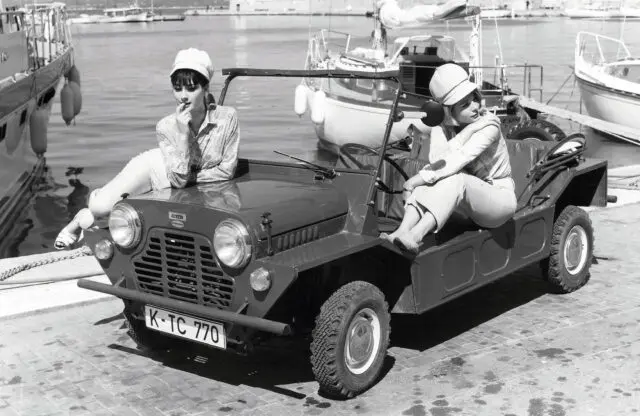
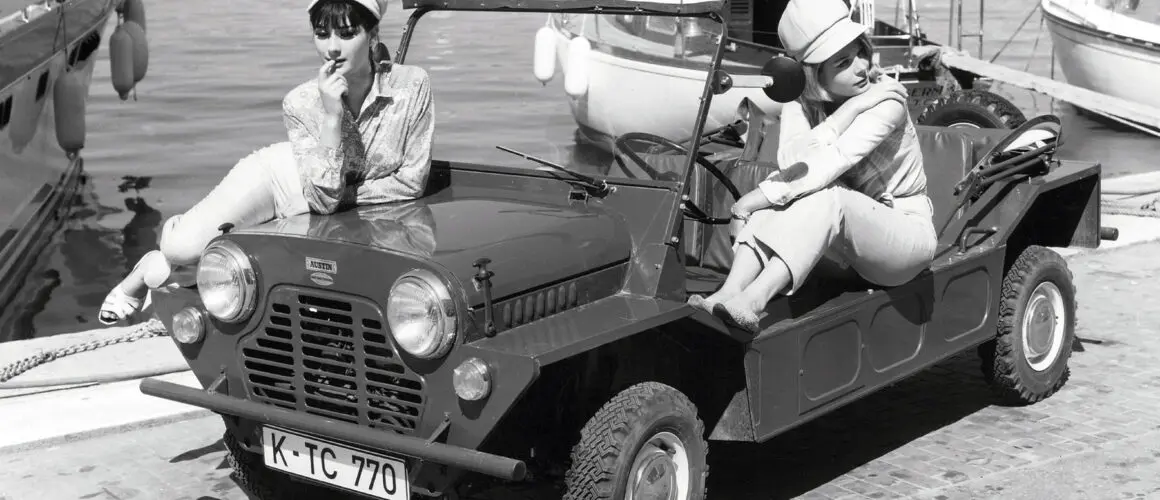
Few cars capture the carefree spirit of summer quite like the Mini Moke. Whether parked outside a beachside café or cruising along a coastal road with no doors, no side windows and very little between occupants and the elements, the Moke has always been more about enjoyment than practicality. Yet despite its status as a fashion icon and leisure vehicle, its origins were surprisingly serious.
The Moke began life as a military project conceived by Sir Alec Issigonis. The idea was to create a lightweight utility vehicle that could be easily transported and deployed by the British Army. However, while the Mini-derived mechanical layout offered simplicity and compact dimensions, the low ground clearance imposed by the Mini’s front and rear-subframe design limited off-road ability. Military chiefs quickly lost interest and the project was redirected towards civilian buyers.
Production commenced at BMC’s Longbridge factory in 1964, with Austin and Morris-badged versions offered at £405. Although sales were initially modest, the Moke soon found favour in holiday resorts and warm climates around the world. Its simple construction, open bodywork and cheerful appearance made it particularly popular in coastal regions, where practicality mattered less than fun. The model’s reputation was further enhanced through appearances in film and television, most famously in The Prisoner, filmed in Portmeirion, Wales.
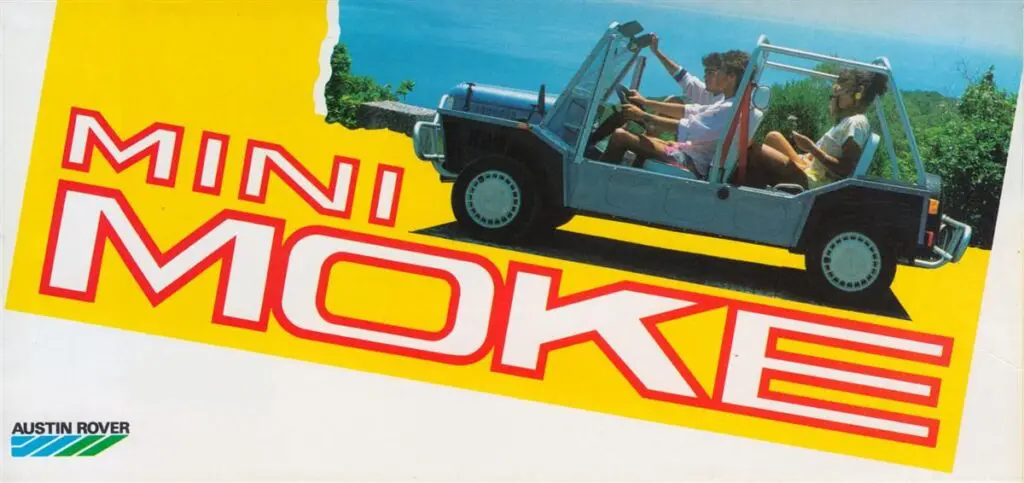
The original British-built Mokes were relatively basic machines, powered by small-capacity A-series engines and equipped with minimal weather protection. Production moved to Australia in 1966, where the Moke evolved into a more developed product. Australian-built examples benefitted from specification improvements and, over time, larger engines that made them more usable in modern traffic. When Australian production ended in 1982, the tooling was transferred to Portugal, where manufacture resumed in 1983.
Portuguese-built cars are generally regarded as the most practical and refined versions, with specification improvements introduced in 1986 included a full roll-over structure and integrated inertia-reel seat belts, making them more suitable for regular road use. Production eventually ceased in 1989, although manufacturing rights passed through several owners and limited production briefly resumed under the standalone Moke name before ending for good in the early 1990s.
Over a production life spanning almost three decades and three countries, nearly 50,000 Mokes were built. Today, buyers can choose between early British cars, desirable Australian examples and later Portuguese models, each offering a slightly different ownership experience. Early UK-built cars appeal to collectors seeking originality, Australian versions combine character with greater durability, while Portuguese cars tend to offer the best blend of usability, corrosion protection and safety equipment.
Regardless of which version is chosen, the Moke remains one of the most distinctive derivatives of the Mini ever created. It may not excel in terms of practicality, comfort or performance, but few classics can match its ability to generate smiles wherever it goes.
Common problems
Body and structure
• Corrosion is the single biggest concern. Early UK-built Mokes received little in the way of factory rust protection, making structural condition far more important than mechanical health when assessing a potential purchase.
• Pay particular attention to the rear subframe mounting points and heelboard area. Serious corrosion here can be expensive to rectify and may indicate wider structural deterioration elsewhere.
• Examine the floorpan, side panels and underside carefully. Many cars have undergone repairs during their lives, and poorly executed patch repairs can conceal significant corrosion issues.
• Australian-built Mokes benefit from galvanised steel construction, providing greater resistance to rust than UK-built cars, although corrosion can still develop around welded areas and neglected sections.
• Portuguese-built cars generally offer the best corrosion resistance, thanks to a more comprehensive anti-corrosion dipping process used during manufacture.
• Complete replacement bodyshells are very difficult to source, although most individual body panels remain available through specialists and parts suppliers.
• Hood assemblies, side-screens, trim components and most body fittings can still be obtained either as original-stock items or high-quality reproductions.
Engine and gearbox
• Engine, gearbox and running gear are shared with the Mini, making parts availability excellent and maintenance relatively straightforward.
• Excessive exhaust smoke usually indicates valve-guide or valve-seat wear. Fortunately, A-series engine rebuilds are well understood and supported by numerous specialists.
• Gearbox whine is common and not necessarily a cause for concern, but noisy transmissions should still be checked carefully for excessive wear or poor maintenance.
• Many engines have been converted for unleaded fuel. Unmodified engines generally tolerate occasional unleaded use, although frequent mileage may eventually accelerate valve-seat wear.
• Engine upgrades are common, with 1275cc A-series conversions among the most desirable modifications for improved performance and drivability.
• Stage 1 and Stage 2 tuning packages are popular upgrades and can provide worthwhile gains without significantly compromising reliability.
Suspenson and upgrades
• The rubber-cone suspension system is generally durable, but tired cones can affect ride height and handling. Replacement components remain widely available.
• Early British cars were not fitted with a roll-over bar. Buyers intending to use seat belts may prefer later Portuguese-built examples, which feature an integrated rollcage and inertia-reel belts.
What to pay?
The Mini Moke is no longer the bargain it once was, although values remain highly dependent on age, originality and condition. True project cars are now relatively scarce in the open market, but recent auction data suggests rough or less desirable later examples can still appear below £10,000. Anything needing serious structural restoration should be approached cautiously, as repair costs can quickly overtake the purchase price.
Usable, roadworthy cars generally start from around £10,000-£12,000, while most presentable examples sit in the £15,000-£25,000 bracket. Well-restored early UK-built cars, desirable specifications and particularly tidy Portuguese or Cagiva-built examples can push beyond £25,000, with the best retail asking prices often around £30,000.
Exceptional or unusual cars can achieve substantially more, but those are outliers rather than the core market. For most buyers, condition, corrosion repairs and provenance matter far more than chasing a particular year or variant.
Mini Moke specifications
| Engine | 998cc four-cylinder A-series, OHV, single SU carburettor |
| Power | 39bhp @ 4750rpm |
| Torque | 50lb ft @ 2500rpm |
| Transmission | Four-speed manual |
| Drive | Front-wheel drive |
| Steering | Rack and pinion |
| Top speed | 81mph |
| 0–60mph | 27.9sec |
| Wheelbase | 2020mm |
| Length | 3050mm |
| Width | 1300mm |
| Height | 1400mm |
| Weight | 630kg |