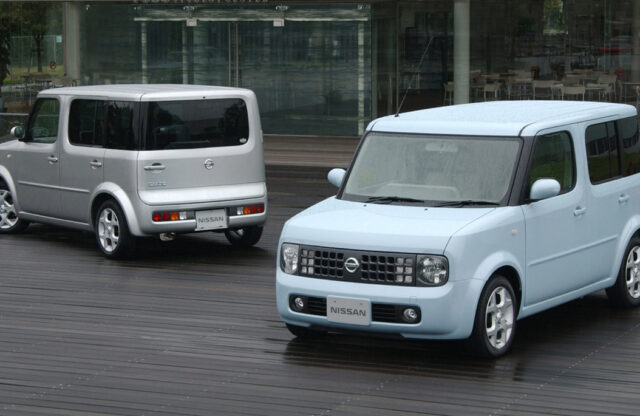
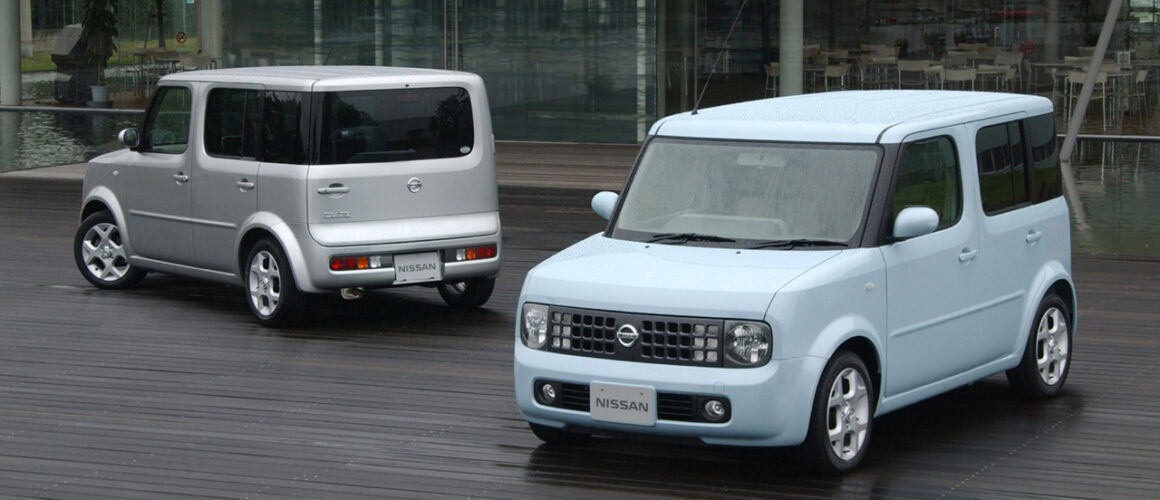
Asymmetry in automotive design is uncommon, and probably one of the main reasons that the Z11 Nissan Cube caused such a stir when it was launched in 2002. With a perfectly descriptive name, this boxy Nissan quickly found a cult following globally. And over 20 years on, it still oozes visual character and offers brilliant packaging and usability.
Just like Nissan’s earlier ‘Pike cars’ – the Pao, Be-1 and most notably the Figaro – Nissan’s Cube coupled Micra underpinnings with a much more interestingly styled body. Although the ‘cool’ second-generation Cube arrived in Japan in 2002, the first-generation was actually launched in 1998. Considerably less remarkable to look at, it set the model’s template, in essence a small footprint with tall sides and boxy proportions to maximise cabin space.
The second-generation car, codenamed Z11, was a real breath of fresh air when it was launched – so much so that the Cube quickly gained a strong cult following around the world, despite being intended purely for the Japanese domestic market.

An efficient 1.4-litre engine provided 97bhp as standard, with a 1.5 option in 2005 upping that to 109bhp, both available with either a four-speed automatic or a smooth CVT, but no manual. Ultimately, this is just a no-frills propulsion unit, and with the Micra also providing the suspension, brakes and the majority of the mechanical components it’s more than capable enough to live with – not to mention easy to maintain.
Ultimately, however, you don’t buy a Cube for the driving experience, you buy one because of the way it looks. It’s a brilliant combination of straight lines and soft edges with plenty of great details. The side-hinged rear tailgate – with a single wraparound glass section on one side only – not only looks unique, it also makes the Cube an incredibly useful family/utility wagon. Inside, the cabin is spacious, and clever storage spaces abound.
For those wanting a little extra space, Nissan later offered a seven-seater version called the Cubic. There was also a (mild) 4×4 variant that offered limited rear wheel propulsion via an electric motor to aid in occasional low-grip scenarios. As you might expect, personalisation was common – and encouraged by Nissan, which offered 12 different grille variants, as well as various bodykits and wheel designs.

After the Cube became a cultural phenomenon around the world, Nissan decided that it would offer the third-generation Z12 officially in the USA and Europe for the first time. Launched in 2008, its style was a natural evolution of the Z11, although it has gone even further with the rounded edges – and the interior is considerably cooler, adopting a casual lounge vibe, with a sofa-style rear bench seat.
Despite more engine and gearbox options, suited to each market (the UK was limited to a 1.6 petrol) sales sadly didn’t live up to expectations. The model was discontinued in Europe after 2011 and, after similarly disappointing results, in 2014 in the US. Japanese production continued to 2019.

While the newer, officially imported Cube is probably the more sensible option, there’s something very cool about the second-gen car – and prices are now seriously tempting.
Nissan Cube common problems
• The main problem with Japanese cars, and their reputation for reliability, is that owners often assume that servicing is not strictly necessary. With the Cube, that’s far from the truth and, while engines are long-lived with proper care, missed oil changes can lead to timing chain issues. Thankfully, replacement engines are cheap and plentiful.
• Quite a few Cubes were fitted with the factory-approved Impul supercharger kit, pushing power to a heady 140bhp. Certainly worth keeping an eye out for if you want more performance.
• The JATCO CVT gearbox should be serviced every 60,000km and will eventually fail if not. Cars with the conventional four-speed automatic are more rugged.
• Mechanical items and consumables are generally easy to find and affordable, but some Cube-specific parts can be expensive – especially if you need to replace the tailgate glass.
• If you’re swayed by one of the Autech cars, or those with unusual bodykits and trim, just be aware that finding spare parts might not be straightforward – although the community for Cube owners in the UK is generally pretty helpful.
• Failed central locking actuators are common, so make sure all doors lock. Inspect the underside for rust. As with any imported JDM car, it’s vital that it’s protected before being ravaged by salted roads.
What to pay?
Whether or not you want a Z11 or Z12, prices start at around £3000 for higher-mileage examples, rising to £4500 for something in slightly fresher condition.
There are plenty of great cars priced from £5000, with some of the best, freshly imported Cubes advertised closer to £7500.