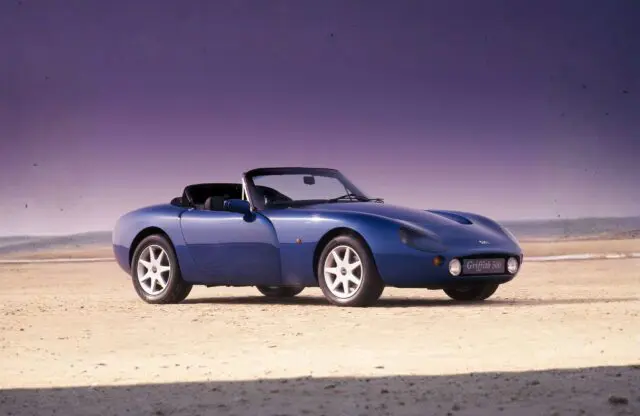
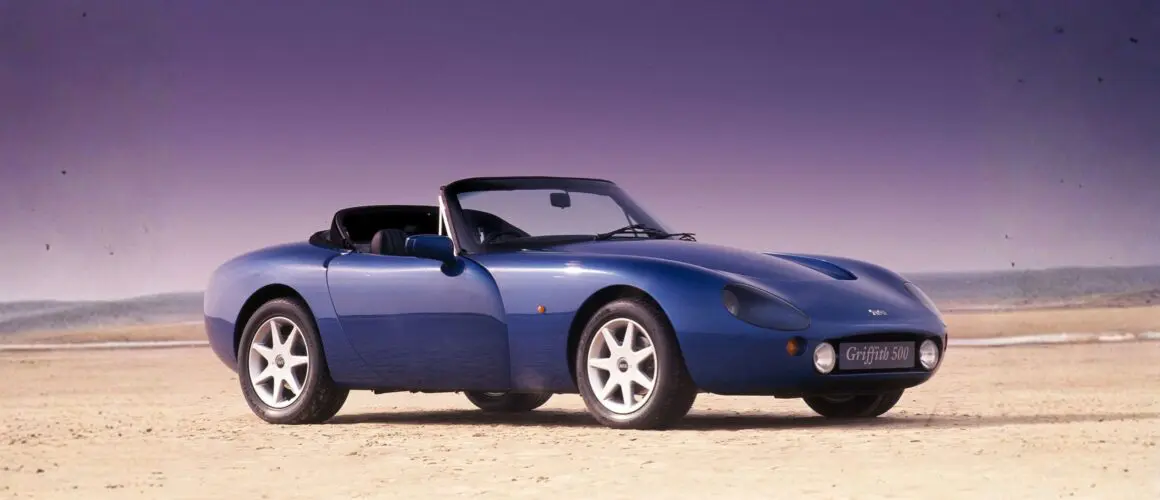
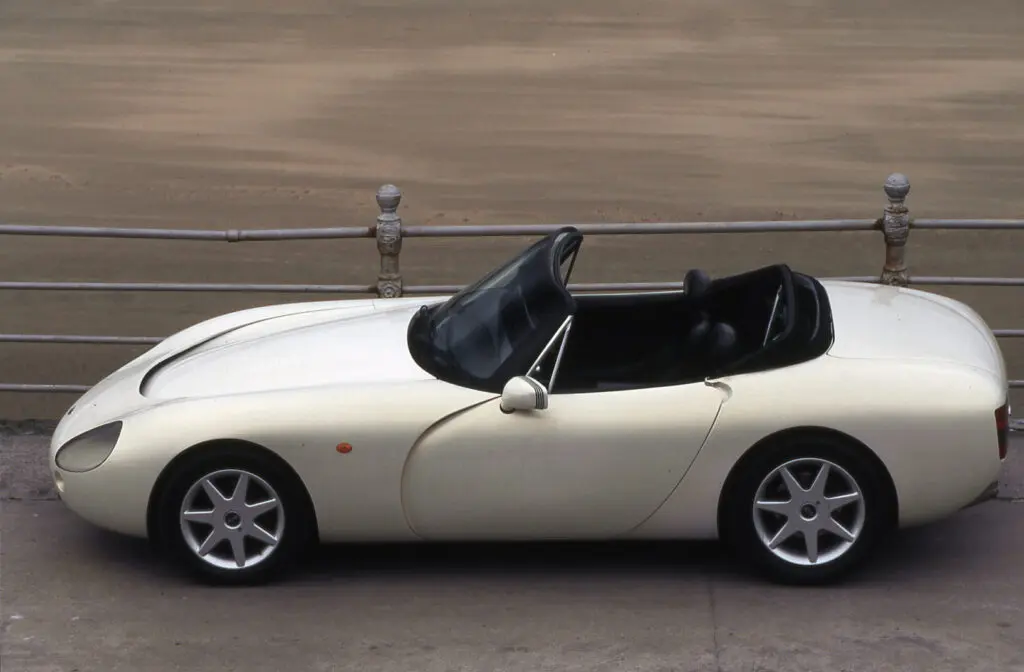
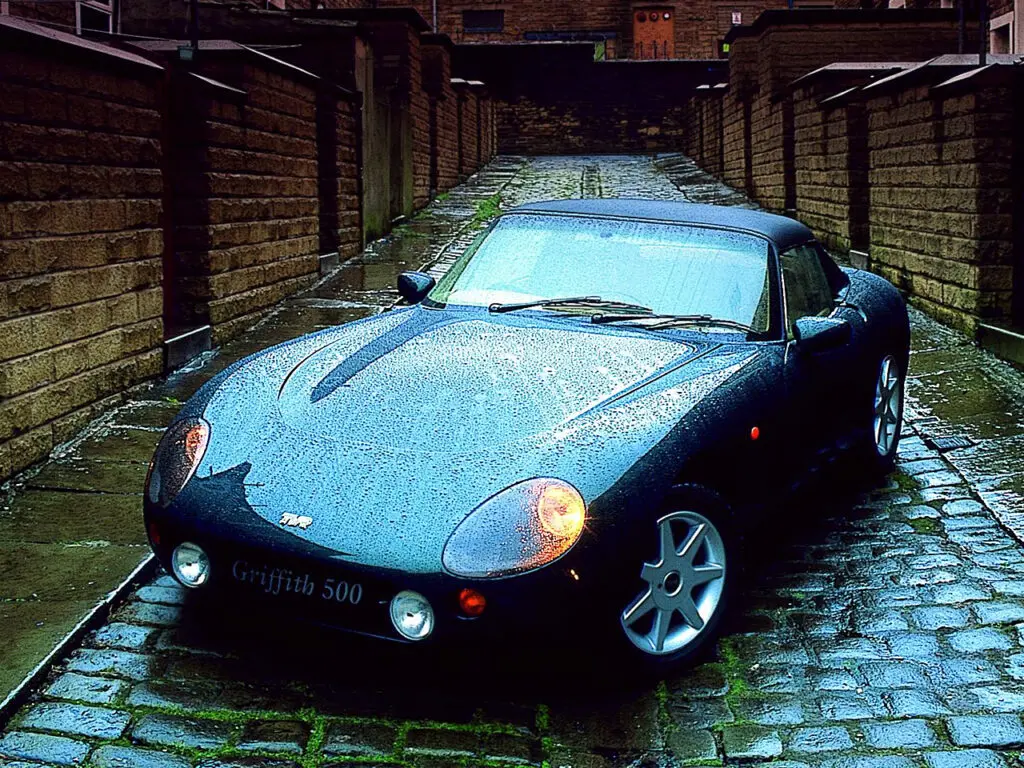
Few cars embody TVR’s particular blend of beauty, noise and barely restrained performance quite so effectively as the Griffith. Revealed at the 1990 British Motor Show, the Griffith arrived when open sports cars were still relatively scarce, its curvaceous bodywork looking modern without appearing fussy – while the compact dimensions, low weight and burly Rover V8 promised distinctly traditional thrills.
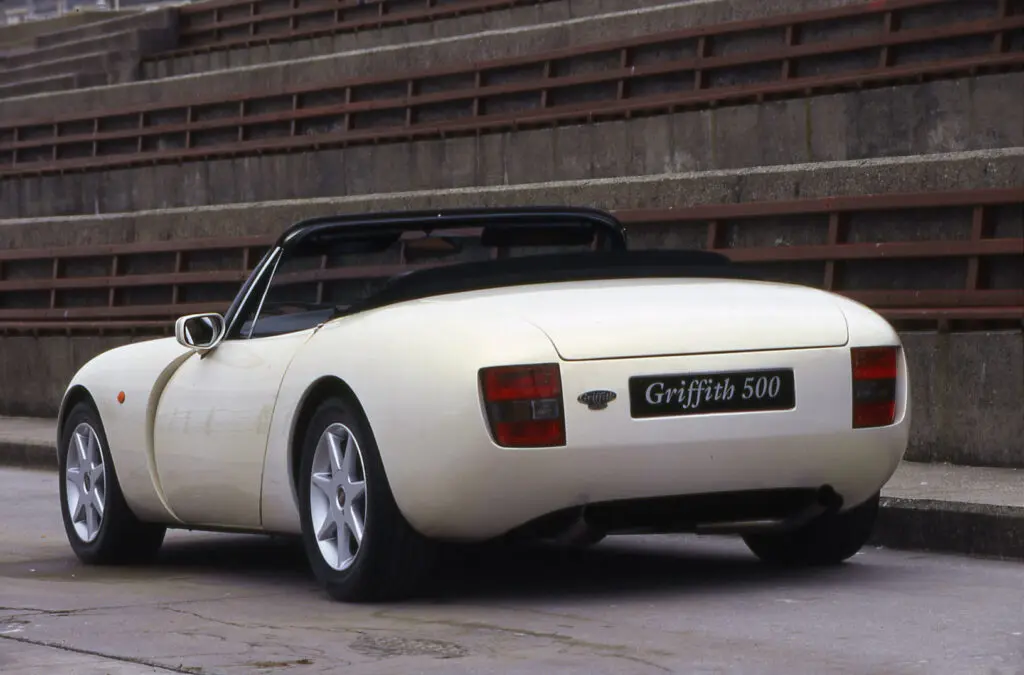
The Griffith marked an important turning point for TVR, as the Blackpool company had spent much of the 1980s producing fast and effective, if occasionally awkward-looking, sports cars. With the ‘Griff’, it found a shape of remarkable purity. The glassfibre body contained few unnecessary lines, while the long bonnet, short tail and muscular haunches gave it huge presence.
Production began in 1991 with 4.0 and 4.3-litre versions. The engines were developments of the all-aluminium Rover V8, fitted with Lucas engine management and driving the rear wheels through a five-speed manual gearbox. The 4.0 produced around 240bhp, while the 4.3 raised output to approximately 280bhp. A rarer big-valve version of the 4.3, identified by its BV designation, offered around 300bhp and is now one of the most sought-after early derivatives.
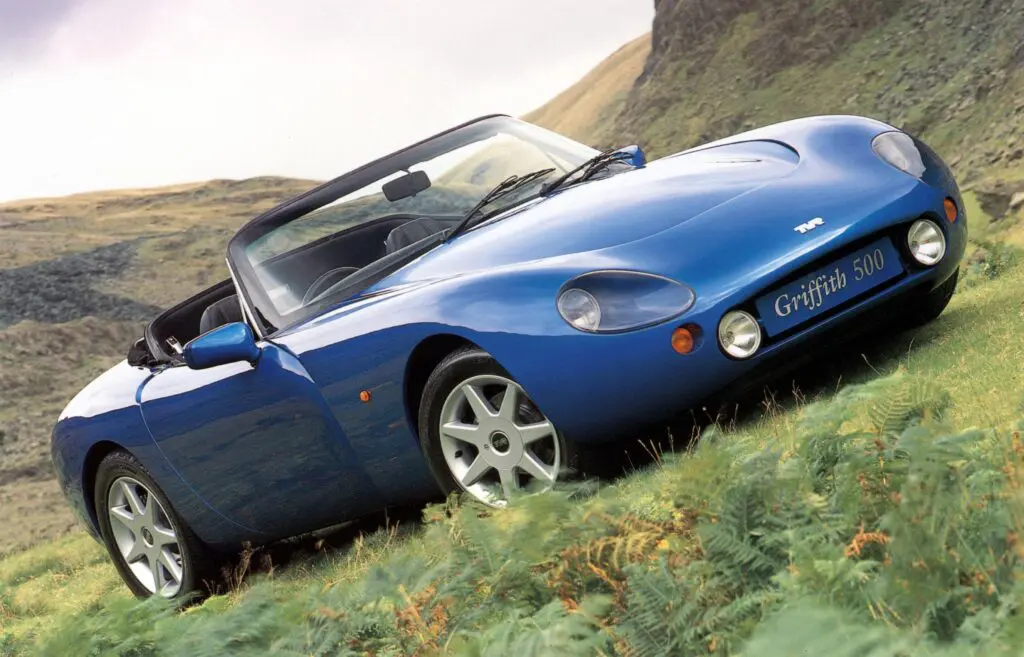
The defining Griffith 500 arrived in 1995, using a 5.0-litre version of the Rover V8, developing a claimed 340bhp and 350lb ft of torque. With only around 1075kg to move, performance was formidable: 0-60mph took a claimed 4.1 seconds and top speed was quoted at 167mph. Larger brakes and revised suspension accompanied the additional power, while catalytic converters became part of the specification.
Early cars used the Rover-derived LT77 transmission, but from 1994 TVR adopted the stronger and more highly regarded BorgWarner T5 gearbox across the range. Every Griffith was equipped with a limited-slip differential, initially a GKN unit and later a Salisbury item. Power-assisted steering became standard during the mid-1990s, making later cars considerably easier to manoeuvre at low speeds.
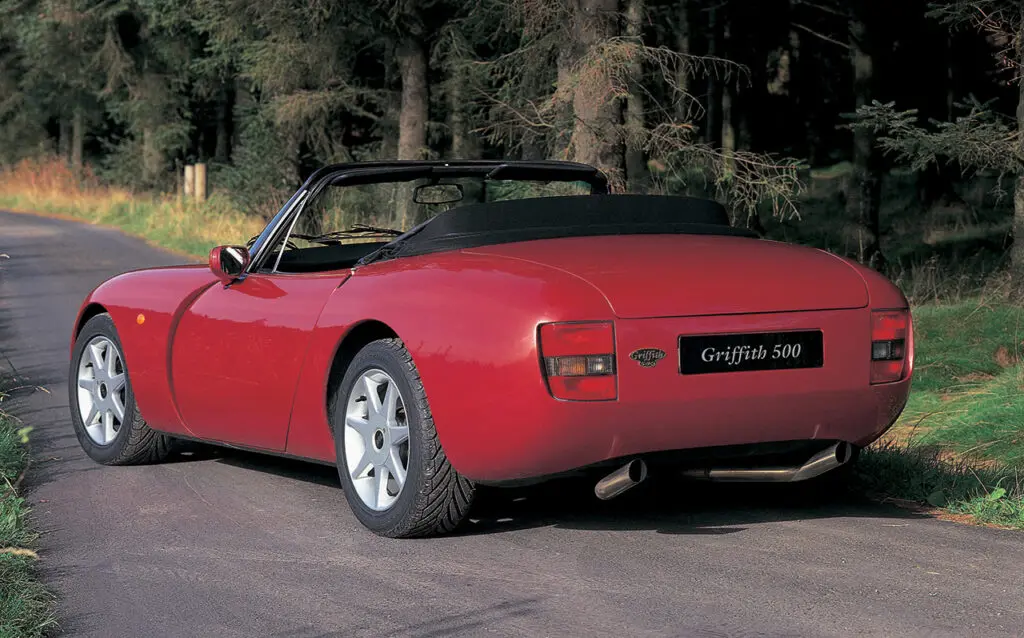
A Griffith Speed Six powered by TVR’s own straight-six engine was announced in 1996, but it never reached production. The Rover V8 therefore remained central to the car throughout its life. Production wound down at the beginning of the 2000s. The final 100 cars were built as Griffith 500 SE models, identifiable by detail changes including revised rear lights, different door mirrors and bespoke badging. These last-of-the-line cars have become especially collectable, combining the most developed specification with rarity and historical significance.
Which Griffith to buy?
The 5.0-litre Griffith 500 delivers the greatest outright performance and is the easiest derivative to find, while the earlier cars have a slightly cleaner appearance. The 4.3 big-valve is particularly appealing, being rarer than the 500 and possessing much of its pace. Even the basic 4.0 is hardly lacking in performance, however, and condition matters far more than engine size.
There are no electronic driver aids to disguise what is happening beneath the wheels, and the combination of modest weight, abundant torque and a short wheelbase demands respect. It is not a car that rewards clumsy inputs, particularly in wet conditions, but a properly maintained example offers immense feedback and performance for the money.
Parts support is generally good, aided by an active specialist and owners’ club network. Some components – including original power-steering racks, certain heater parts and items associated with the gearboxes – can be difficult to source, but the Griffith is far from impossible to maintain. The essential requirement is to buy on structural condition and maintenance history rather than colour, mileage or claimed specification.
Common problems
Engine and cooling
• Regular oil changes are critical to the longevity of the Rover V8. A detailed history showing consistent servicing is more meaningful than unusually low mileage, particularly when the car has spent long periods unused.
• Listen for excessive valvetrain noise and check that the engine pulls cleanly throughout the rev range. Camshaft wear is common, often becoming apparent from reduced performance, uneven running or persistent mechanical noise. Cam replacement is labour-intensive, so evidence that the work has already been completed using good-quality components is valuable. Cheap replacement parts can produce disappointing results.
• The cooling system requires close attention, so check the temperature gauge during an extended test drive and allow the car to idle after reaching operating temperature. Radiators can leak or become partially blocked with age. Many cars have been upgraded with an aluminium radiator.
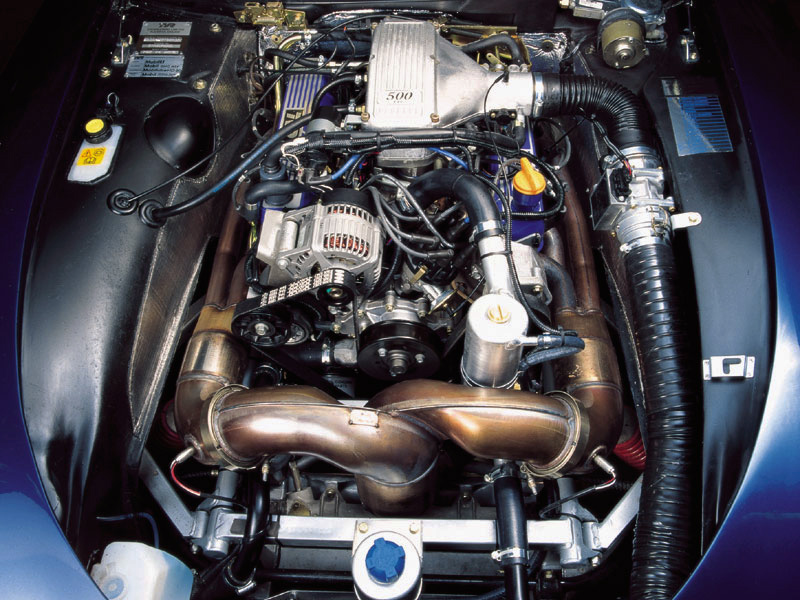
• Oil leaks from the rocker-cover gaskets and sump are common. A slightly damp engine is not unusual, but significant leaks, oil on the exhaust or evidence of long-term neglect should not be dismissed.
• Exhaust heat can shorten the life of the starter motor, making difficult hot starting a familiar Griffith complaint. Check that the engine restarts promptly after a long test drive rather than testing it only from cold.
• Most cars now have stainless-steel exhaust systems. Inspect the low-mounted pipes and silencers for impact damage, and listen for blowing from cracked manifolds with the engine both cold and fully warm. Also ascertain the status of the catalytic converters (if required) before you present it for an MoT.
• The 4.3 big-valve engine is especially desirable, but badges alone do not prove authenticity. Check the supporting invoices, engine specification and vehicle history before paying a premium for a claimed BV car.
Transmission and drivetrain
• Early Griffiths used the Rover LT77 five-speed gearbox, while the BorgWarner T5 was fitted to the 5.0-litre model and adopted throughout the range from 1994. The T5 is generally considered the stronger and more desirable unit. Check that every gear engages cleanly and that the transmission does not jump out of gear under load. Excessive noise, baulking or a vague change may indicate wear or poorly adjusted linkage.
• All Griffiths were fitted with a limited-slip differential, with early cars using a GKN unit, with Salisbury differentials appearing later. Some whine at higher mileages is not unusual, but heavy clunks or rumbling require investigation.
Chassis, suspension and brakes
• The single most important inspection concerns the powder-coated steel spaceframe. The glassfibre body cannot rust, but corrosion in the structure beneath it can turn an apparently presentable car into an expensive project. Pay particular attention to the outriggers running beneath the doors. They are difficult to inspect fully with the body in place and can corrode from the inside, so photographic evidence and invoices for previous chassis work are highly desirable.
• Never assume that a low-mileage or dry-stored car has a sound chassis. The original powder coating can crack and separate from the steel, allowing moisture to become trapped beneath it. A partial outrigger repair is less reassuring than properly documented replacement work. Inspect the welding, corrosion protection and surrounding tubes, and use a specialist who understands the Griffith chassis before agreeing to purchase.
• Check the front wishbones carefully because their original corrosion protection was limited. Surface rust may be treatable, but deep pitting or weakened mounting points require replacement or refurbishment.
• Clunks over broken surfaces usually indicate worn ball-joints, bushes or damper mountings. Early cars used Koni dampers, while later Bilsteins are generally considered the better factory arrangement. Many Griffiths now have aftermarket suspension. Good-quality dampers can improve control, but excessively stiff or poorly set-up systems can spoil the ride and make the car less predictable on uneven roads.
• On power-assisted cars, listen for groaning, knocking or other unusual noises while turning the steering from lock to lock. Original steering racks are difficult to obtain, making the condition of the existing system important.
Bodywork, roof and weather equipment
• The glassfibre body panels do not corrode, but they can crack, craze or suffer accident damage. Uneven gaps, poorly aligned panels or inconsistent paint texture may indicate previous repairs.
• Stone-chipping is extremely common around the bonnet, nose and headlamp apertures. Many cars have had their front ends repainted, so judge the quality of the preparation and finish rather than expecting untouched paint.
• Inspect the body in strong natural light for microblistering, sinkage and stress cracks. A recent repaint is not necessarily a problem, but poor glassfibre preparation can cause defects to return quickly.
• Examine the removable roof panel, folding rear section and plastic rear window. Replacement or comprehensive refurbishment is expensive, and damaged catches or a badly fitting panel can allow substantial water ingress. Check all hood and door seals for deterioration. Damp carpets, stained leather and condensation inside the instruments suggest that water has been entering the cabin, sometimes over a prolonged period.
Interior and electrics
• The leather-and-veneer cabin is a major part of the Griffith’s character. Check the seats, door trims, carpets and dashboard carefully, because a high-quality retrim can run well into four figures.
• Confirm that every gauge and switch works, including the heater fans, windows, mirrors and central locking. Electrical faults are not unusual, and amateur modifications can be difficult and time-consuming to rectify.
• Air conditioning was optional and is worth having when functional, but neglected systems can be costly to revive. Check that it produces properly chilled air rather than merely confirming that the control illuminates.
• Walk away from cars displaying obvious wiring bodges, exposed connectors or rows of undocumented aftermarket switches. An untidy installation may conceal intermittent starting, charging or engine-management faults.
What to pay?
The Griffith market remains broad, with condition and history making a substantial difference. High-mileage or tired cars can still be found from around £10,000–£13,000, but these should be treated as potential chassis and mechanical projects. A sound 4.0- or 4.3-litre car generally costs £15,000-19,000, with the best pre-catalyst examples commanding more.
For the Griffith 500, budget around £18,000-24,000 for a usable car and £25,000-32,000 for a particularly good example with strong cosmetics, specialist maintenance and documented chassis work. Exceptional low-mileage cars or those restored to a very high standard can reach £35,000-45,000.
The final 500 SE usually sits at the top of the market, with good examples generally worth £30,000-40,000 and the very best capable of exceeding that. As ever, a properly restored chassis and consistent specialist care matter far more than mileage alone, and the cheapest car rarely proves the best value.
TVR Griffith 500 specifications
| Engine | 4988cc all-alloy, naturally aspirated V8 |
| Power | 340bhp |
| Torque | 350lb ft |
| Transmission | Five-speed manual |
| Drivetrain | Rear-wheel drive |
| Suspension | Independent double wishbones, coil springs and dampers |
| Brakes | 260mm ventilated discs, front and rear |
| Kerb weight | 1060kg |
| 0-60mph | 4.1sec |
| Top speed | 169mph |
| Length | 3892mm |
| Width | 1943mm |
| Height | 1205mm |
| Wheelbase | 2282mm |