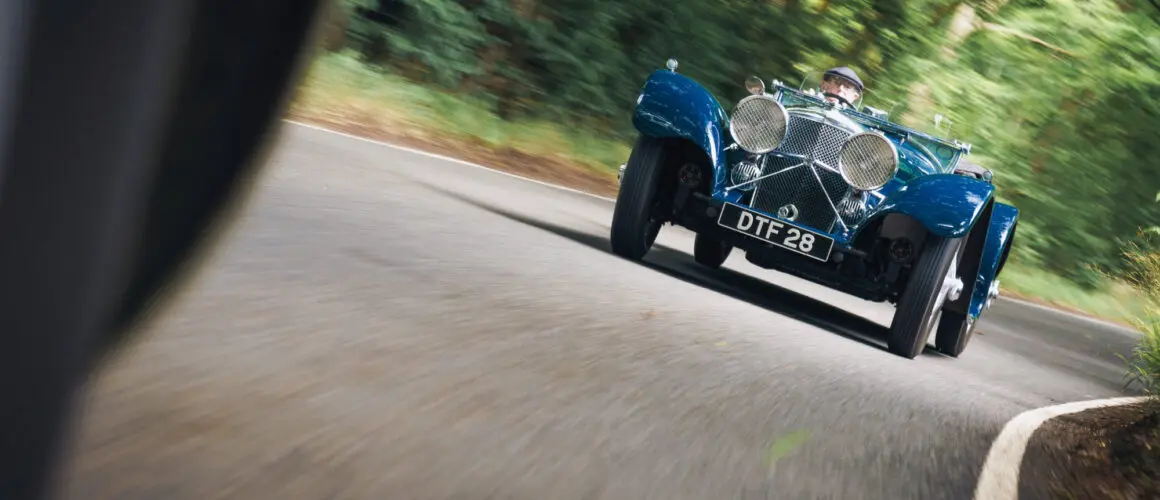
Jaguar built its legend through competition success and the production of elegant high-performance cars that also offered incredible value for money. The business was established as the Swallow Sidecar Company in Blackpool, 1922, by William (later Sir William) Lyons and William Walmsley. Gradually it branched out into the production of stylish bodywork for mass-produced chassis such as the Austin Seven, aimed at buyers on a budget who wanted something a little more exotic.
This article originally appeared in Octane 250.
Lyons was ambitious, though, keen to become a car manufacturer in his own right. In 1934, and without Walmsley, he launched a new range of cars with the style and performance of contemporary Bentleys but much more affordable. They were marketed as SS Jaguars – the first use of the Jaguar name. After World War Two, Lyons prudently rebranded as Jaguar Cars Ltd, a move made viable by the striking two-seater sports car that put the name on the map: the SS100 Jaguar.
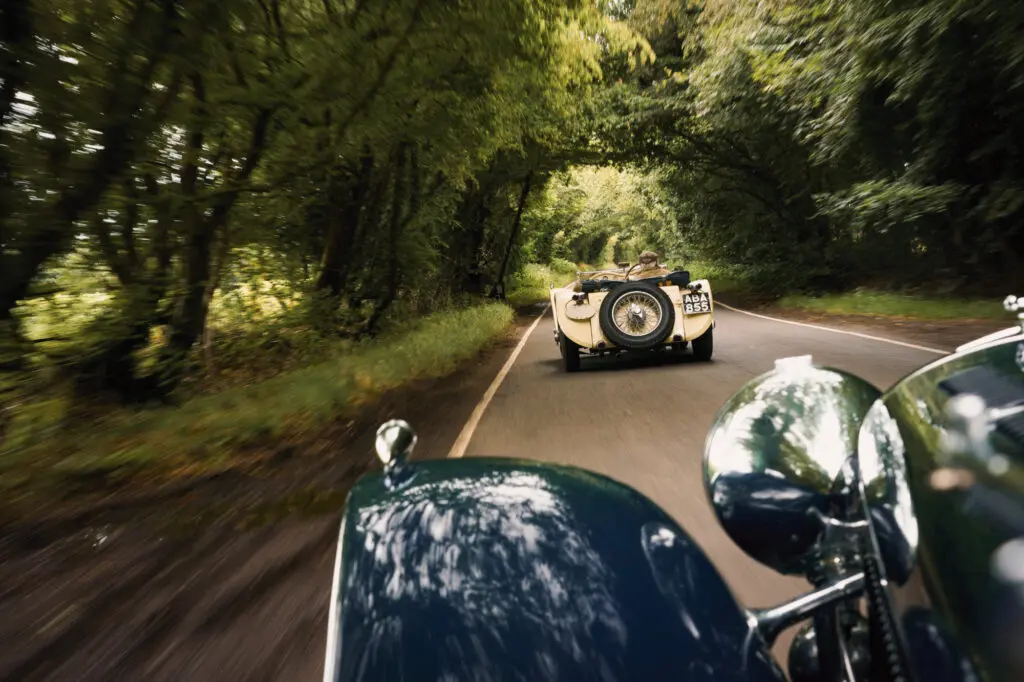
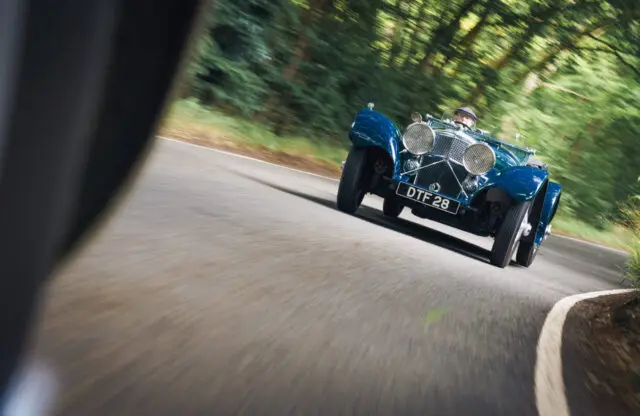
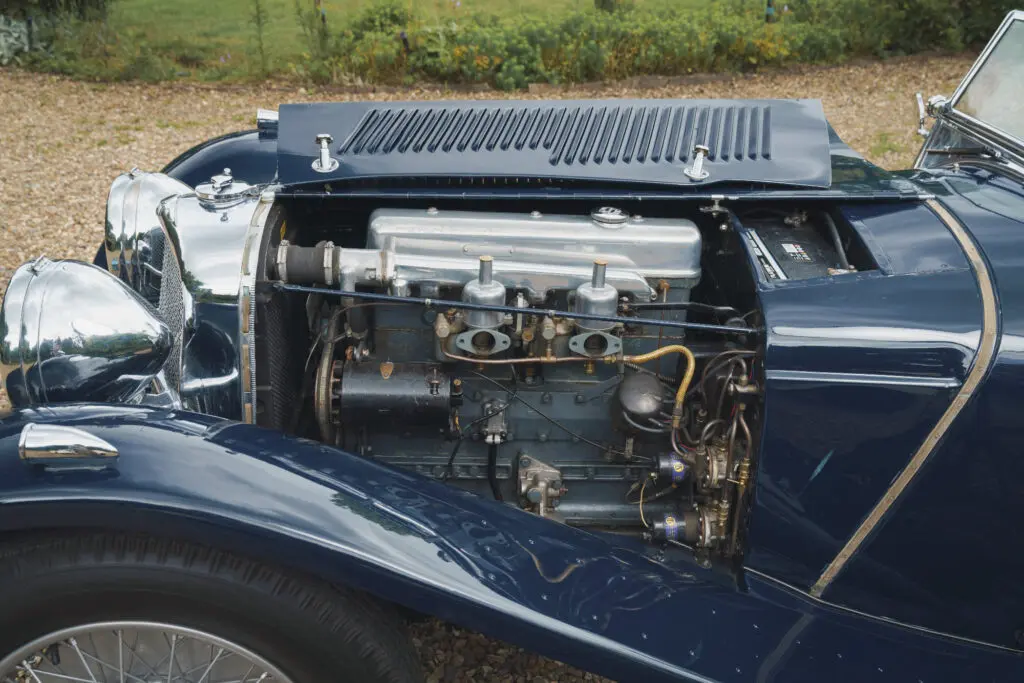
And here are two that have been in long-term ownership: DTF 28 (chassis 39075) bought in 1955 by the then-budding illustrator Michael Turner (see Octane 132), and ABA 855 (chassis 39082), given by an indulgent mother to then-student John Guyatt for his 21st birthday in 1967. Both are the later 3.5-litre versions (it was launched as a 2.5), dating from 1939, genuine 100mph cars of which only 116 were built.
Today we know Michael Turner as the revered aviation and motorsport artist. His first car, an Austin Seven special, was followed by a six-cylinder 1271cc MG F-type Magna. By the mid-1950s, having turned 21, he was looking for something faster and spied an advertisement for an SS100 Jaguar after combing through the small ads in Motor Sport.
Michael describes the scene when he met the seller at a dusty mews lock-up in Bayswater. ‘The car had cycle wings and small headlights. It had been modified for racing after the war, its later, larger, XK120 carburettors necessitating a hole in the bonnet louvres. The car was being sold on behalf of its owner in Wales and the gearbox needed rebuilding, which the so-called dealer agreed to within the £350 price.’
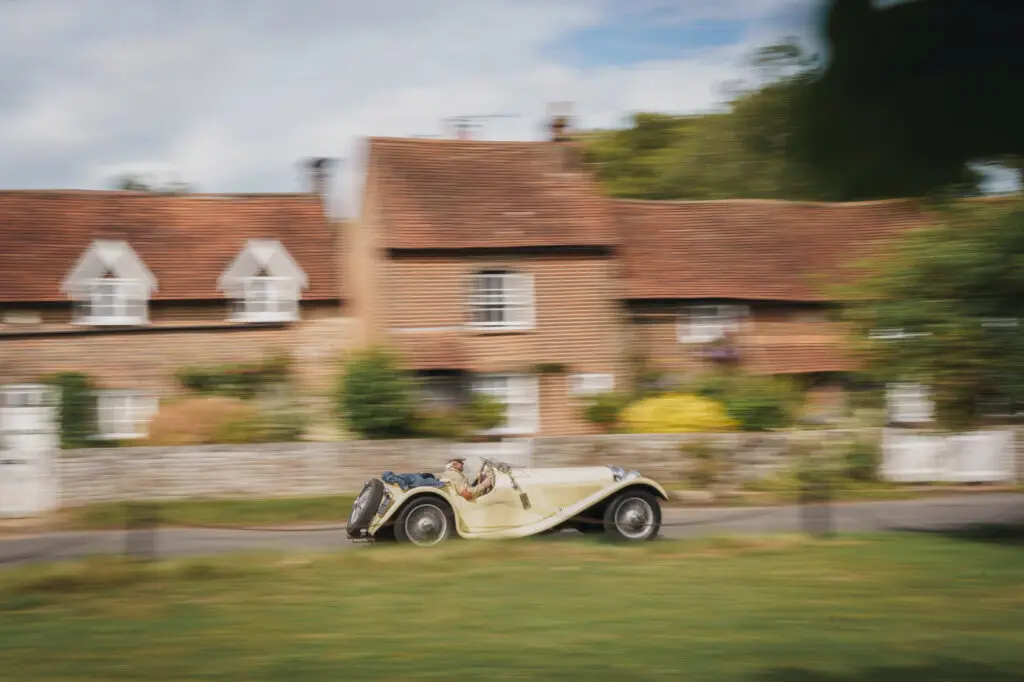
Not all went according to plan, though. ‘I paid a deposit of £100 and arranged to go back the following week to collect the car. However, when I returned there was no-one in evidence so I knocked on the door of the adjacent flat. A woman appeared in her dressing-gown, fag in mouth, and told me that the fly-by-night salesman had disappeared with the money. I was distraught and contacted the police. They managed to get hold of the car’s owner in Cardiff and he came to Notting Hill police station to meet me. Amazingly, he said he would sell me the car for £250, the agreed price less my deposit. The only problem was that the gearbox still needed rebuilding.’
Michael contacted local garage Pinner View Motors, which then repaired the gearbox, tidied up the car and got it back on the road. The SS had previously been raced with some success, and Michael had his own ambitions, but a trip to Silverstone, where he witnessed a massive accident at Becketts Corner, caused a rethink. ‘The SS was my daily driver so I couldn’t afford to risk damaging it. I loved competing, so restricted myself to driving tests, gymkhanas and the like, but I’ve seen photographs of the car racing with its previous owner at Silverstone with its cycle wings. The originals caused the car to lift at high speeds.’
‘In 1957 a friend and I took the SS to Aintree to watch the British Grand Prix. Returning home, I had dropped off my friend in Ruislip and a car shot out straight into the side of my SS. I was ejected from the driver’s door into the road, and the rear wheel went over my foot. The other car was being driven by an American serviceman who was most apologetic, but my car was quite badly damaged, with bent dumb-irons and a twisted chassis.’
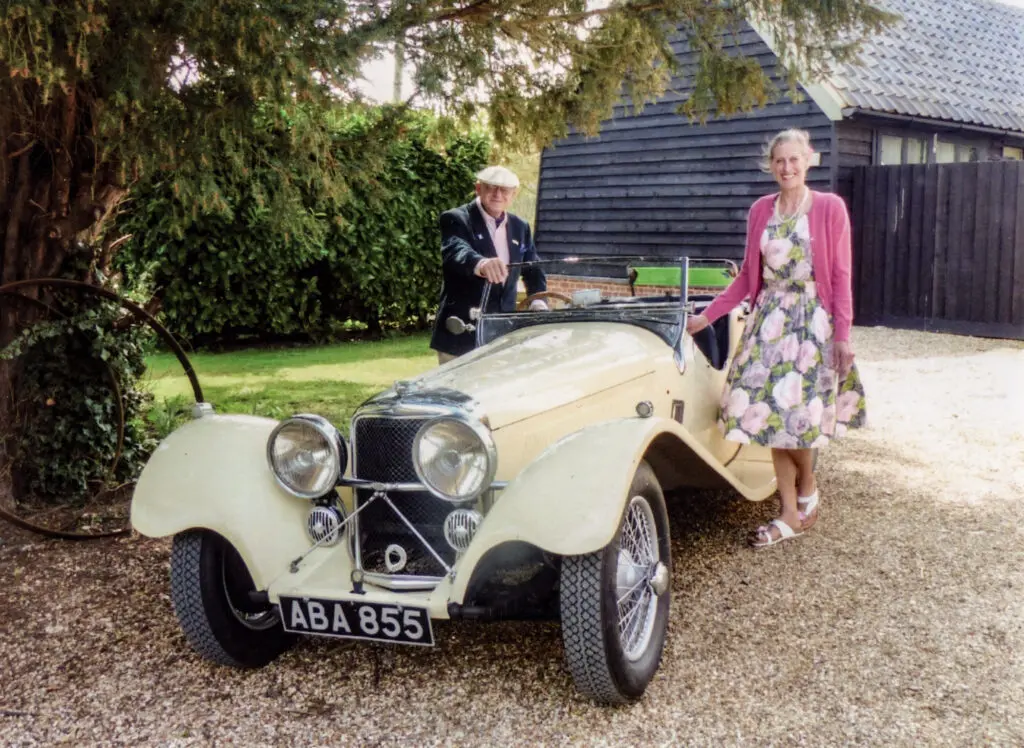
That would lead to further work later. Meanwhile, there’s a romantic angle to Michael’s life with the SS100. ‘The SS100 is really the story of my marriage. Helen, my wife who I sadly lost in September last year, always loved going out in it. One day we were driving from Wendover to Aylesbury on our way to Silverstone when I decided to see whether my car would achieve the 100mph claimed. I put my foot down and got up to an indicated 105mph when a line of stationary traffic loomed up ahead – I’d been paying more attention to the speedometer than the road. The SS has rod brakes that are not the car’s best feature, but I managed to pull up with about three car lengths to spare. Amazingly Helen remained calm and took it all for granted. I knew then that I had found the right girl for me.’
The SS continued as daily transport when Michael went freelance in 1957, and beyond until 1960. ‘That’s when Helen and I got married. I bought a brand-new Austin A40 Farina and the SS went into a lock-up. Some years later I was offered £600 for it, which I thought was a good price, but I decided not to sell. On another occasion I had a call from Andrew Whyte, then Jaguar’s PR director, who said that they wanted an SS100 for their collection and would I swap my car for a brand-new E-type? Again, I thought long and hard and, although I’d tried E-types and loved them, I couldn’t bring myself to part with my SS.’ Today Michael has an E-type in his stable, alongside the SS100.
‘The car still had its cycle wings when I took it to the 50th anniversary celebration at Jaguar’s Browns Lane factory in 1986. There were 17 SS100s in a line and my car stood out like a sore thumb, so I decided to revert to the original style. Fortunately there was a chap in Stanmore, Alan Giddins, who ran the SS Register; he had a pair in his loft and agreed to sell them to me. I sent them off with my car to James Pearce of Billingshurst, West Sussex. I’d also acquired a pair of the correct Lucas QK596 headlights at the Beaulieu Autojumble. When the car was stripped down we found that quite a lot of the woodwork needed replacing, and when the body was removed it was revealed that the chassis was bent not only behind the dumb-irons but also at the rear. It all had to be straightened out.’
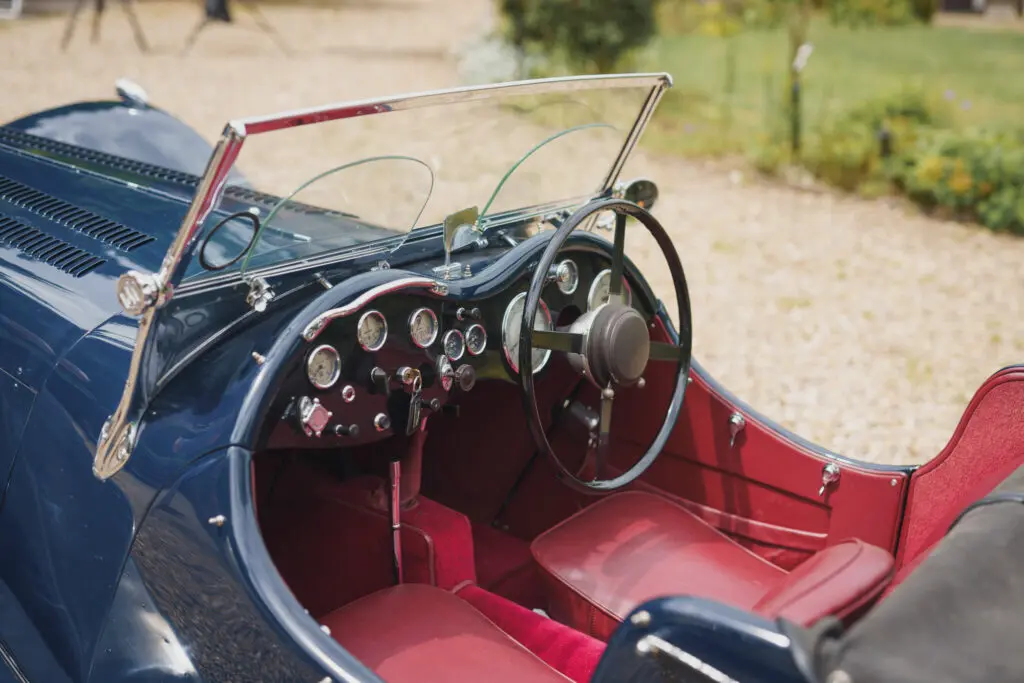
Before Michael’s tenure, modifications to DTF 28 included a competition exhaust and Andre Telecontrol dampers, as well as a high-compression cylinder head, the XK120 SU carburettors and, of course, those cycle wings. The car took part in 21 races, spanning May 1948 to September 1954, including class wins in handicap races at Croft in 1950 and Goodwood in 1952. In fact, DTF 28 was placed first, second or third on ten occasions.
Michael’s reputation as a world-renowned artist has allowed him to enjoy and improve his SS100 over the past 68 years as well as adding to its rich competition history through appearances at Buckinghamshire’s Kop Hill Climb. Today, resplendent in its dark blue coachwork, DTF 28 is immaculate, though it is no show pony and is regularly dusted off to be driven, remaining a much-loved member of the Turner family.
John Guyatt’s first classic was an SS1 tourer. Says the well-known VSCC racer: ‘I restored it very amateurishly but when I saw an SS100 at a dealer I really wanted that. This was around my 21st birthday so I requested it from my mother as my present.’ Thus, in 1966, ABA 855 was given to John by Mrs Guyatt, baffled by her son’s desire for what she saw as an old bone-shaker. ‘Wouldn’t you rather have a new E-type?’ she asked. John responded, tongue in cheek: ‘How about for my 22nd?’ – and a year later an E-type followed.
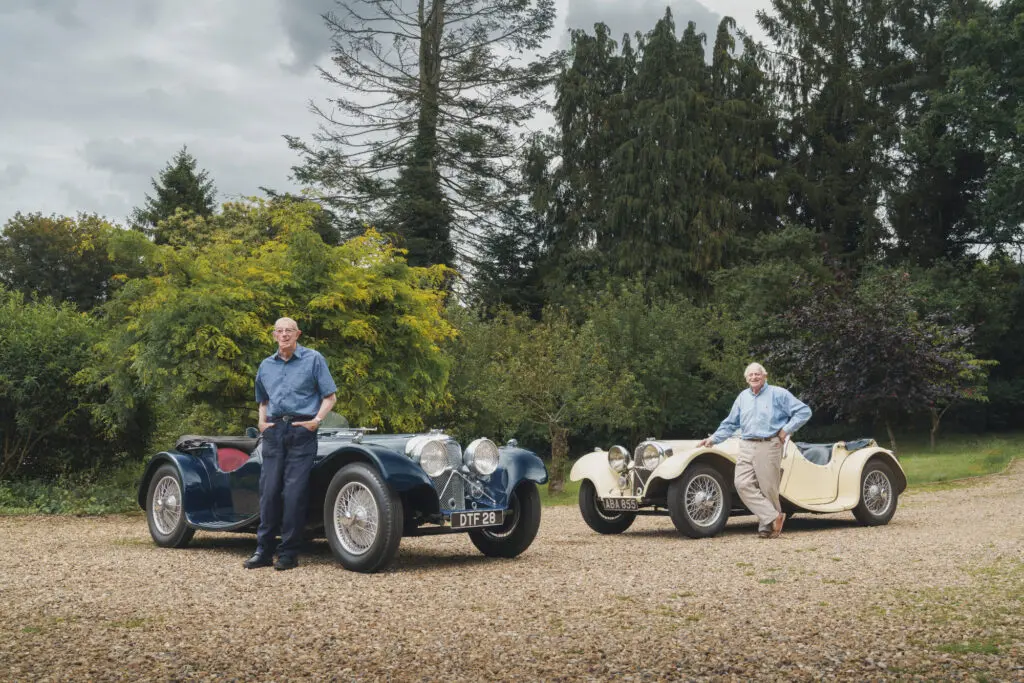
John recalls his early days of ownership: ‘I had become interested in skiing and set up a company that enabled me to spend the winter in the Alps and to go racing in the summer.’ The SS100 provided regular year-round transport, rain-or-shine, frequently undertaking long European journeys.
When he took on ABA 855, its original engine had been replaced by a post-war unit. ‘Later I was lucky enough to get hold of one of the three experimental engines [number M2] that had been built and raced by the factory, and that is what it has today.’ Back then the car was green, later changed to white and, more recently, to its current ivory colour. ‘It may be scruffy but it wears its battlescars with pride,’ he says.
ABA 855 is, says John, the only car he has kept – and for more than 50 years now. Others have come and gone, including Lagondas, supercharged Alfas, English Talbot racers, Talbot-Lagos, a Mercedes ‘S’, a low-chassis Invicta, a Delage, a Ferrari, various Astons and Jaguars (including a D-type), and even a Kurtis-Kraft Indy car.
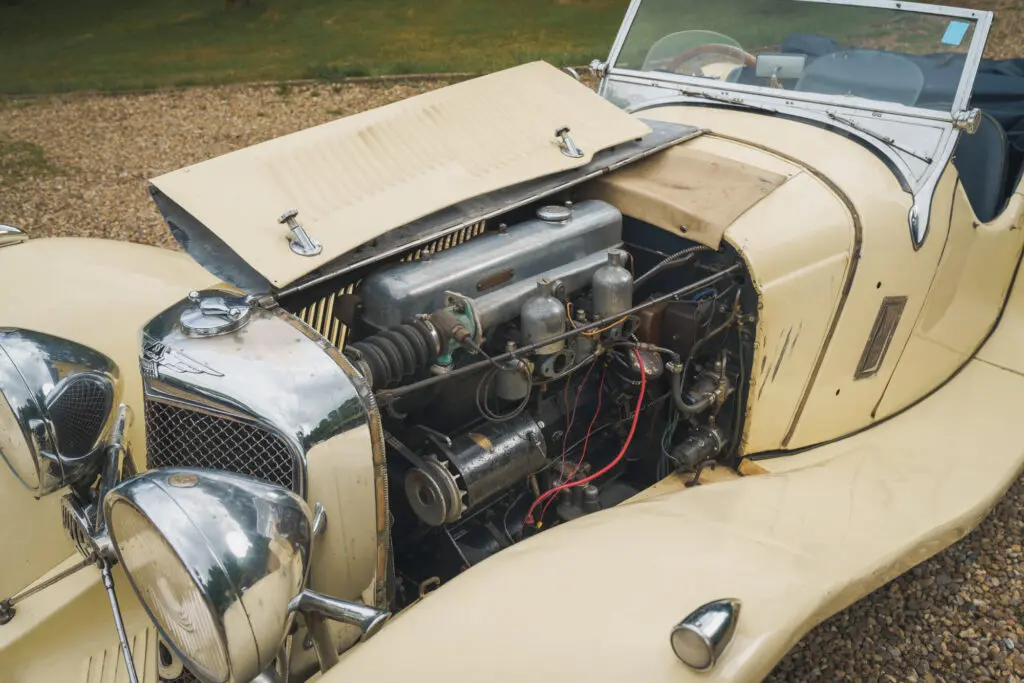
John’s late wife was Lesley Macalpine, herself something of a VSCC legend and a fan of ABA 855, even down to helping John with a rebuild including paint, mechanics and upholstery, in time for the 50th anniversary celebrations in 1986, which they attended as well as the Turners.
‘No matter how far from home we are and whatever happens, the SS always gets us home,’ Lesley had told me, recalling an incident on the way to a wedding in Brussels when the head gasket failed. ‘We stopped regularly on the way back to refill the radiator and made it home safely.’
Lesley recalled another occasion when, having driven with John in the SS100 to the Prescott hillclimb, he saw an advertisement for a load of Talbot parts in the depths of Wales. ‘We headed off to Wales, John bought the parts, loaded up the SS and we returned home, parts spilling out everywhere.’ Wisely, he had fitted a luggage rack.
Both John and Michael have driven vast mileages in their respective SS100s and, while the journeys may be shorter these days, the special bond between the cars and their drivers remains intact.
Having never previously driven an SS100 but as the long-term owner of its successor, the Jaguar XK120 Roadster, I have been looking forward to the opportunity to drive not one but two examples of this groundbreaking model: Michael’s car, beautifully restored, immaculate in its deep blue coachwork; and John’s, self-maintained and wearing the kind of patina that can be earned only during years of motoring adventures.
Michael’s car first. The cockpit is snug to say the least, the tight footwell and closely spaced pedals a challenge for anyone with feet larger than a ballet dancer’s, while the broad steering wheel, close to the driver’s chest, makes entry and exit less than elegant. Once in, I find the driving position comfortable and the nicely weighted controls direct and intuitive, as is the steering, which requires some heft yet offers plenty of feel and a surprising level of directional stability.
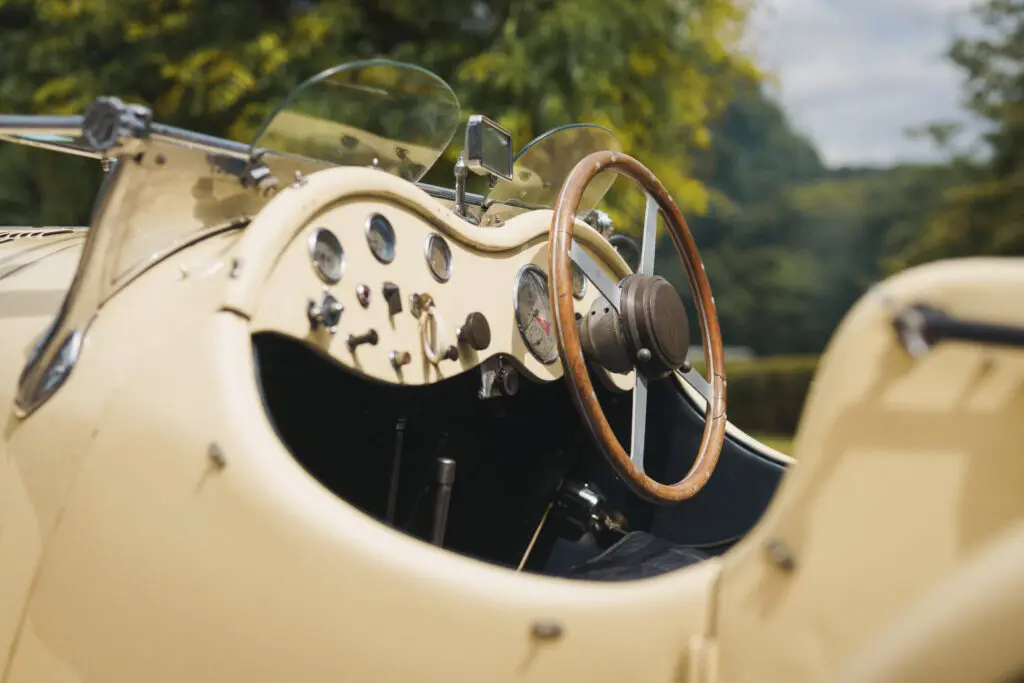
The 3.5-litre straight-six proves lively and torquey, demonstrating that Michael’s car still delivers the enhanced performance of its early post-war competition career. The SS100’s oft-maligned Moss gearbox is a joy, its rifle-bolt precision more than making up for the need to pace the shifts. Meanwhile the rod-actuated drum brakes, while very much of their era, provide a reassuring level of retardation.
John’s car, perhaps understandably, feels somewhat ‘looser’ but is no less enjoyable to drive and its ex-works competition engine feels even more willing than that in Michael’s car. Furthermore, and to quite a surprising degree, there is evident similarity in driving dynamics between the SS100 and the XK120.
The SS100 Jaguar was the first genuine high-performance sports car that could be bought by the merely well-off rather than the super-rich, a tradition continued with the XK120 and E-type. Although now highly prized, the SS100 has not, perhaps, received the credit it is due as the first ever ‘affordable’ supercar. These two owners would surely attest that it lives up to that.
THANKS TO the late Lesley Macalpine and Helen Turner, to whom this feature is dedicated.