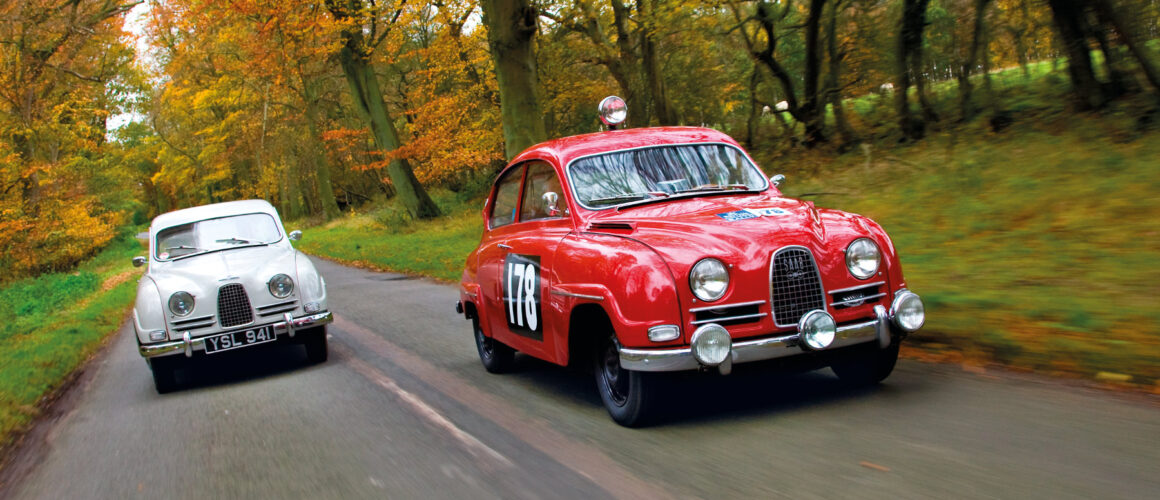
Back in the May 2011 issue of Octane (number 095), John Simister spent the day with rallying legend Erik Carlsson, reminiscing about two-stroke Saabs and drivng around the English countryside on on the 50th anniversary of his RAC Rally victories. Enjoy it in full below.
Eaton Bray, Bedfordshire, mid-November. Mine should not be the only two-stroke Saab in the village, because I have come to find the king of all Saabfolk. Erik Carlsson lives here. But where? The Google map has told me a fib, it seems.
A bit further along… and is the air-rending I hear that of a very healthy two-stroke with a competitive attitude? It is. Erik is warming up his rally car; two-stroke Saab expert and 2010 Le Mans Classic racer Chris Partington is encouraging the process. I’ve arrived.
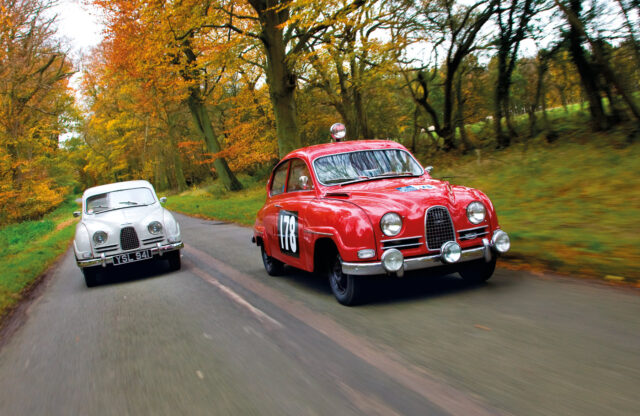
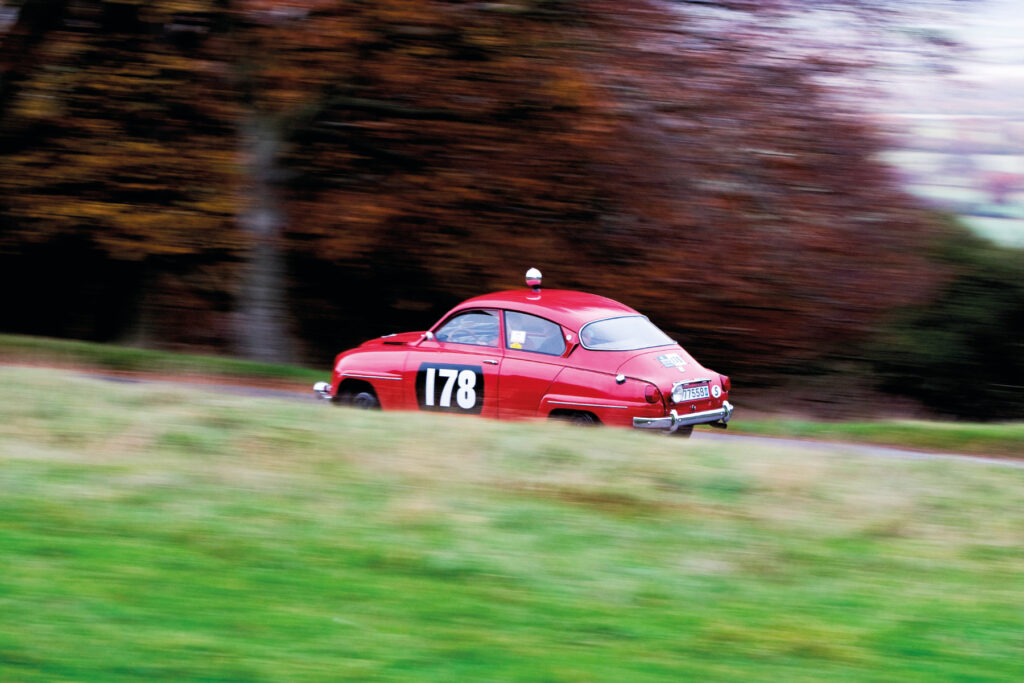
This is Erik’s own toy. We’ve recently seen it in the motoring press, helping the great man celebrate the 50th anniversary of his win in the 1960 RAC Rally – and one of the first major international rally wins for the then-new Saab 96. For the celebration it was given the number 178 to make it look like the actual winning car, a car that still exists and which, by the time you read this, should be residing at Saab’s Trollhättan headquarters having been prised away from its most recent US owner.
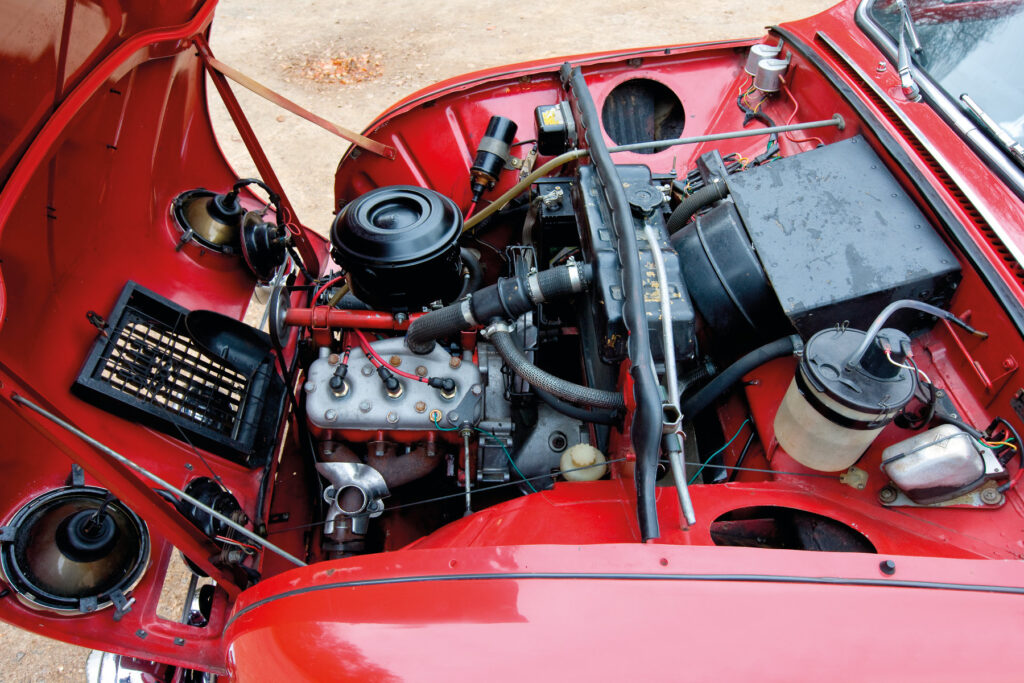
Erik’s toy is actually a replica of a rather important 1963 rally car, still with a single Solex carburettor and an underbonnet view remarkably like that of my machine. Appearances deceive: instead of 38bhp it has around 65, and even that is quite mild compared with the rally cars in their more extreme tune. But too much power would have been bad news, because what a rally car really needs is a broad band of torque. You might not think a rapid two-stroke could manage this, but it can.
Saab’s favourite son is looking good for his 81 years. He was 30 when he won the RAC, 50 when Saab gave him the birthday present that was the rebuilding of his roadgoing 96 – ‘It belonged to an old lady, and I bought it for the equivalent of £120 when she died’ – into a replica of the 96 that Erik drove to victory in the 1963 Monte Carlo Rally, wearing competition number 283.
The dashboard and its accessories, and the seats, are from the actual Monte winner. ‘The cars were put back to standard after the rallies, and sold as used cars,’ says Erik, ‘but the rally bits were kept. Saab asked me what I would like as a present. “A tractor,” I said, “preferably a Massey-Ferguson.” But this Saab is very nice.’
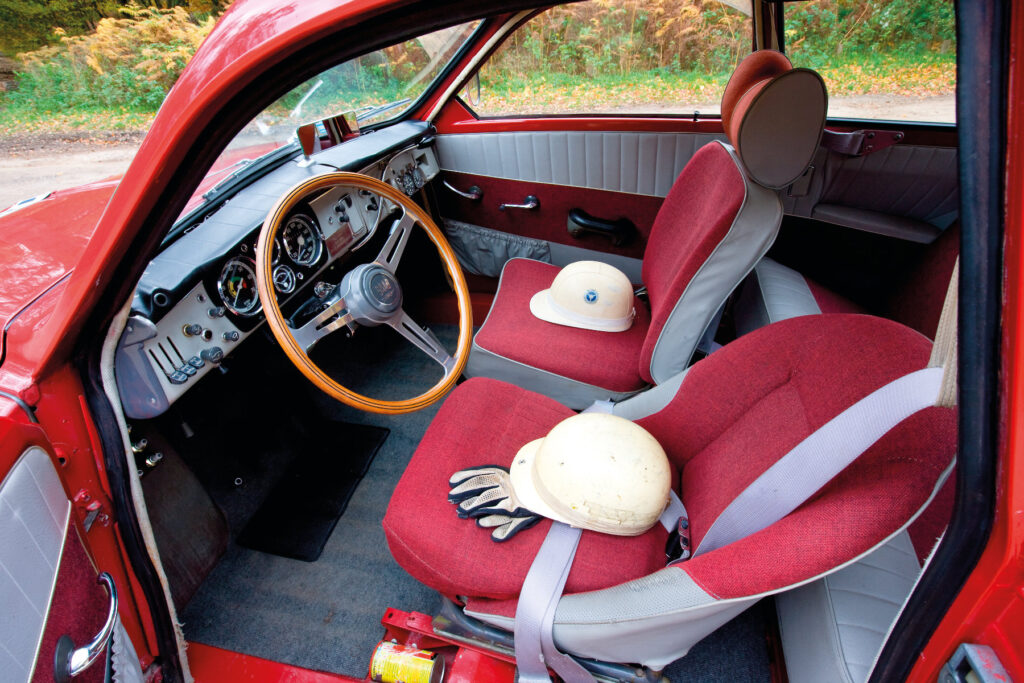
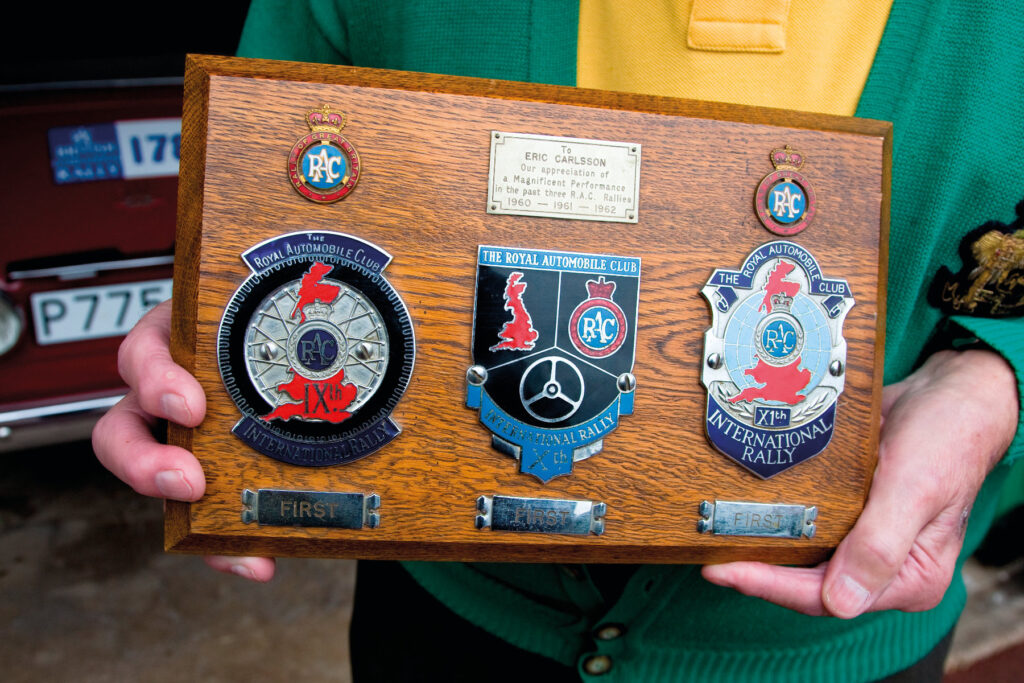
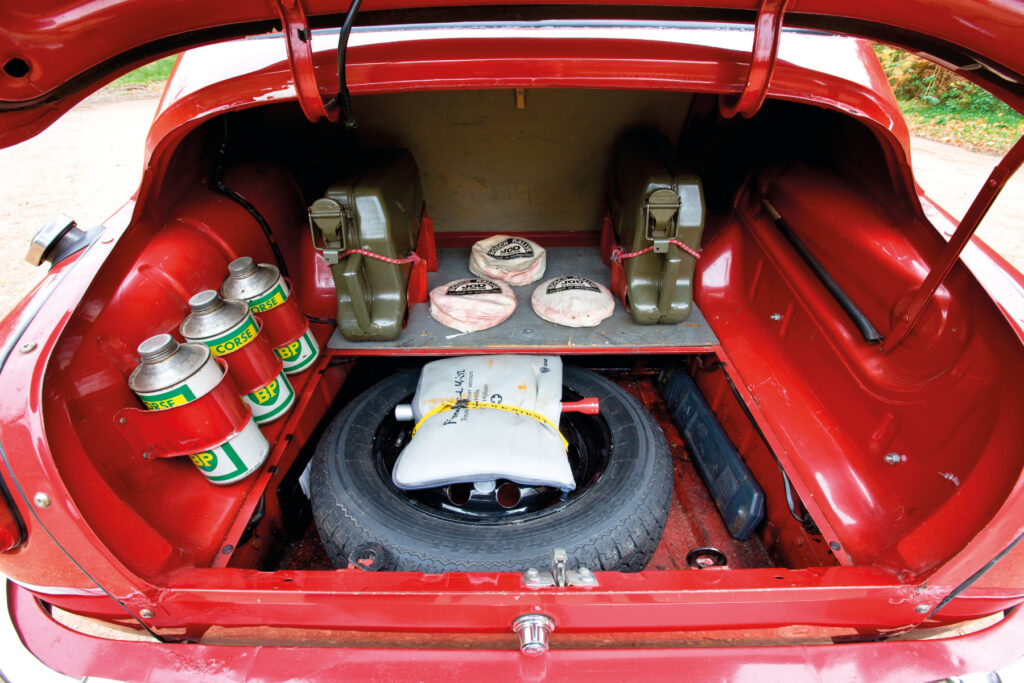
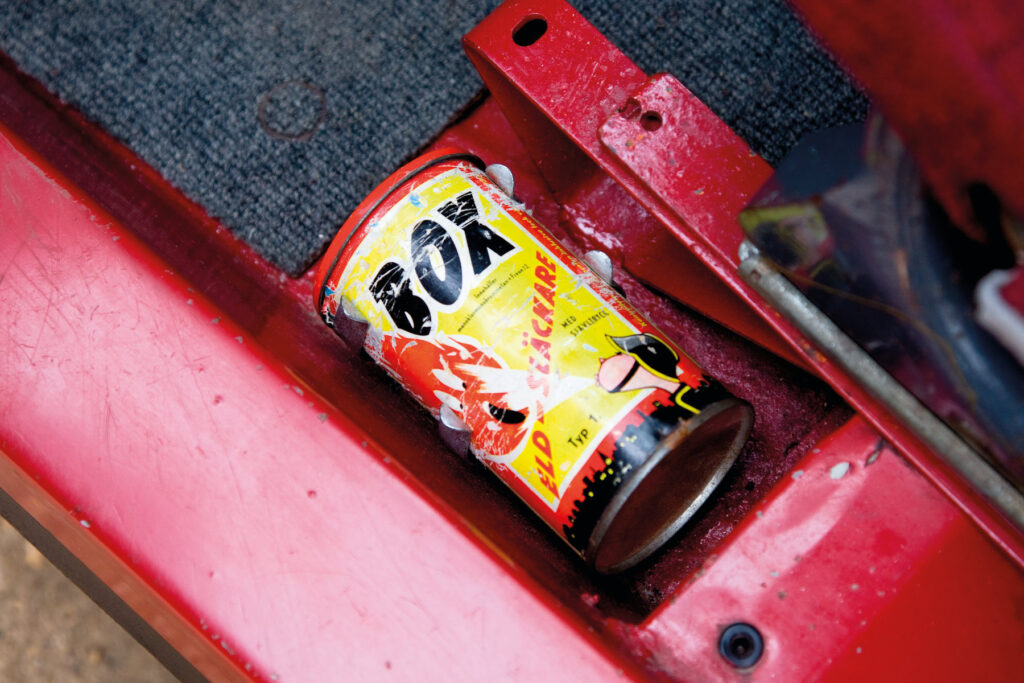
It is indeed. It’s full of period pieces, from the ultra-rare Bosch fog and spotlights (which Bosch wanted for its museum) to the BP Energol two-stroke oil cans in the boot. Unlike the 1960 RAC car (and mine), though, it has a four-speed gearbox instead of a three-speed and disc brakes for the front wheels. Technology had moved on by 1963. And it even wears the Monte car’s P77558 numberplate, by special Swedish dispensation even though it conforms to an obsolete system. A plaque on the dashboard says ‘Till Erik 5.3.79 Saab Personbilsdivisionen’.
We’re off to the hills. ‘It’s a bit down on power with 65bhp,’ Erik is saying as we bwaaarp-ring-ding-bwaaarp up through the gears. ‘At the time we had 75 to 78bhp. Other people said they had more but we were always faster.’ He never liked using the freewheel on rallies, because you never quite know what lies around the next bend and the freewheel deprives you of instant variability of balance. Would he use it on a race track? ‘Yes,’ he says, ‘because you know where you are going.’
Three gears must have been a hindrance on a rally, which is why Erik sometimes used the 95 estate car version in 1961. It was the first Saab with a four-speed transmission, controlled by a gearlever chromed instead of painted. This difference in finish caused trouble for Pat Moss, Erik’s late, rally-winning wife, because the three-speed 96 she was campaigning in 1961 also had a chromed lever, as right-hand drive cars did. Rivals filed protests, but they were wrong.
Erik enjoyed spooking the protesters. At the German Rally in 1961, DKW started a rumour that Erik was using an illicit four-speed ’box in his 96. He won, and a protest duly followed. ‘All through the rally I’d been dipping the clutch to make four-speed noises. So they had the engine and gearbox out and the gearbox in bits, but they couldn’t find a fourth gear…’
This rally car seems very short-geared, its fourth gear shorter even than my car’s third. All the better for pace off the line, and Erik never used to worry much about revs. ‘Normally I kept to 7500rpm: “Don’t go over that or you’ll blow it up,” they said. But in Monaco one year I had to use 9000rpm going down to the Station Hairpin in second gear, to keep ahead of Böhringer’s Mercedes. It didn’t blow up, though.’
We’re powering nicely through some corners, so I wonder about left-foot braking and imagine Mr Carlsson to be quite an exponent of the art. Not so, for Erik is ever the pragmatist: ‘Yes, there’s some advantage but it used too much brake linings. And it’s a hell of a job to change them.’ Too true, especially with the drum brakes. You need a monster puller and then the hub taper lets go with a bang like a 12-bore shotgun.
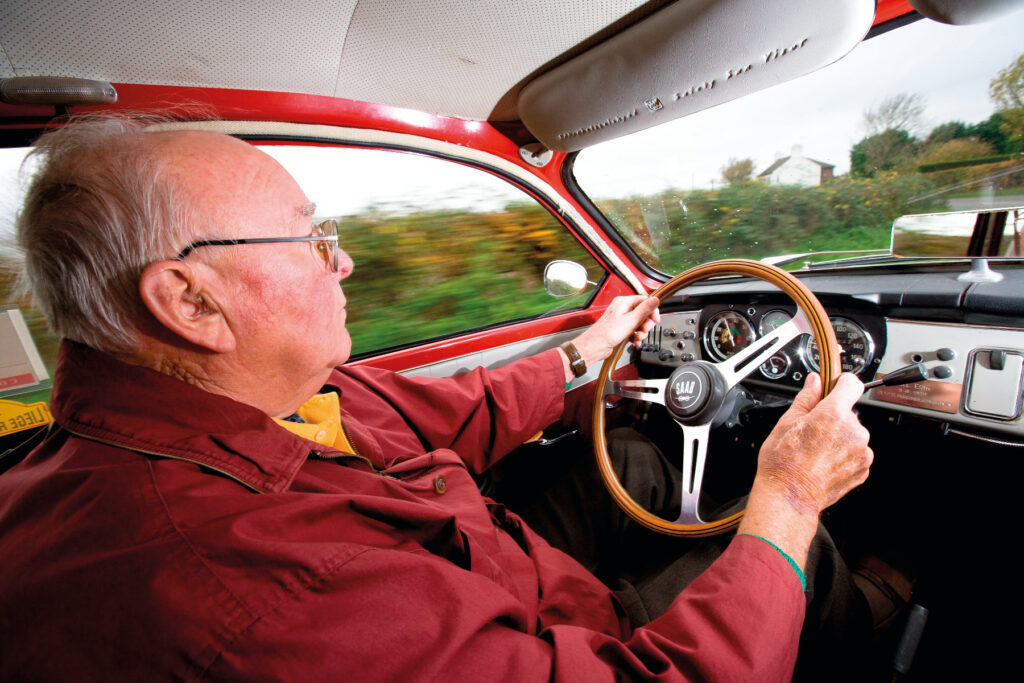
Erik is mindful of speed limits hereabouts – his Toreador Red rally car is quite conspicuous both visually and sonically – but he enjoys a good blast on the open road. Snow would be even better, but that has arrived only as I write these words. I’m watching from the roadside as the little Saab blares back and forth for the camera, blue oil-smoke trailing because it’s set to run richer and oilier than mine. Several hill-walkers are watching too, all smiling. It’s that sort of car.
Now it’s my turn to try it, Erik next to me in the seat originally occupied by navigator Gunnar Palm, watching how I treat his baby. I’m privileged to drive it, because he doesn’t entrust it to those unfamiliar with a Saab two-stroke’s ways. The surprise is its tractability, something I hadn’t expected given its power increase over standard and its angry, manic tickover. All those gears are gone through in a trice, and there’s a lot of surging and snatching on the overrun with the freewheel locked out, but at no point does it bog down and turn dyspeptic.
The throttle response is as crisp and blippable as a throttle can be; the sound is like mine but played through a PA system instead of a transistor radio.
The ride is firmer, too, thanks to uprated dampers. Not springs; they are standard. Erik favours these, with one-and-a-half turns cut off if necessary for racing. ‘The Safari Rally in 1963 was the first time we altered the suspension, using Bilstein dampers. For 1964 Saab made special springs. We collected the cars from Mombasa, and even before the start of the rally two springs had broken on my car and one on Pat’s. Standard was best.’
Standard, too, would reduce sudden lateral weight transfer and the risk of unintended inversion. Ah yes, ‘On the roof’. Erik’s nickname, because he did it more than most, possibly helped by the Saab’s narrow track. Just as well, then, that the Saab’s domed profile and thick metal kept the roof roof-shaped and made the Saab easier to return to the correct orientation. The rally cars didn’t even have roll cages. Even better, a sumpless two-stroke recovers more readily from inversion than an oil-swamped four-stroke, and will even continue to run if there’s enough fuel sloshing about.
Erik proved the point after one Safari Rally by turning his 96 on its roof again to demonstrate how the engine still ran. ‘So the Ford team tried it with a Cortina. There was battery acid everywhere, oil, a terrible mess, and they couldn’t get it upright again. It didn’t run, of course.’
What is not standard in this car is the cluster of four round dials from the triple-carburettor Saab Sport, replacing the ribbon speedometer and adding the vital revcounter. There are stopwatches and tripmeters too, and the steering wheel is the wood-rimmed, three-spoke Sport item.
The racket from those exhausts played havoc with Erik’s hearing, especially on epic rallies such as the Spa-Sofia-Liège. ‘We were awake for 100 hours continuously, 94 of them driving. In our Saab we had to go flat-out the whole way, with just an hour’s stop in Sofia.’
Erik remained faithful to Saab throughout his rallying career, finally succumbing to back trouble and retiring in 1967 after just one rally in the V4-engined 96. There were tempting offers to defect – from BMC and from Ford – but he stayed loyal. ‘Please, Erik,’ Saab’s managing director pleaded down the telephone. ‘You can’t go to bloody Ford!’ So he stayed.
Now comes a treat. Erik lowers his towering frame behind the wheel of my 96 and we head off. Each gearchange is crisp and instinctive, and he is grinning broadly.
‘I couldn’t remember how nice it was,’ he says with his intriguing Swedish tense-shift. ‘This is a pleasure! This is so nice! So many years ago… the torque… see how it pulls in third… so quiet… I couldn’t believe it was so nice!’
I believe he likes it, which is rather special. The great Erik Carlsson has driven my Saab, and I’ve driven his. What a magical day.
1963 Saab 96 rally car specifications
ENGINE 841cc three-cylinder two-stroke, aluminium head, single Solex 40 BI downdraught carburettor
POWER c65bhp @ 6000rpm (standard car 38bhp @ 4250rpm)
TRANSMISSION Four-speed manual, freewheel, front-wheel drive
STEERING Rack and pinion
SUSPENSION Front: double wishbones, coil springs, telescopic dampers, anti-roll bar. Rear: U-shaped beam axle, radius arms, coil springs, telescopic dampers
BRAKES Discs front, drums rear
WEIGHT 825kg
PERFORMANCE Top speed c90mph on rally gearing