Countach! This exclamation, originating from the truffle-hunter dialect of Italy’s Piedmont region, is among the most renowned in the country’s language. Not because of the truffles, of course, but because of its links with a car manufactured 300km away.
Ferruccio Lamborghini founded his car company in 1963, when Italy was enjoying an economic boom, unemployment was low and prospects looked, well, prosperous. Into that vision Lamborghini launched the 350GT, the Miura and the Espada, but in March 1971, mere days before the Geneva motor show, Italy was suddenly beset by industrial action. As a result, Ferruccio and coachbuilder Nuccio Bertone changed tack, moving the assembly team of their new show-car to a secret place.
Bertone designer Marcello Gandini had penned the prototype of a car codenamed LP500, ‘LP’ for Longitudinale Posteriore, a description of its engine position, mounted longitudinally aft of the cabin. While they were working during the hours of darkness in a barn close to Bertone’s factory in a Turin suburb, a farmer, suspicious of the noises coming from inside, threw open the door expecting to find burglars. Instead he saw technicians working around a yellow car that looked more like a spaceship. ‘Countach!’ he cried, using a colloquialism that might translate to something with four letters. And thus the car was named.
Most of the men in the barn were from Emilia and had no idea what it meant, but Gandini was a local and knew the word well. A quick check with test driver and New Zealander Bob Wallace confirmed that it sounded good to anglicised ears and Gandini convinced Bertone to add the name to the show-car.
Destiny would always play a role in the story of both the Countach and Lamborghini as a whole. The company had to be rescued several times before it achieved some stability in 1998, when visionary Volkswagen boss Ferdinand Piëch gave it a new life. The lowest moment had come in early 1980, after almost two years during which the court of Bologna had gradually determined that nothing could be done to save it. Come that February, preparations began to shut down Lamborghini.
Except that destiny was at work again.
During the summer of 1980, the young Jean-Claude Mimran was cruising the north-west coast of Italy on his yacht, a passion he shared with his brother Patrick. Theirs was one of the world’s wealthiest families, leaders in the field of sugar cane production. While talking about their shared passion for yachts, Jean-Claude let it be known that he wanted a Lamborghini. And so the brothers drove to the closest dealer, Achilli Motors in Milan, only to find that they couldn’t order a Countach because the company was in receivership.

Realising that Lamborghini HQ was just a couple of hours’ drive away, the Mimrans headed to Sant’Agata Bolognese. That same evening, they called Achilli Motors again. The brothers had bought Lamborghini: not a single car but the whole company. And from the following day they actively began resurrecting the firm, eventually writing a cheque for 3.8bn Italian lire on 23 May 1981, a sum just shy of €2m. The ‘new’ company was named Nuova Automobili Lamborghini.
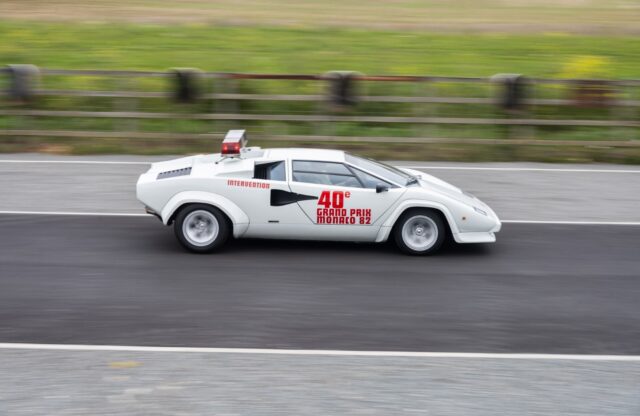
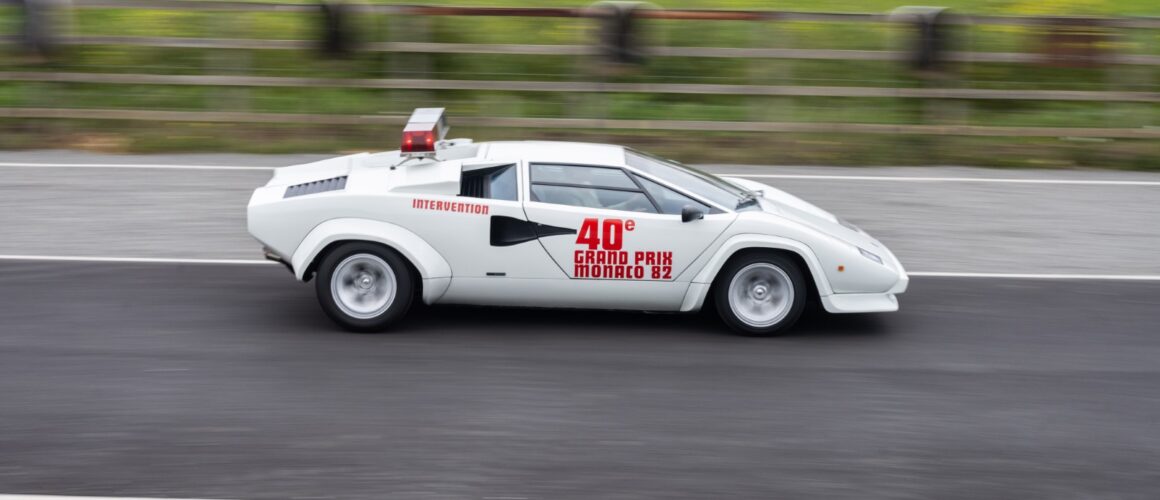
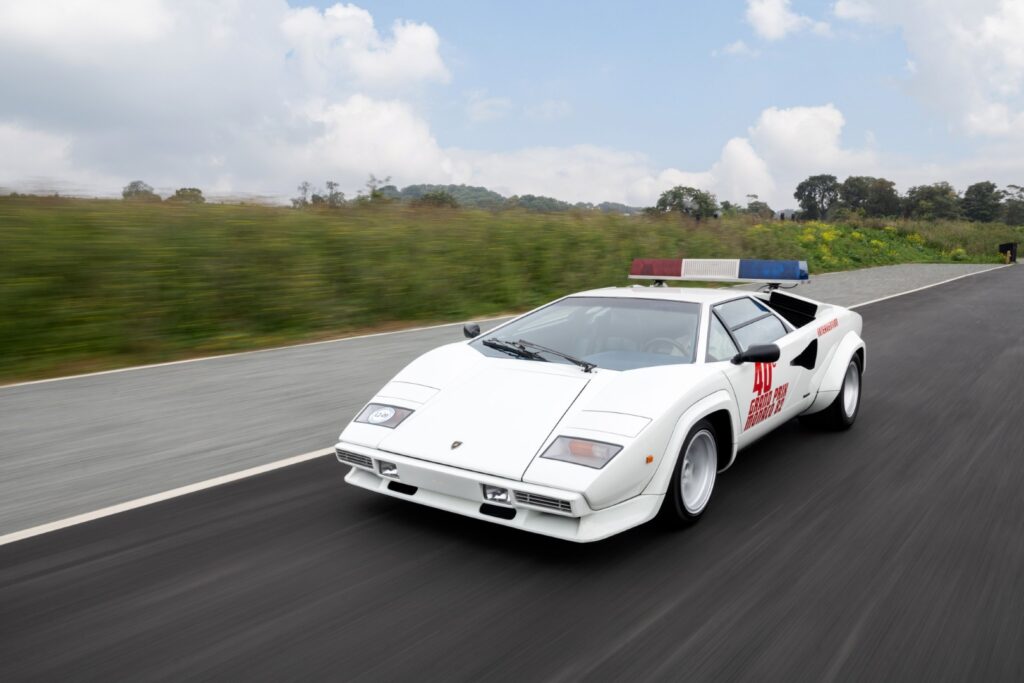
Shortly before that date, the two Mimran brothers had each received a Countach. On 13 May, Patrick took delivery of chassis 1121312 (in Rame Colorado with Senape trim), and on 15 May Jean-Claude found himself the keeper of chassis 1121314 (Bianco on Bleu, or white with blue leather. Yes, it’s the car you see here.
The brothers owned many Lamborghinis in their time as owners of the company, but, given the perilous state of Sant’Agata finances when they took over, it’s safe to assume that owning the company was not enough to score a freebie.
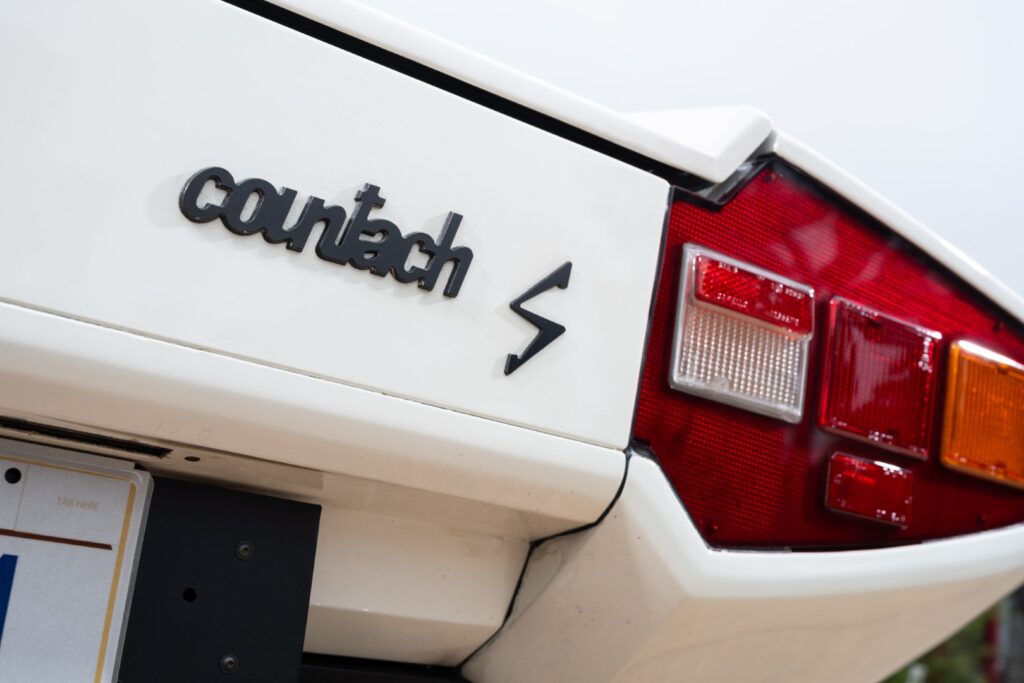
What made these two cars special is that they were the first and second of the LP400S model, which would come to be recognised as the third series. And that’s a story in itself.

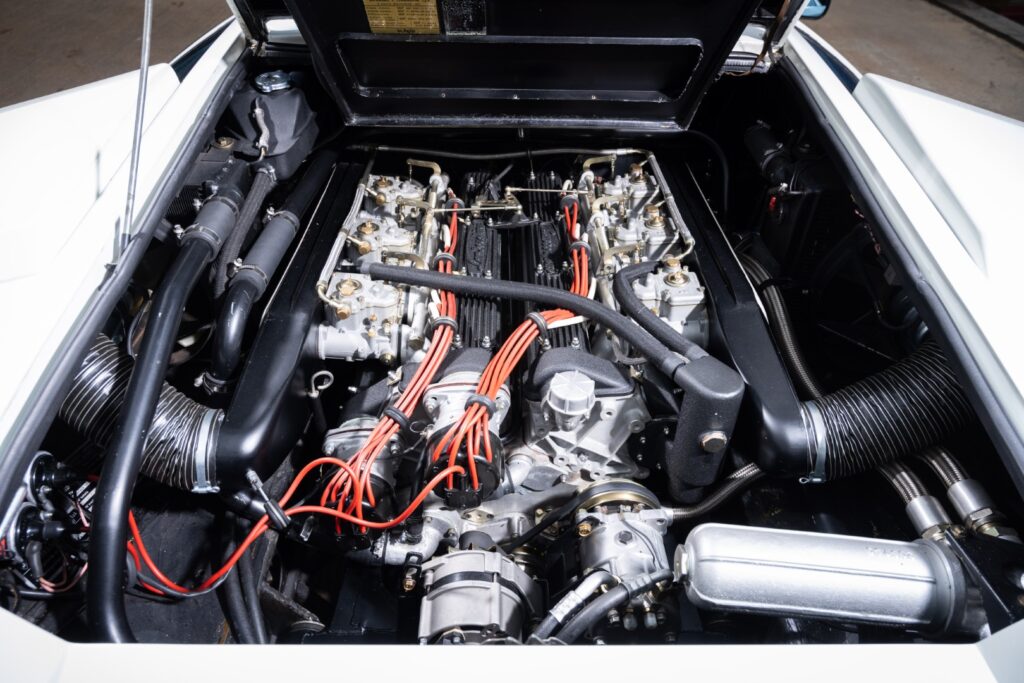
When the Countach had finally gone on sale in spring 1974, its shape was slightly different from that of the Geneva show car of 1971. The LP400 was shown with a 4.0-litre engine rather than the 5.0-litre envisioned, and went on to be nicknamed Periscopio on account of its roof-mounted rear-view mirror. It remained linear and clean, without superfluous elements except for the air intakes for the engine, mounted on the top of each rear wing.
Early customers included Walter Wolf, a friend of the company and passionate about racing. He was happy with his car yet felt that it would benefit from more development and performance. He hired Ingegnere Giampaolo Dallara as a consultant, just after he had left his position as technical director of Lamborghini to open his own company, focusing on racing.
Dallara’s is a name that needs no introduction, and he performed his magic on Wolf ’s LP400. ‘The limit was the tyres,’ he says. ‘They were still the 205/70 VR 14 on all four corners. Pirelli, with the introduction of low-profile P7 tyres in 1976, wrote a new page on this area, allowing far more interesting development in suspension settings.’
Indeed, Wolf ’s car received the new tyres in two different sizes, 205/50 VR 15 on the front and 345/35 VR 15 on the rear, allowing for revised, stiffer suspension and bigger brake discs. Reshaping the wings to accommodate the wider tyres was too costly, so wheelarch extensions were fitted. A front spoiler was added for better aerodynamics, while a rear wing, adjustable with an electric motor, appeared at the rear. Wolf ’s car then gained an improved engine, with a 5.0-litre capacity, though that remained a one-off.
The Wolf Countach became an immediate hit and Lamborghini was flooded with requests. The LP400S was born as a result, endowed with the newly muscular shape that made the Countach so charismatic and famous for the following 15 years of production.
While the LP400S was a single model, of which 235 were manufactured between March 1978 and February 1982, latterly collectors split them into three distinct series. The Mk1, 50 made, was the ‘Low Body’ because of its low roof and low front spoiler, easy to recognise thanks to its ‘telephone dial’ wheels and small instrument gauges. The Mk2, 103 made from October 1979, came with smoother wheels, larger gauges and a reduced front spoiler. The Mk3, 82 built, had a higher roof, hence a taller cockpit, and came with raised suspension.
When delivered to its prestigious first owner, 1121314 was registered in Switzerland and immediately put to work. It seemed the Mimran brothers’ reward for saving Lamborghini was to be the two coolest guys in Monaco with the very latest cars.
Jean-Claude was a genuine diehard fan and was known to use his Lamborghinis frequently – when he sold this car it was succeeded by a 5000S – and there are pictures of him in Monaco with this car in its road trim, but how it ended up leading the F1 cars around the famous Monaco circuit remains a mystery.

Most likely, given the era and the tightknit Monégasque elite community of which the Mimrans were part, these well-known and well-connected brothers about town were simply asked by the ACM if they had anything suitable and leapt at the chance for some free publicity for their ailing recent acquisition.
So it was that, wearing a new livery and dramatic roof-mounted lights but no further modifications, this car lapped the circuit before every session of two Monaco GP weekends.
During the Monaco Grand Prix of May 1981, this 400S, wearing Intervention stickers on the rear flanks and with those coloured lights flashing, was reserved for the F1 doctor in a race that Gilles Villeneuve won by a healthy 40sec margin from Aussie Alan Jones in the Williams (long-time leader Nelson Piquet had crashed his Brabham and Jones suffered fuel maladies). The most dramatic aspect of the race was a fire in the Loews hotel kitchen that delayed the start, so the Lamborghini’s duties were largely ceremonial.
The F1 paddock was still reeling from the loss of Villeneuve at Zolder when Monaco rolled around again in 1982. Complete with a hefty wing, this Countach was co-opted by the race director – and thus stickered Organisation and Directeur de Course – for an event in which Villeneuve’s team-mate Didier Pironi, running the only Ferrari out of respect for the Canadian, was denied a win when his car conked out in the tunnel on the final lap. In a comedy of errors, the next two cars – Andrea de Cesaris’s Alfa and Derek Daly’s Williams – also somehow failed to make the chequer, handing victory to Riccardo Patrese, who himself had to roll his Brabham down a hill to jump-start it after spinning on oil and stalling.

After its second Monaco outing, the Countach was sold to René Leimer, who had co-owned Lamborghini from 1974 to ’78 after buying it from Ferruccio with Georges-Henri Rossetti. Then, in September 1983, it appeared in Belgian magazine Calandres, the publisher of which had bought it from Leimer.
No. 1121314 was then stored, reappearing in the USA – still wearing its original paint – only when current custodian, Doug Cohen from Rhode Island, bought the car in 2019 from Curated of Miami, which had rediscovered it. Since then it has starred at The Amelia Island Concours and at Pebble Beach.
‘It has about 7000km on the clock,’ says Doug. ‘It is in remarkable preserved condition. The paint is original, and so are the materials in the interior. I love to underline the special features requested by its original owner, such as internal door panels covered in non-standard leather and extra space for a bag on the left side of the cockpit, all still there and almost unique.’ It’s only ‘almost’ because they were shared with the other Mimran 400S.
‘It is Lamborghini Polo Storico certified, which was important because it could confirm the non-standard configuration. It took time to find the flashing lights, but eBay came to our rescue. We had to remanufacture the metal mounting bar based on period pictures.’
Doug confides that there is an added bonus with this car: ‘When you drive a Countach, you can’t pretend to pass unnoticed. It doesn’t matter where you go, or how slowly you try to drive, you’re centre-stage. Driving a Countach with big flashing lights on the roof makes the impact still more visible! To me, the most notable benefit comes while driving on the racetrack, as I did at Laguna Seca during the 2021 Countach Celebration Rally. I become a safety car on duty, and all the other guys lined up behind my Countach, so in the pictures I always look like the fastest guy, as I’m leading the pack. Very funny indeed.’
In Lamborghini’s history, several important moments have been linked with Monaco, such as the Miura’s debut on Casino Square during the 1966 Grand Prix weekend, or when the Marzal show-car was ‘kidnapped’ by Prince Rainier and Princess Grace for the opening lap of the 1967 GP, or when Car magazine’s Mel Nichols documented his journey back from the 1973 Monaco Grand Prix with the Countach… while still a prototype, and driven by Bob Wallace.
The Countach ‘Safety Car’ and its sibling are both part of this mythological status: special even in such exalted company. And it is heart-warming to see how this superbly preserved car is still used and enjoyed as it should be by its very careful current keeper.
Maybe one day the opening scene of the The Cannonball Run could be remade, featuring the white, flashing Countach chasing the black one. If that happens, I want to be there.
This feature first appeared in Octane 261.