Tsutomu ‘Tom’ Matano, the Japanese designer best known for the Mazda MX-5 and FD RX-7, died on Saturday 20 September 2025, aged 76.
News of his passing first surfaced on social media before being confirmed by Mazda in an official statement. At the time of his death, Matano was serving as executive director at the Academy of Art University in San Francisco.
Over a 30-year career, Matano held design posts at Volvo, BMW and General Motors before joining Mazda in 1983. There, he became instrumental in shaping the first-generation NA Miata – known as the MX-5 in the UK – as well as the revered rotary-powered FD RX-7.
While the MX-5 became his defining legacy, with more than 1.2 million cars sold across four generations in 35 years, Matano also guided projects such as the 1996 Miata M Coupe concept and the RX-8 before retiring from Mazda in 2002.
His affection for the marque never waned. In retirement, he continued to drive a silver FD RX-7 and an MX-5 M Edition, and was a regular presence at Mazda events worldwide.
He will be sorely missed. Below is Dan Trent’s Octane issue 191 interview with Matano, in which he reflected on how he designed the MX-5.

It’s tempting to deify key players in an iconic car’s design or development, but designer Tom Matano is arguably up there as one of the guiding lights in the MX-5 story. Recruited by Bob Hall, he joined the team in 1983 and provided the creative spark. He recalls the atmosphere at the Irvine R&D centre as the Light Weight Sports project took shape.
‘When I joined there were just seven or eight of us in one regular office space, he says. ‘There was only one wall large enough to do 1:1 drawings, so I started stretching the paper using a staple gun and the president walked into our office to find out who was banging the wall behind his desk!’ It wasn’t the only time his improvisational spirit would be challenged. ‘We got funding for a full-size presentation model, remembers Matano. ‘I had to occupy a conference room for a month because it was the only table big enough for full-size drawings – it was like an old coachbuilder’s technique.’
The perception that the MX-5 was developed by car nuts rings true too. ‘Our team lived with small, two-seater convertible sports cars and we had car talk in the office every day,’ recalls Matano. ‘We were frustrated that the cars we wanted were either too expensive or too old. We wanted the spirit of the ’60s to be an integral part of the LWS and, though it wasn’t based on one particular car, we bought a Lotus Elan, Triumph Spitfire and such to demonstrate that spirit to headquarters. I even made one designer in our studio commute to the office with the top down for a year.’
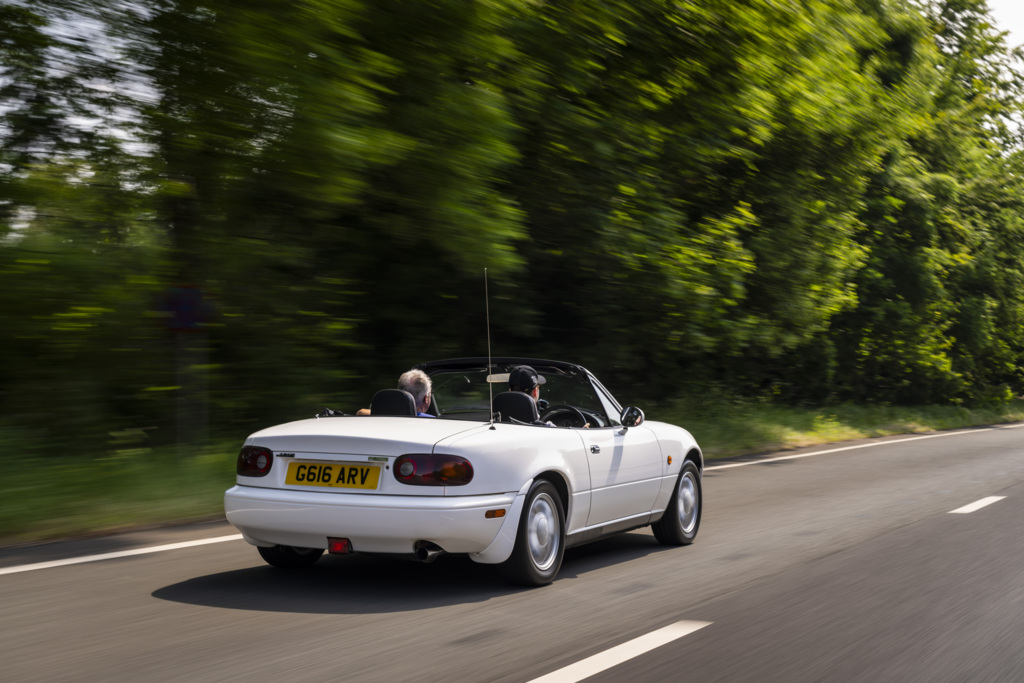
For all that enthusiasm, the LWS was never a dead cert. ‘If Mr Kenichi Yamamoto [then head of R&D and later president of Mazda] hadn’t set a vision of “Kansei engineering” and proposed studios where the customers were, this car couldn’t have happened,’ reflects Matano. ‘If Bob Hall hadn’t met Mr Yamamoto, this couldn’t have happened. If I hadn’t met Bob at the LA Auto Expo I wouldn’t have been called upon by him to join the Mazda studio in Irvine ten years later. If we had waited a year to present LWS, it would have missed the opportunity and we wouldn’t be celebrating the 30th anniversary.’
Thankfully the stars were aligned. ‘The proudest moment came when I test-drove the pre-production prototype,’ says Matano. ‘Bob and Norman Garrett provided hardware. I did more on the psychology side. For instance, the diameter of the steering wheel rim should give the same feel as holding the shift knob. The power should build in a linear way with the movement of the revcounter. The car should inspire you to pick a more challenging route on the commute and make you want to say goodnight to it before retiring for bed. Maybe someday you will want to restore it to recapture the good times or to pass on to your child. All was achieved on that prototype.’
And he’s still living the dream. ‘I had a Mariner Blue Miata I paid sticker for in August 1989,’ he laughs. ‘But I had a secret desire to do a leather interior. I was getting grey hair so I bought a top and leather in light grey and waited for the right exterior colour to match. A 1996 M-Edition in Starlight Mica blue was perfect – I still drive it.’