Road trips are measured in miles. One hundred miles is a good day out; 1000, a pleasant week’s touring. Ten thousand? That’s the stuff of continent-crossing epics: real bucket list stuff. So, what hope for a road trip of less than 6000 metres? Well, that all depends on the context.
For years, my classic car passion had been swept up in the pursuit of distance. I’ve crossed Africa in a trusty Porsche 944, journeyed from Europe to Singapore in an all-American Corvette and, most recently, in 2018, travelled the length of the Americas in a TVR Chimaera (see Octane 182). But on my return from Patagonia at the end of that 27,000-mile trip, I felt as though I’d taken this style of travel as far as I could, if you’ll excuse the pun. What I needed was a different yardstick against which to measure my automotive adventures, and the answer was simple. Instead of seeing how far I could drive a classic car, why not see how high I could drive one?
This feature first appeared in Octane 261
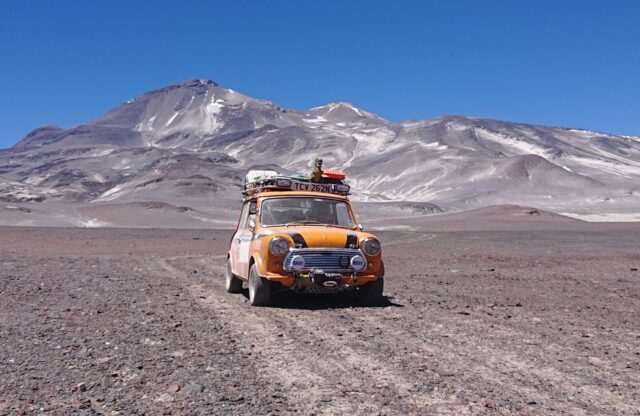
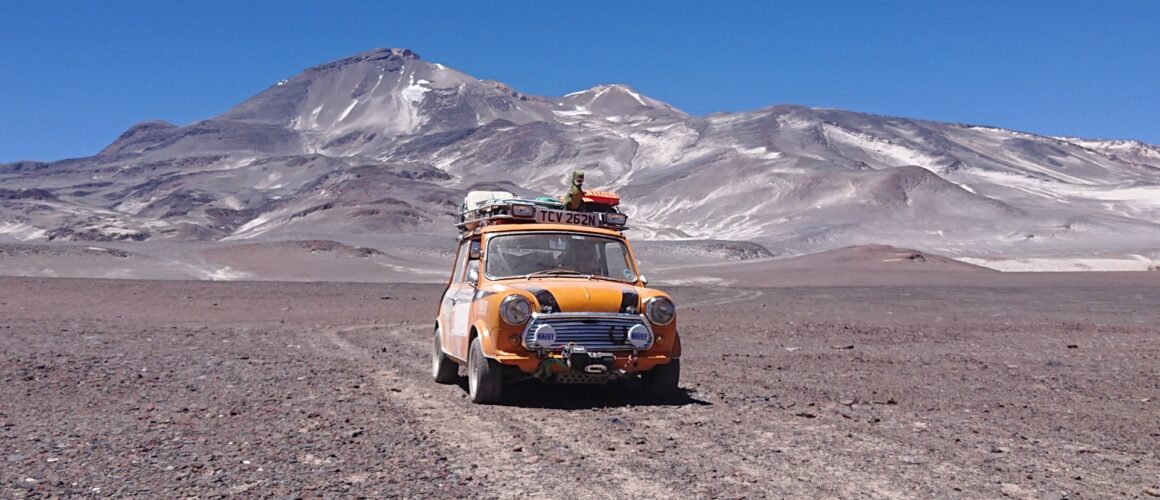
Following some research, I set myself the target of marking the 60th anniversary of the Mini by getting my 1974 example to 6000 metres above sea level, on the slopes of the world’s highest volcano – Ojos del Salado, in Chile’s Atacama Desert. Because, when sitting at home on a winter’s evening with a dram of whisky to hand, such trains of thought seem perfectly logical. And so the ‘Mini 6000’ Expedition was born.
The cold light of day is a crueller judge, however, and with it came the realisation that my Mini wasn’t exactly an ideal choice. Not only is it not a 4×4, it hadn’t run in almost a decade either, having spent most of my ownership gradually decomposing in a barn. I’d have my work cut out preparing it for a trip to South America in time for that anniversary, in 2019.
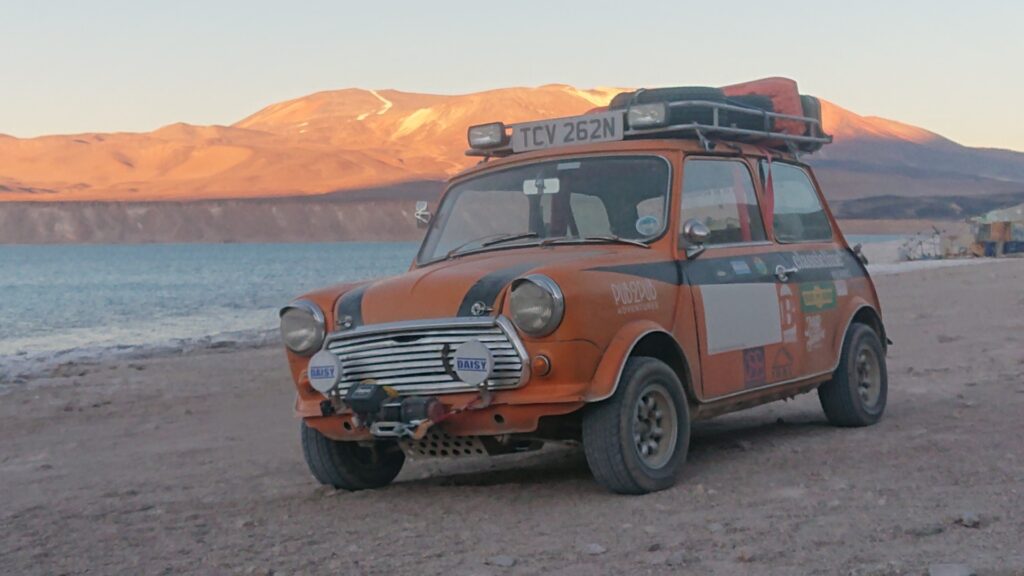
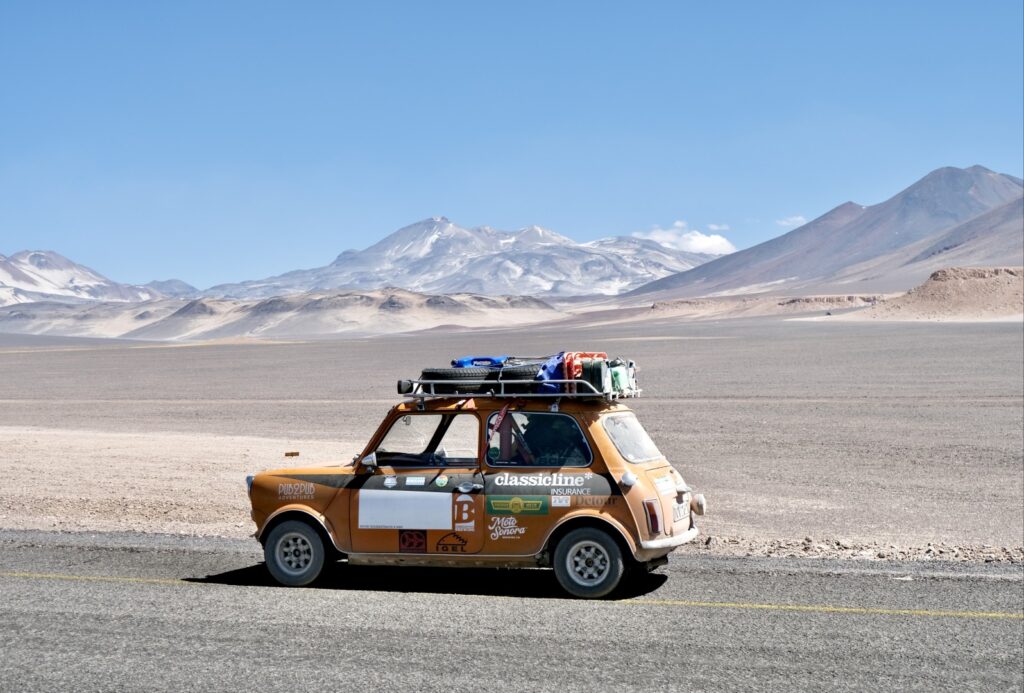
Other projects came along – and then there was the small matter of a pandemic. All this meant that it was the winter of 2023 before the Mini was ready to begin its long journey to South America. In the intervening months, it had been the focus of much attention. Not only had I completed a full restoration, there was other work, too, to prepare it for the volcano. The engine was supercharged, better to cope with the rarefied air. The suspension was raised, a (hopefully unnecessary) roll-cage installed, and underside protection added. A bespoke roof-rack was fitted for lugging loads in the desert, a winch attached to the front subframe, and the altimeter from a Tornado GR4 jet bolted to the dashboard. Because everything’s better with an altimeter, right?
It begins, and our journey to the mountain will follow a circuitous route. First, accompanied by a friend’s 1991 Range Rover, the Mini is delivered to Felixstowe, where both cars are loaded into a container and shipped to Montevideo, in Uruguay, to arrive in late November. Once import procedures are complete, it’s then the small matter of a 1500-mile drive across Uruguay, Argentina and Chile, before the landscape is finally bleached of all its moisture, and the Atacama Desert beckons.
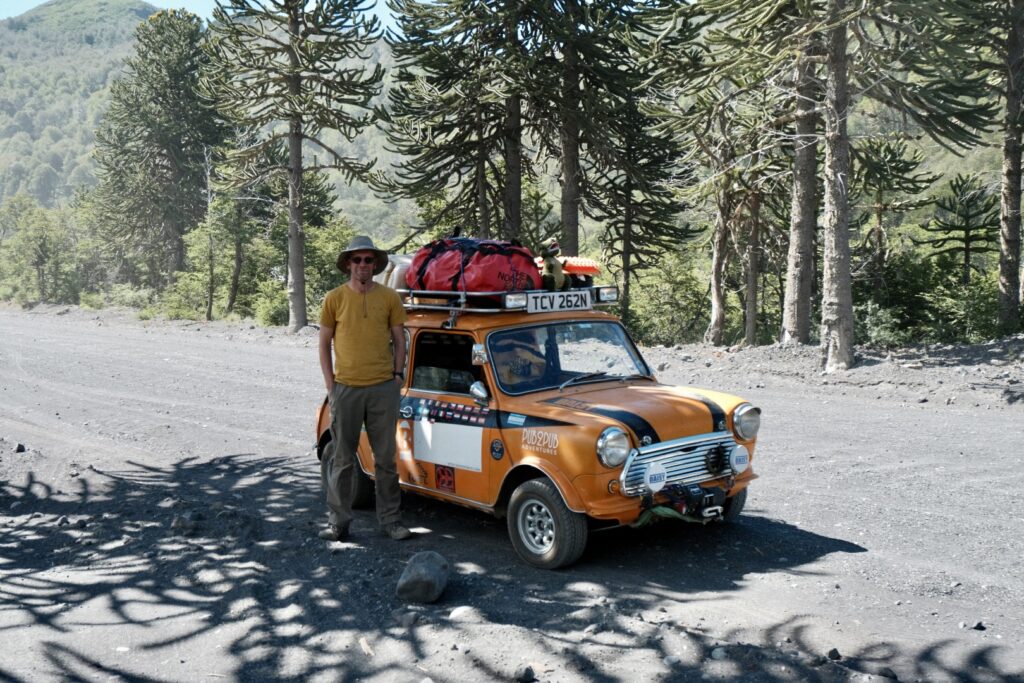
That drive takes five days: a 50-year-old Mini, with 50-year-old seats and a very short final drive in the gearbox, isn’t the quickest or most comfortable way to cross a continent. On leaving Uruguay, for hundreds of miles we roll across Argentina’s central plains, South America’s big sky version of the US dust bowl, before the road beneath us begins to contour over gradually increasing undulations, and the Andes rise dramatically ahead.
The Paso de los Libertadores takes us across this loftiest of barriers, the road climbing to more than 3000m above sea level as we roll along in the shadow of Aconcagua, the highest mountain in the Americas. At a shade under 7000m, climbers spend weeks toiling and acclimatising in their attempts to reach its summit. But the highest point of the mountain we’re heading for is barely 50m lower – Ojos del Salado is the second-highest mountain in the Americas. It isn’t so much a road trip we’re embarking on as a mountaineering expedition. In cars.
With Uruguay and Argentina now behind us, the stacked hairpins descend steeply into Chile as we drop from the border post and set course across the third country of the trip. Regaining lower elevations near Santiago, our destination is still about 600 miles away, and so our last two days on tarmac are spent cruising north, as the landscape gradually dries out to become the long-awaited Atacama Desert: the driest place on Earth.
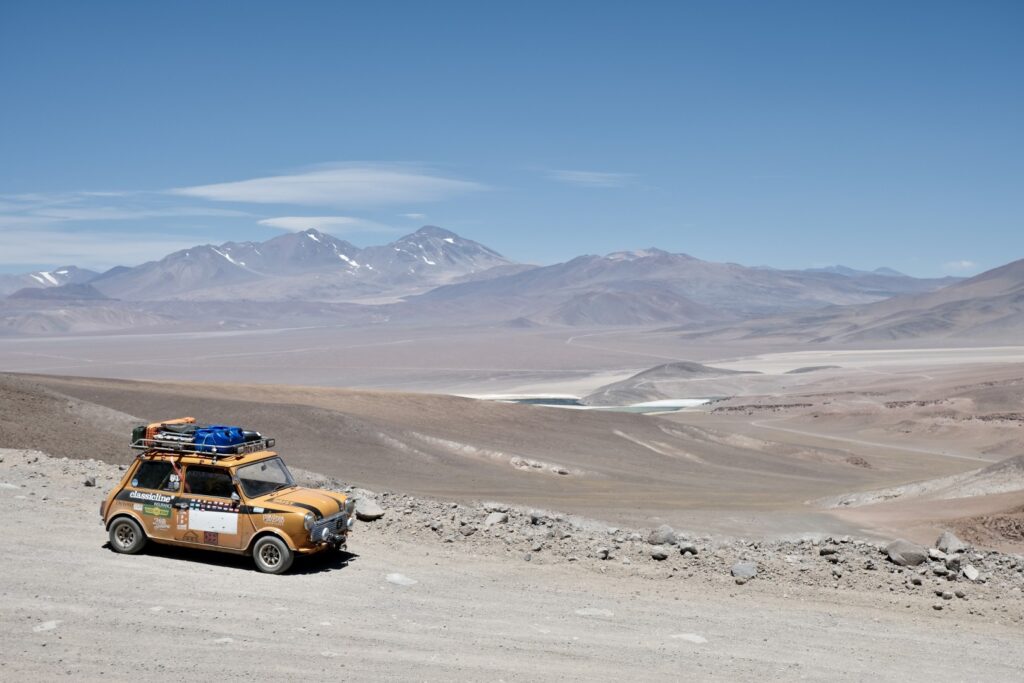
We’ll be spending weeks living in this parched wilderness as we work our way up the mountain, and so in the last town of note – a dusty mining settlement named Copiapo – we spend several days shopping for supplies before setting off into the desert, our cars overloaded with fuel, water, oil and Pot Noodles.
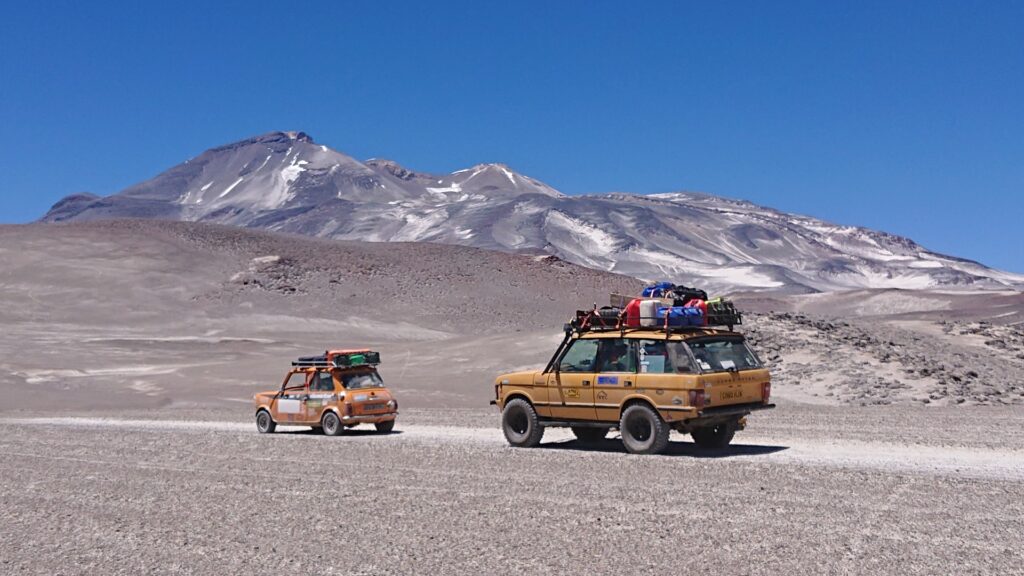
Naturally, given its size advantage, the Range Rover carries most of the weight. As we leave the city behind and climb into the sands, the tarmac becomes mottled then broken before giving way to a rough gravel track, and that old Rover V8 is working hard. This brings its not-quite-perfect cooling system into sharp focus, and so multiple stops are required to prevent it from boiling over as we head for our first camp spot, in a dusty valley located at a heady 3000m above sea level.
Altitude is a law unto itself. Take liberties and it can prove fatal. Altitude sickness and cerebral and pulmonary oedemas are just a few of its favourite ways to ruin your day.
Fortunately, in the climbing world, there are some pretty well-documented rules regarding gaining altitude. Climbing high during the day helps with acclimatisation, but be sure to come down to a lower altitude to sleep each night. And speaking of sleeping, once you’re over 3000m up, you shouldn’t increase your sleeping altitude by an average of more than 300m per day. These are the laws by which we live during our time on the mountain, and they make for slow progress as we gradually inch our way higher. But even if you do everything right, altitude can still catch up with you. It’s an unpredictable, uncontrollable foe, and the best you can do is to weigh the odds in your favour.
It’s not only the human body that is affected by the thin air, of course. Even at only 3000m, the cars are noticing it, too. At this elevation, we’ve already lost about a quarter of the air we’re used to at sea level. This means 25% less cooling air flowing through the radiators, and 25% less air being drawn into the engines. In the best traditions of the famous piston-engine fighter planes of yesteryear, I’d supercharged the Mini in preparation for this, and we’re carrying a selection of different fuelling jets with which to adjust the carburettor’s mixture as the altitude increases. In spite of all this, however, cold starts increasingly become a matter of trial and error as we ascend. The Range Rover generally has no such issues though. Being fuel-injected, its big V8 automatically compensates for the thinner air, and a gradual drop-off in power as we climb is the only real symptom for most of its trip.
Over those early days we drift on up, camping beneath those amazing Atacama skies by night, enduring the baking sun and wind-blown sand of this harshest of environments during daylight. The cars demand constant attention during our waking hours. Both roof-racks collapse, fatigued by corrugated tracks while carrying hundreds of litres of fuel. The Range Rover’s cooling system is gone over with a fine-tooth comb and, when it loses its fuel pump on the crest of a 400m pass, we have to remove its boot floor to fix the wiring.
This isn’t its only electrical issue. An alternator failure means we have to bodge-on the Mini’s spare to keep it running; a rather stressful prospect when you’re way out in the desert. Meanwhile, at our first camp we convert the Mini to electronic ignition to improve its reliability. The Atacama Desert is proving to be a tough adversary.
It has its rewards, though. The bone-dry landscapes have an emptiness and clarity that are impossible to find back home. The views can be spectacular: shimmering salt lakes dotted with flamingos; soaring sand-peaks drawn sharp against gin-clear skies. And then there are the nights, when the absence of light pollution takes us back to an age before electricity, and the Milky Way is painted across the sky. It isn’t only our cars that hark back to the past: our whole experience does.
A week into the expedition, we’re camped on the shores of Laguna Verde, 4450m above sea level. The turquoise waters shimmer and salt coats the shores of this high-altitude saline wonder. But our needs are more pressing. Out in the desert, the fuel requirements of our vehicles are huge, and the team members are rapidly going through supplies, too. At altitude, each person needs five litres of water per day to stay hydrated, and food supplies are also being consumed rapidly. We need to resupply on a weekly basis, and it falls to the Range Rover to perform the 300-mile, eight-hour round trip, every seven days.
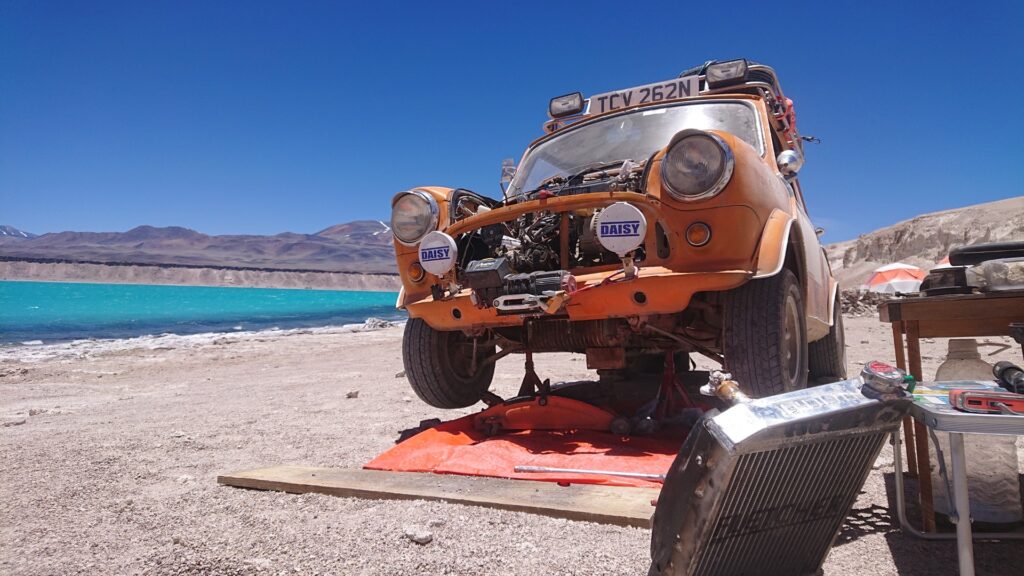
As custodian of the Mini, it’s my duty to keep on top of the maintenance of our tiny ship of the desert in the meantime. There are less scenic places in which to work on a car than Laguna Verde, though the winds that build up from late morning each day mean it can be a little like working in a sandblaster at times.
From Laguna Verde we make our way on up, passing the height of the Matterhorn and gaining our first decent views of Ojos del Salado: 6893m tall. The world’s highest volcano. Still 12 miles distant, it looms high above the horizon, its complicated slopes a melee of sand, ash, rock and snow. The world of the road trip is well behind us now; this is the domain of the mountaineer.
Beneath our tyres, the surface becomes increasingly challenging. We’re following the 4×4 track that runs to the climbers’ base camp, and it’s a track of two halves. For one part, it’s rough, rutted gravel, and the Mini acquits itself well, its raised suspension keeping its armoured underside clear of the worst of the rocks. However, on encountering the plains of soft sand and ash that sometimes block our path, the tiny wheels and lack of four-wheel drive mean our tiny steed is quickly out of its comfort zone. Sometimes we clamber out and push it through; on other occasions the Range Rover offers a tow.
The Mini’s driveability is suffering, too. Despite the air:fuel ratio gauge we’d fitted to monitor the mixture as the altitude increased, pulling away uphill is becoming increasingly difficult. Even using the biggest jets we have, the carburettor is failing to draw enough fuel when the clutch is dropped, making hill starts quite a challenge. This means that, once the Mini is moving, maintaining momentum is key. So, when conditions allow, we get rolling and then we fly along the rutted tracks, bouncing over rocks and crossing our fingers that the little car’s underside will survive.
The altitude increases. 4600, 4700, 4800 metres. We make camp at an altitude higher than Mont Blanc’s snowcapped summit, in a dusty moonscape of gusting winds, eddying dust and incomparable memories. But the lack of oxygen is ever apparent, and one of our four-person team can go no further – a return to the thick air of Copiapo, 150 miles distant, is the only option. Early the following morning, the Range Rover sets off, returning after dark laden with supplies for another week on the mountain. And with its bonnet strapped to the roof, to try to prevent it overheating.
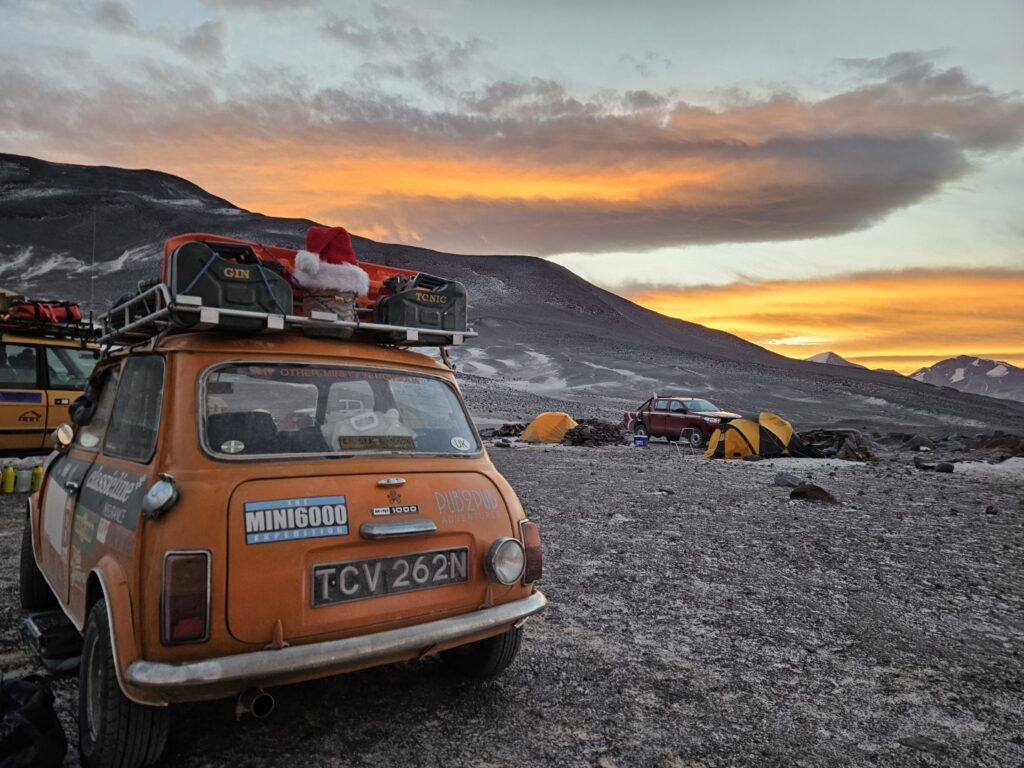
Christmas Day sees us at the climbers’ base camp, 5200m up. Santa hats and a cake mark the occasion as we fettle the cars, and plan the final leg of our ascent.
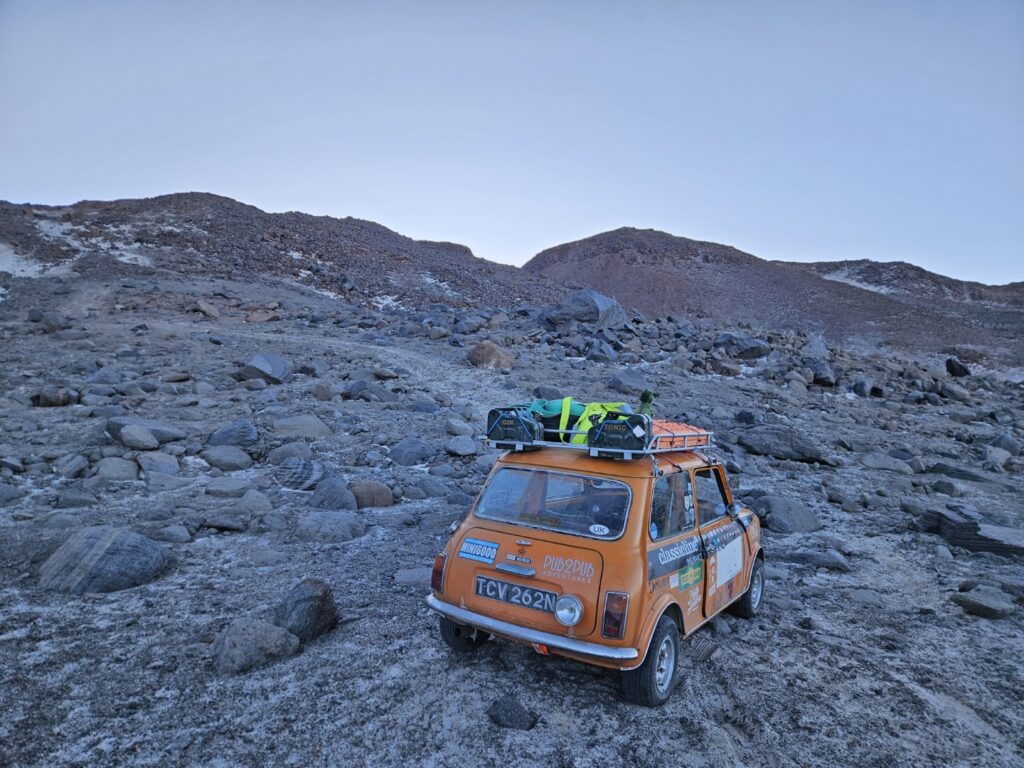
Above base camp, the sand grows deeper, the slopes steeper, the track rougher. The Mini struggles, a design penned for the suburbs of the ’60s all at sea on the ageless slopes. Time and again it gets stuck, and time and again we bring its winch into action to make progress. Some steep sandy slopes are beyond it, but the Range Rover is peerless, dragging it up through the sand, its chunky tyres and four-wheel drive paying dividends.
For two nights we make camp at 5800m. Here the availability of oxygen is only just over half that at sea level, and the overnight temperature falls to 20 below zero. We’ve left the world we knew behind; it’s just us, the mountain, our two faltering steeds and the occasional passing group of climbers. Who, naturally, are somewhat confused by the presence of a 1974 Mini in their midst.
Up here, nothing is easy. Even starting the Mini from cold is an exercise in patience, a ten-minute process of mixture adjustments and crossed fingers. The Range Rover has climbed into air thinner than its ECU mapping can cope with, and is now also most unenthusiastic about starting.
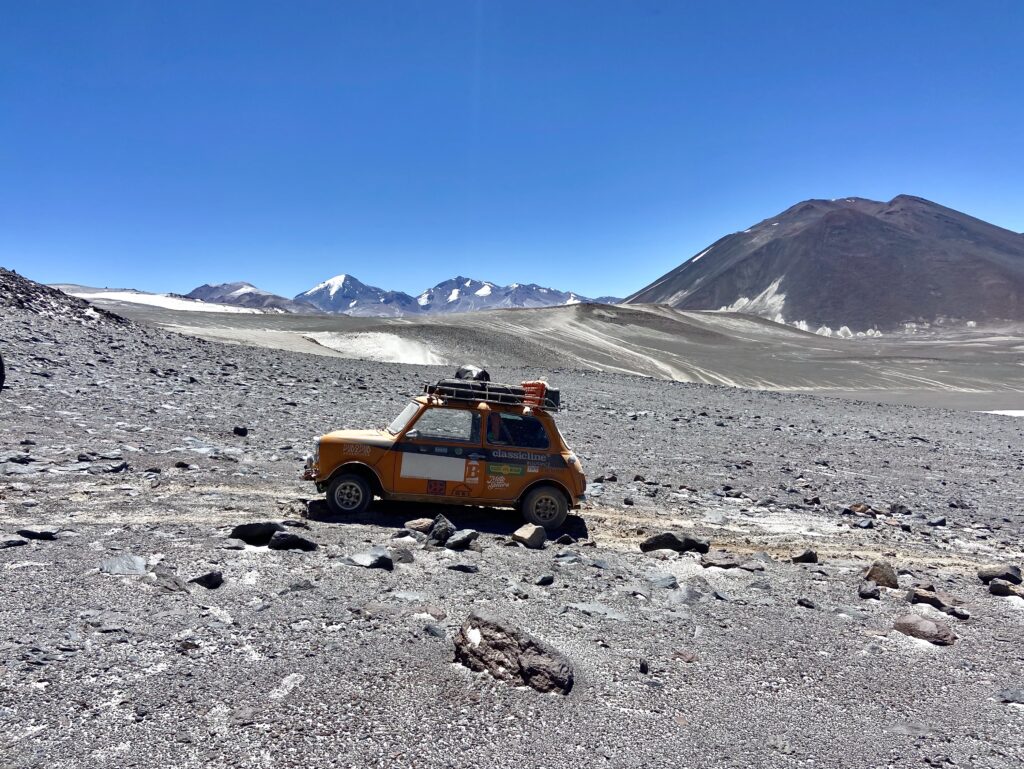
At times, both of our cars are broken down. And to top it all, the Range Rover’s coolant congeals, cracking a freeze plug and resulting in a leak from the engine block. Here, near the summit of the world’s highest volcano, the best we can do is fashion a rubber bung to roughly seal it, and hope for the best.
We carry on up the mountain. The boulders become bigger, the terrain rougher. We are now higher than any road in the world and, far from its comfort zone, the Mini can proceed only by using its winch. So on we go, throwing slings around boulders and dragging it higher. We are within 100m of our 6000m goal.
But then, at 5920m, the engine cuts out and won’t restart. The float in the carburettor appears to be sticking, due to the steep slope angle. Whatever we do, we can’t get the engine to run. And without the engine running, the winch won’t work for long. We’ve reached our high point. Almost 6000 metres up the world’s highest volcano. And all that’s left for us to do is begin our journey back down.
We roll, push and drag the Mini back to level ground, and the following morning, on the first day of 2024, we are finally able to coax it back to life. It might not have made it to the 6000m objective but, as the calendars rolled into the new year, our little Mini was the highest car on the planet.
And with that, there is only one thing left to do: head back down to civilisation. But that, as they say, is a whole other story.