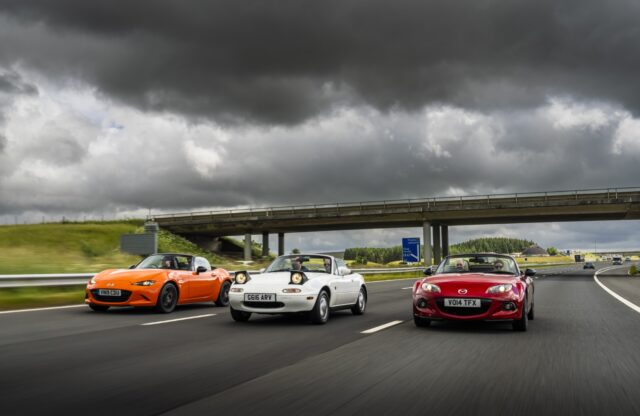
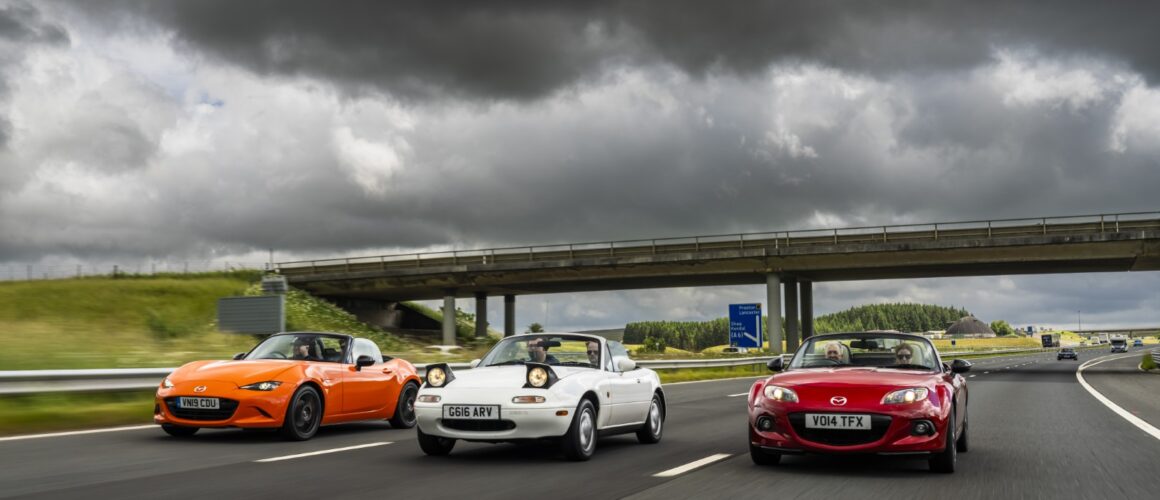
Singularity of purpose is one of the most endearing qualities of Mazda’s MX-5, and through four generations and 35 years it has largely remained true to what the original engineers set out to achieve. Pure unadulterated fun – or, more precisely, high driver engagement at modest speeds – is the name of the game, and no other car has hit the mark quite so perfectly for quite so long.
When it was launched in 1989, Mazda effectively re-invented the two-seat British sports car, which is why it was such a huge success in both the US and the UK. Thanks to its compact dimensions, it’s a car suited particularly well to narrow UK roads, something I’m suddenly very grateful for as I mentally prepare for the journey we’re about to embark on. We’ve joined Mazda UK at Land’s End for the beginning of a 1000-mile trek to John O’Groats. Not only to celebrate 35 years of the MX-5, but also to complete the journey using 100% synthetic fuel – a feat never previously accomplished.
If you regularly ponder the long-term future for the historic car industry and our beloved petrol-powered cars, the prospect of commercially available synthetic fuels promises something of a silver bullet and we’re about to find out if that’s true. Mazda has been running its heritage fleet, including the four MX-5s you see here, on Coryton’s Sustain Classic Super 80 fuels since June 2023. That’s a classic-friendly ethanol-free mix that’s made up from 80% sustainable content, but for this trip Coryton has supplied a 100% synthetic blend. We’re planning to find out more about the fuel at various points along the route, including a few stop-off points with a connection to synthetic fuel.
I set off from the tip of Cornwall in the MX-5 Mk3. There is a good reason for this. For me, getting inside the Mk3 is like greeting a familiar friend, albeit one I’ve not seen for a while. Early in my career, this was one of the first new cars I tested and just sitting behind the relatively chunky wheel brings back memories of some fabulous drives. Although the NC-generation roadster had a slightly lukewarm reception when it was launched in 2005, due to being bigger, heavier and a little soggy-feeling after the Mk2, it wasn’t long before Mazda sharpened up the handling significantly. By the time this 20th Anniversary model was launched in 2009, it had gone through a facelift and was a seriously well-sorted car.
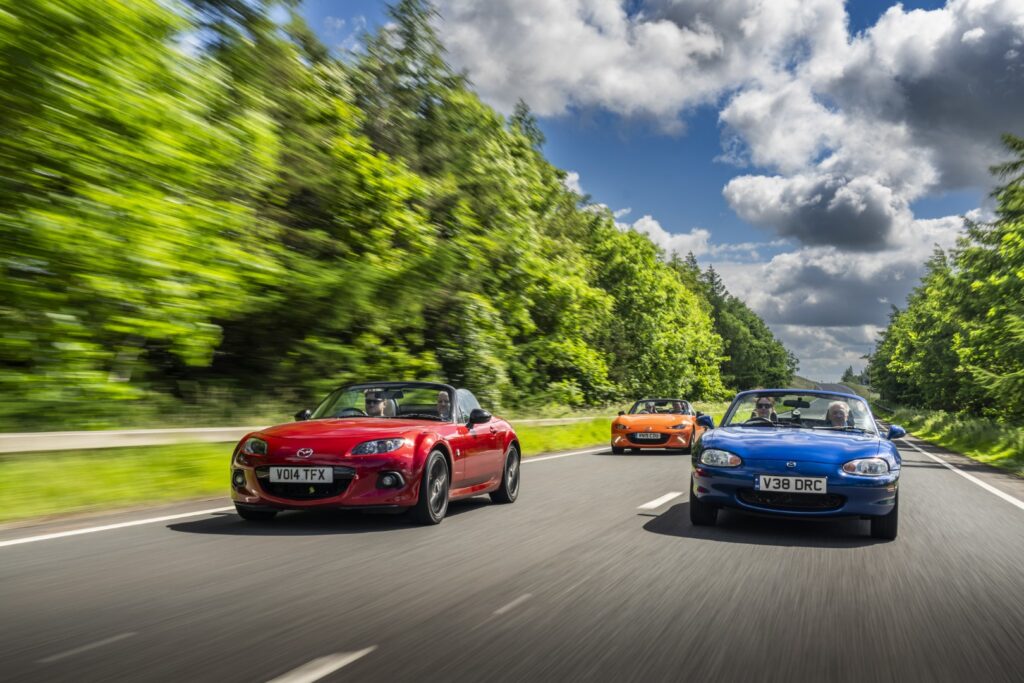
Roof down, we head out in convoy towards the A30, enjoying the bright sunshine with a stiff Atlantic breeze taking off the edge. Our first stop is Bicester Heritage, which at around 280 miles will be our first fill-up location. Immediately, I’m into sports car mode, and revel in the light, precise steering, beautifully set-up pedal box allowing for easy heel-and-toe, and a slick six-speed manual ’box.
With 158bhp from the restrained-sounding 2.0-litre naturally aspirated four-cylinder engine, it feels nippy rather than properly quick, with fairly long gear ratios taking the edge off performance. This is especially noticeable on some of the steep hills on this leg of the journey, but it’s good fun and, once you start exploiting the chassis a little more, the MX-5’s universal balance comes to the fore.
As the (thankfully quiet) dual-carriageway A-road turns to motorway, it’s time to make the most of this MX-5s modern creature comforts, namely cruise control. We’re warned that this will be the longest stint without opportunity to refill (although a back-up vehicle is following with a supply of Sustain, just in case), so we drive economically for the rest of the leg. Turns out there’s no need to worry; we arrive at the familiar former World War Two airbase with almost a quarter of a tank of fuel left.
Currently, the Sustain pump at Motor Spirit at Bicester Heritage is the only place you can fill-up with this fuel in the UK, unless you can house a barrel and manual pump at home. Sustain Classic 80 is a direct drop-in replacement for petrol, which means that no modifications are required. It’s manufactured with 80% sustainable content – processed and refined currently from agricultural waste and by-products from crops. The last 20% is still derived from fossil fuels – that’s still a potential 80% reduction in CO2 – but of real importance to classic owners is the fact that it contains zero ethanol, unlike pump fuels. That means it will not eat away at perishable seals and is also extremely stable, so is perfect if you’re leaving a vehicle in storage over winter, eliminating the risk of moisture getting into the fuel system.
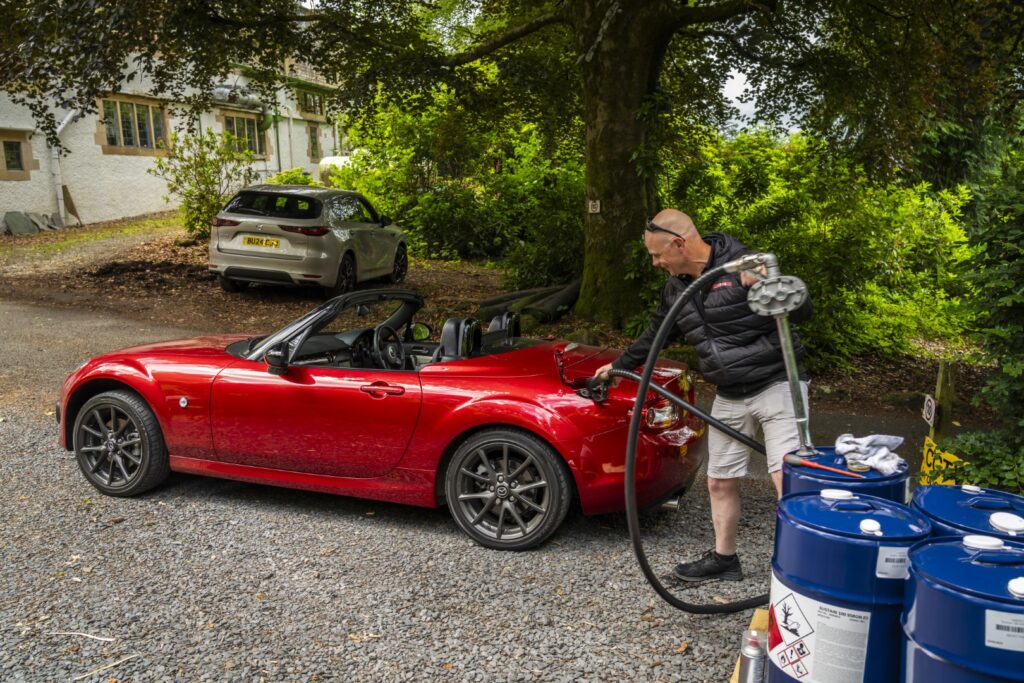
The high price – upwards of £3 per litre – means it’s not likely to appeal to anyone filling up a daily driver, but it is a viable option for classic cars that have more limited use. I’ve spoken with Octane readers who regularly use this pump, one of whom runs an Abarth hillclimb car exclusively on the fuel and swears by it.
After grabbing lunch and some bottles of water, I switch into an orange Mk4. Launched in 2015, this revelatory car hugely disrupted industry trends. It exemplified Mazda’s quest to rediscover the pure essence of a sports car, being smaller and lighter than its predecessor, and held off the shift to turbocharged power in favour of a new high-compression 2.0-litre four-cylinder with around 180bhp.
On our 122-mile drive to the Translational Energy Research Centre at Sheffield University, the cabin feels less roomy after the comparatively luxurious Mk3. That shouldn’t be a surprise, given that the Mk4’s footprint is so much smaller (105mm shorter and around 100kg lighter) than the Mk3’s. Despite that, safety is much improved, too.
This example is a 30th Anniversary special edition from 2019. Lower springs and Bilstein dampers, lightweight Rays forged alloy wheels and uprated Brembo brakes have tightened up the standard 2.0-litre’s handling considerably. It still rolls a bit, but is a definite step up from the Mk3. The steering wheel features a slender leather-wrapped rim, with nicely weighted albeit slightly dead-feeling steering. The difference between the Mk3’s hydraulic set-up and the EPAS here is noticeable.
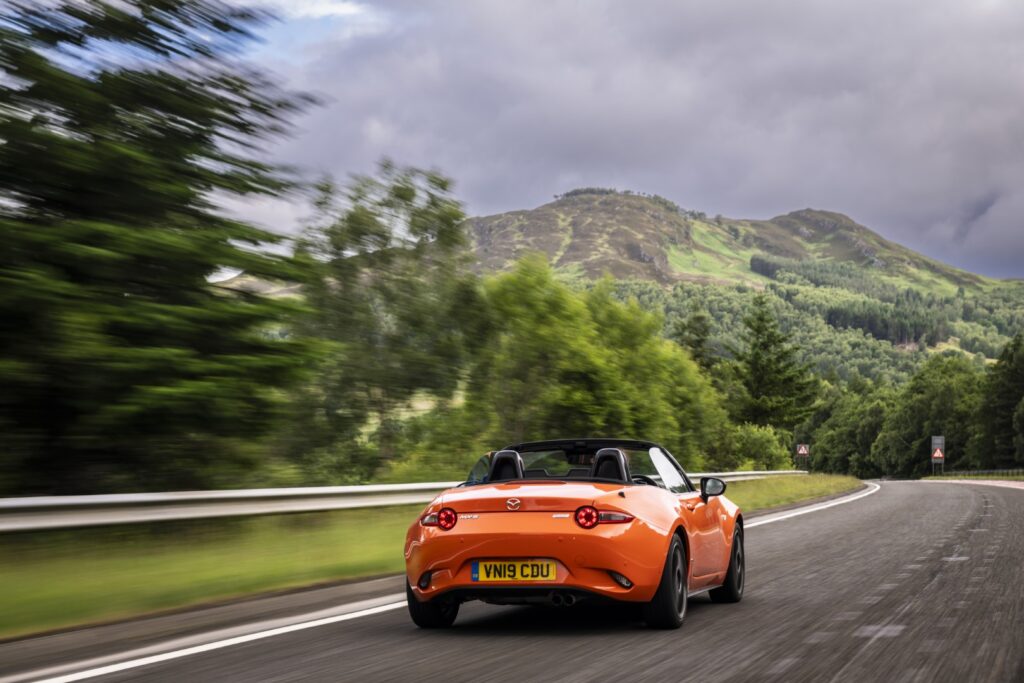
That’s about the only criticism I can actually level at the Mk4. The engine is surprisingly muscular, if slightly artificial-sounding, but there’s a pleasing rasp towards the top end of the rev range. The gearing feels even longer than the Mk3’s, but the extra punch and lower weight mean it’s not an issue – this is by far the most efficient car here, potentially capable of up to 50mpg. The gearbox is a highlight, with a superbly tight and mechanical-feeling action. Shifting is a real delight.
Thanks to traffic problems on the M1, and mile upon mile of tedious 50mph roadworks, we arrive too late to tour the research facility and head for our hotel instead.
We’re up and off early the next day and immediately head for the Lake District, confronted by rather more familiar British weather – grey skies, biting wind and intermittent showers… but not enough to make us put the hood up. Back onto the M1 for a short spell before joining the A1 and then onto the fabulous A66, where it really opens up. The country suddenly feels a lot less claustrophobic and the scenery begins to look a whole lot more interesting.
As we head into the Lakes, I’m following the Mk1, which is being hustled along at a decent pace by PR manager Owen Mildenhall. While the Mk1 looked like a scale model in modern traffic on main roads, it is far more at home here, and I’m beginning to get excited about switching into it at the next stop. As it’s the only car here without a catalytic converter, when you follow closely you notice an unexpectedly distinct smell coming out of the exhaust. It’s odd: sweeter and even cleaner – which makes a lot of sense, as the synthetic fuel contains fewer of the nasty hydrocarbons that cause secondary exhaust emissions. This is the first (and only) time on the trip that I notice any difference between a car running on pump fuel and the synthetic brew.
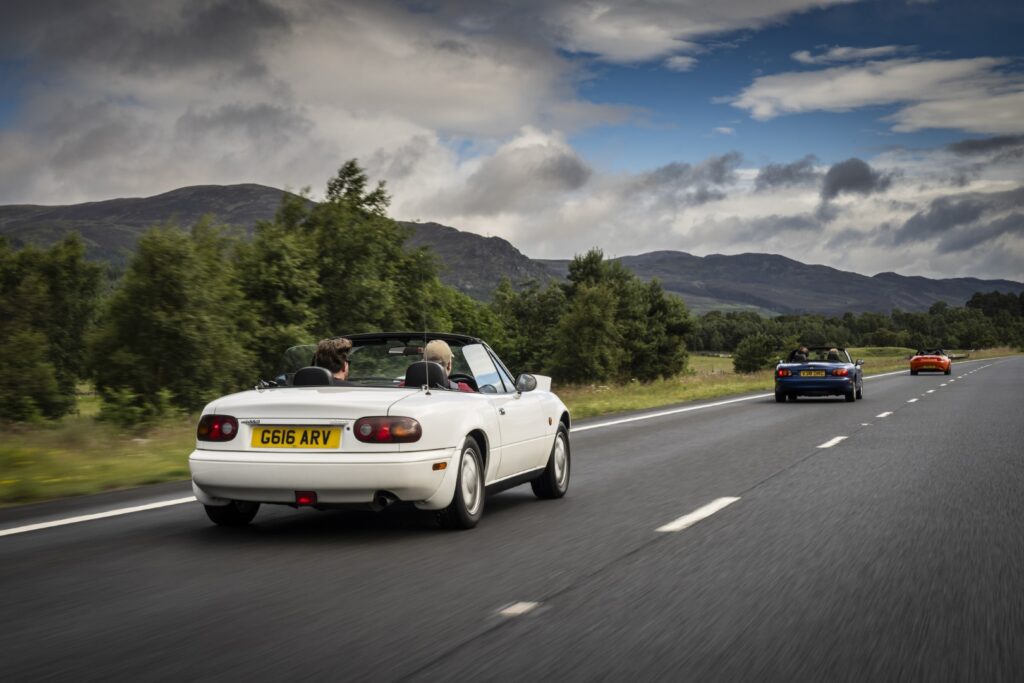
We arrive at Windermere Boat Club (WMBRC) for our first stop of the day. An interesting location, as it is the oldest powerboat racing club in the world, with Sir Henry Segrave and Donald Campbell CBE among its former members. Today, it runs its powerboats exclusively on Sustain fuels. Very cool, yet I’m struggling to focus on anything but getting behind the wheel of the Mk1.
There’s more room in the cabin of the Mk1 than the Mk4 and the simplicity and clarity of the dashboard are refreshing. After starting the engine, my first instinct is to press an unfamiliar button in the centre console – to see the headlights pop-up. Adorable! This example is an early UK- spec, low-mileage 1.6-litre car with power-assisted steering, something Octane contributor and Mk1 MX-5 owner/ enthusiast John Simister insists is the perfect combination. While it’s by far the least powerful car here, it’s the keenest feeling. Five close ratios, combined with the willing and beautifully crisp and responsive 1.6, instantly deliver everything you expect from a two-seater sports car.
Our final stop of the day is the Celtic Renewables refinery in Grangemouth, roughly equidistant from Glasgow and Edinburgh. With the drudgery of a long slog up the A74(M) towards Glasgow starting to wear a little thin, someone within our convoy suggests a more interesting route, so we follow. This turns out to be an extremely wise decision.
By sheer luck I find myself experiencing the Mk1 MX-5 on the best roads we’ve encountered: fast, sweeping, well-sighted and with epic mountain views to top it all off. The Mk1 laps it up and relishes the opportunity to exploit all of its 114bhp. That might sound modest, even in this company, but combined with the lowest weight and modest grip levels it feels so well-balanced, engaging and confidence-inspiring that it entertains at extremely sensible and legal speeds.
We’re now heading vaguely in the direction of Edinburgh, and well off the ‘official’ route. As the rain starts to get heavier, we finally relent and put the roof up, then head back towards civilisation. Best detour ever.
At Celtic Renewables, a young company with big ambitions, we fill the cars and take a quick tour of the impressive-looking site. It’s developing new ways to produce vital chemical components – required for many industries, not just synthetic fuels – from the bio-waste put out by whisky manufacturers and other sources, instead of the traditional fossil fuel sources. Once refilled, it’s a short 50-mile hop up to Dunkeld for an overnight stop.
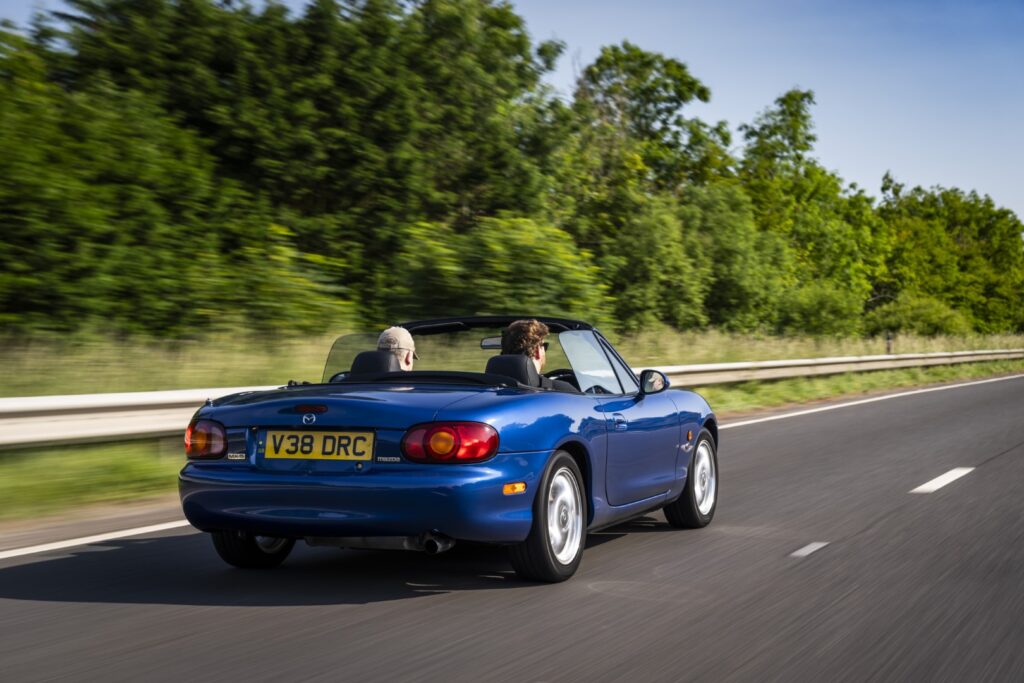
For the final leg of our journey, 217 miles up to John O’Groats, it’s my turn in the Mk2. Visually, the Mk2 lost its signature pop-up headlights and gained a slightly larger, stiffer and more curvaceous body, but much of the NA’s basic formula remained. This 10th Anniversary special edition boasted an improved standard spec, including chrome-finish 15-inch alloy wheels, black leather and blue Alcantara seats, a matching Nardi steering wheel and a six-speed gearbox. Bilstein dampers were standard, too, and it was powered by the top-spec 140bhp 1.8-litre engine.
Many of these elements make for a more modern-feeling and ultimately more capable machine. The extra stiffness in the suspension and larger wheels offer considerably more grip, but rob the car of a little of the Mk1’s magic. Still, as we are heading onto the stunning North Coast 500 road, the extra performance makes a big difference, especially on smoother sections. This Highlands stint is faster and easier than anywhere else along the route and before we know it we are passing the ‘Welcome to John O’Groats’ sign.
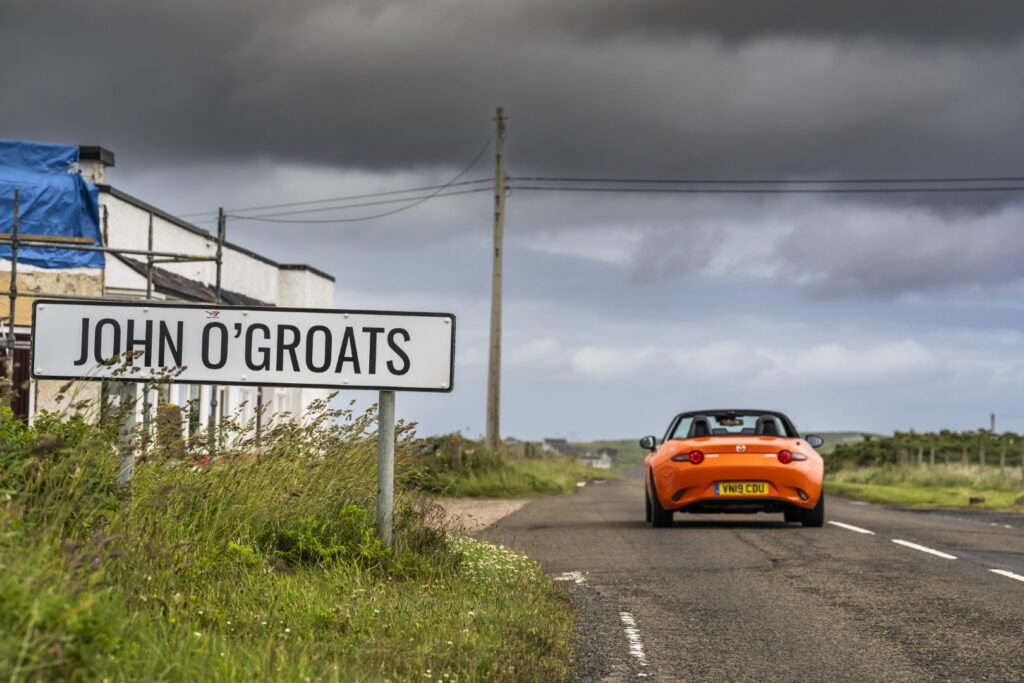
As we pull into the car park, the tripmeter has just ticked over 1078 miles, and what fun it has been. The Land’s End to John O’Groats run is an essential pilgrimage, and the fact that all of the cars – plus the transporter and CX-80 support vehicle – were running on sustainable fuels hopefully proves the potential of them to a broader audience. Of course, their future depends not only on their acceptance by enthusiasts, but also on support from government in order to build scale and bring down prices.
Driving four generations of MX-5 back-to-back has been a real eye-opener. Here’s a manufacturer that hit the bullseye in 1989 with the original, and each generation has (more or less) stuck to the principles that made it such a great car to begin with. As motor manufacturers have moved inexorably towards larger, more complicated and considerably faster cars, we should applaud Mazda for its dedication to catering for real driving enthusiasts. Long live the MX-5.