
The Lamborghini Diablo was a miracle. When big companies change ownership, processes are disrupted and projects get cancelled. Project 132, which became the Diablo, began in 1985 when Automobili Lamborghini decided to prepare its replacement for the Countach. When it was launched on 21 January 1990, it had already proved its worth by surviving a change of company ownership, from the Mimran brothers to the Chrysler Corporation in 1987.
By the end of the Diablo’s production life, the company had changed owners a further three times – quite likely a record. Chrysler Corporation sold Lamborghini to Mega Tech in 1994, then it was passed to V’Power and Mycom Sedtco a year later and, ultimately, to Audi AG in 1998.
Audi soon set to work on a Diablo replacement. Meanwhile, though, it let Luc Donckerwolke loose on Marcello Gandini’s original, which had already been tinkered with by Chrysler’s Tom Gale. There were several technical upgrades and a new interior, all of which kept the Diablo alive until 2001 when the Murciélago arrived. Despite its difficult beginnings, Lamborghini’s supercar had remained competitive in the face of Ferrari and others for more than a decade.

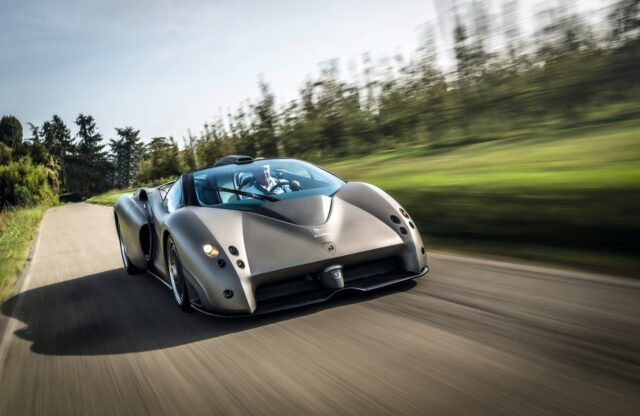
But how could Lamborghini remain at the forefront of supercar style? When Bertone’s Marcello Gandini designed the Miura, he was 28 years old. He was 32 when he penned the Countach, and 52 when, as a freelance, he drafted the lines of the Diablo. So Lamborghini, looking for new stylistic ideas and solutions, sent rolling chassis to several design houses. In 1995, Giugiaro’s Italdesign presented the Calà, intended as a smaller sibling in the manner of the Urraco and Jalpa. A Diablo powertrain and running gear went to Zagato, which responded with the Raptor in 1996 and the Canto in 1997, plus a revised Canto in 1999. Another went to Gandini, who proposed the Acosta in 1996 to show he still had the muse. A third was despatched to Heuliez, which in 1998 showed the Pregunta Speedster – the car you see here.
This coachbuilder was founded in 1920 by Adolphe Heuliez to manufacture horsedrawn carts in Cerizay, a village in eastern France. Heuliez entered the car business in 1935 and later specialised in small-series production for bigger manufacturers. Its output included such high-profile machines as the Peugeot 205 Turbo 16 and Renault 5 Turbo, plus various Citroën estates and the Visa convertible.
In 1980, a new company was added to the Henri Heuliez Group, specialising in bus manufacture. It had a subsidiary in Turin contracted to Iveco, which went on to be managed by the Belgian designer Marc Deschamps. He was well known in the area, as he had worked for Carrozzeria Bertone where he had replaced Marcello Gandini in 1979, managing the style department. His creations included the 1972 Citroën GS Camargue, an important prototype for Bertone because it opened doors to a partnership that led to 1982’s Citroën BX. He was also responsible for the production Citroën XM.
Deschamps joined Heuliez Turin in 1992 and soon came up with the Raffica, a styling study into new solutions for open-top bodywork. In 1996 came the Mercedes-Benz Intruder, presciently a G-Class with a revised SLK body. Then, in 1998, he was responsible for the one-off show car on these pages: the Lamborghini Pregunta Speedster.

‘The letter of intent between Audi and Lamborghini was signed on 12 June 1998,’ says Frenchman Michel Levy, current custodian of the Pregunta with his two brothers. Work on the car, however, had already begun.
‘Early pictures of the making of the Pregunta model, taken at the Heuliez Turin workshop, are dated mid-’98. Precautions were taken at Sant’Agata to prevent any leak of the Pregunta’s styling, including the cockpit design, to any other manufacturer and to jealously reserve any rights for a future use of the prototype concept and shape. That suggests the whole thing could have been a bold undercover attempt from the then-management of Lamborghini to develop a new project based on the idea of a potential “Super-Diablo”.’
The finished car sported a completely new style, inside and out, groundbreaking and provocative, as was the tradition of the company. ‘Lamborghini had donated a factory Diablo development car as a basis for the creation of this new, one-off model, with chassis number ZA9DE07A0KLA12005,’ adds Levy. ‘Lamborghini’s intentions were not revealed but they specifically asked for a new, original design, one impossible to confuse with any other. In the contract, Heuliez-Turin committed to build only one example, and Lamborghini specifically asked for the rights to display the car at any time and that the final model should be approved by Lamborghini before any presentation to the public and to the press.’
Shortly after the takeover of Lamborghini by Audi, every external project was discontinued. That decision was made by Ferdinand Piëch, grandson of Ferdinand Porsche, chairman of the Volkswagen Group board and godfather of the Lamborghini and Bentley acquisition, who also funded the revival of Bugatti. One of Audi’s first activities with the Lamborghini brand was undertaken by Franz-Josef Paefgen, then CEO of Audi, who tasked Bent Axel Schlesinger (chairman of Autogerma, the Italian importer for Volkswagen Group) with market research on how potential customers saw the Lamborghini marque and its design.

The results were clear: an angular shape is key to Lamborghini style. Piëch was insistent that all VW Group design should be carried out in-house, but it was too late, even for somebody as powerful as him, to stop the Pregunta project and to prevent its radical shape being shown to the public at the 100 Ans Mondial de l’Automobile Paris on 29 September 1998.
Twenty-three years on, the Pregunta still impresses onlookers. Its name is the Spanish word for ‘question’, and it lives up to Heuliez’s reputation for provocative styling. Its cab- forward stance evokes a fighter-jet cockpit and the low, muscular shape’s maximum height of just 1.1m results in an immense, almost horizontal windscreen. The body panels employ a mix of resin and synthetic materials, and there are sketches of the car equipped with a twin-panel polycarbonate targa top. The attachment points still exist, but nobody recalls seeing the panels in place.
There’s technology from aerospace and Formula 1 here: Dassault stealth external paintwork as used on the Dassault Rafale jet fighter, dynamic air intakes, fully electronic F1- type Marelli instruments, four-point Schroth safety harnesses, internal optical-fibre lighting (DGA), a rear-view camera replacing the mirrors, a CDI Cristine GPS system and moulded-in seats shaped like a fighter jet’s.
The only major technical change from a standard Diablo is the position of the radiators, shifted from the rear to the front, their air intake highlighted by a wide spoiler. Spectacular lateral air scoops along the flanks gulp fresh air to feed the Lamborghini V12 engine, which drives the rear wheels only via a manual five- speed gearbox. And this is no static show-car: with its 523bhp engine, the Pregunta promises a claimed 333 km/h, or 208mph.

In March 1999 the Pregunta was once again the star of the Heuliez stand, this time at the Geneva motor show. Then it was released into the wild to fulfil publicity activities, including a video of it chasing a Dassault Rafale fighter jet on a military airbase. And then, like so many show cars, it retreated back to its creator and was quietly forgotten.
‘We heard in 2006 that the Pregunta could be for sale,’ remembers Michel Levy. ‘So we bought it, directly from Heuliez Turin, to complete our collection of 20 Lamborghinis, a marque we have loved since our teenage years. Ferrari was very good but Lamborghini was the spaceship. When my brothers, who are architects, started working and making some money, we went buying these old cars that, at the end of the 1970s, were quite cheap.
‘The Pregunta is our cherry on the cake, because to us the Diablo is the last pure Italian Lamborghini, and the Pregunta is the last of the Lamborghini tradition of extreme one-offs. It was, and is, absolutely original, complete down to the smallest detail. And after a good service, we got it back into usable condition.’
An early drive is especially memorable. ‘On one of our first outings in Paris, the police stopped us. We were afraid there might be something wrong with the documents, as we were driving a unique Lamborghini that was never homologated, but the policemen simply wanted to know more about the car and to take some pictures.’
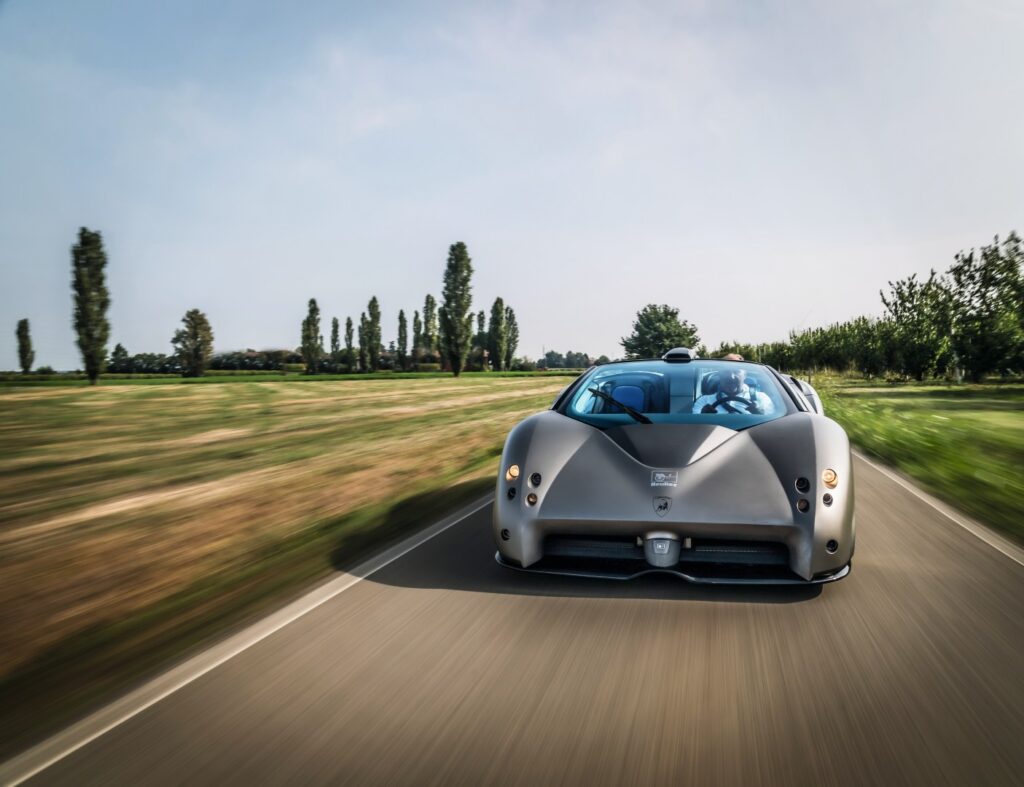
That was by no means the hardest use the car has faced, however. ‘Our fastest event so far has been a trackday at Spa-Francorchamps. We easily passed 200km/h, something you usually do not do with a show car.’
As if to underline the impact the Pregunta had when it was launched, when we met it at Lamborghini HQ it was there not only for a service but also to obtain its Polo Storico certification. But if you can put out of mind its historical and commercial value, the Pregunta is easy to drive. It feels like a lighter Diablo.
The view out to the front and side is better than in the original car, but forget about seeing in detail what happens behind you: the rear- view camera offers only a pixellated view on a monochrome screen. The driving position is not too uncomfortable, but anyone over 6ft tall will find their head protrudes above the windscreen. You’re surrounded by the fearsome growl of the V12 at every speed, which is good for the spirit and helps to hide some groans and creaks from the composite body. After all, the components of this 23-year-old show car were not supposed to last this long.
You’ll certainly be noticed, even in Sant’Agata Bolognese where people are used to seeing Lamborghinis of all kinds. A Diablo-based 12-cylinder one-off that looks so much like a fighter jet, can reach such enormous pace yet maintains urban speeds without running a temperature – the Pregunta is really something special. As Lamborghini’s last blast pre-Audi, it truly marks the end of an era.